
McKinsey noted that in 2025, close to 90% of companies had implemented AI in at least one of their functions, but only about 33% had successfully scaled it to make a visible impact on productivity and profitability. This is not a gap of the technology itself but rather a gap in the organization and functioning of teams. GitHub-based data on GitHub Copilot shows that developers can double their speed at accomplishing tasks. Nevertheless, unless the proper quality control systems are in place, the error rates grow in direct proportion to them.
This leads to a critical question: if AI is not an inherent advantage on its own, where does the real advantage lie?
The answer lies in a new model: build an AI-native engineering team. This is not just a group of people who use AI, but a team designed to operate alongside AI as a core competency. Instead of simply layering AI tools onto old workflows, the teams redesign their work from the ground up.
We’ll explore how today’s AI-native engineering teams operate, which skills matter most, how leaders need to evolve, and the practical shifts that create fast, high‑impact engineering organizations in an AI‑driven world.
What makes an engineering team “AI‑native”?

A traditional team might simply be interested in a tool that will help them work faster on a particular task, while an AI-native team sees their entire system of operations as one that should be constantly optimized. This demands a keen sense of agility in such a fast-changing landscape, where LLM and AI agent updates happen near-daily, and these teams should be agile enough to adapt their processes as quickly.
It’s really all about a continuous effort to remove bottlenecks from the software development life cycle. It’s a complete process approach that doesn’t limit AI to the IDE. Instead, it challenges the importance of all manual interactions, from the broad brushstroke of strategy and feature prioritization to the finer details of code reviews and documentation. The team doesn’t work harder; they re-engineer a sprint to work better and use AI to remove the friction from bug prioritization.
The real differentiator between an AI-native engineering team and others is their focus on what we call “work velocity” instead of “activity.” They can see the unsung delays that build up during a typical development process. In each of the stages (planning, execution, and maintenance), they view them as a data problem to be solved by machine intelligence, and it brings them a new scale of output than has been previously available.
They work with the awareness that AI is not an electronic assistant but the new material for engineering, a culture where the human creative element is able to concentrate on architecture and innovations, whereas the mechanical part of the build is handled by the machine.
Essential skills for an AI‑native engineering team
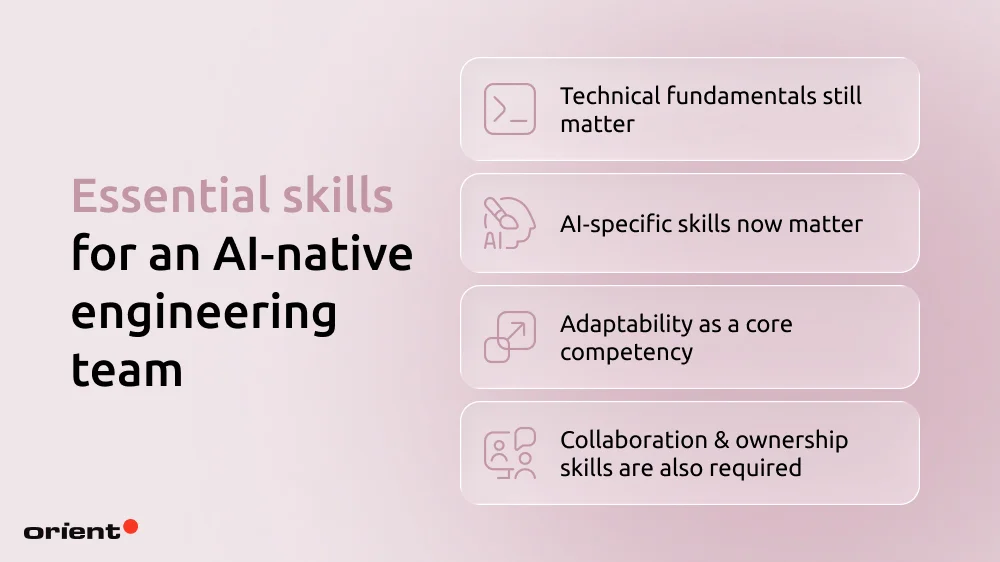
Technical fundamentals still matter
A popular misunderstanding about the use of AI is that it will lessen the importance of foundational knowledge. That is not the case; with AI playing a role in the development process, the job of engineers shifts from writing every line of code to making the right decision.
In such cases, having a solid base in algorithms, data structures, and system design is even more crucial. Understanding what a model outputs, what the limitations of a model are, and when you shouldn’t fully trust it. Critical thinking is developed as an integral part of the process. Just because an answer seems correct doesn’t mean it will work for your system.
AI‑specific skills now matter
In addition to a solid technical foundation, what AI-native engineering needs is a new set of skills that are closely linked to system design and operation.
- Machine Learning/LLM fundamentals: What engineers need to understand is how LLM models deal with context, reason under ambiguity, and most importantly, how they fail! Because of the non-deterministic nature of outputs, writing prompts will only be the beginning. What’s really essential is the design of clear instructions, the control of the logic, and the evaluation of results in various contexts. Simply “running and passing tests” is not enough to rely on an AI system. Teams need to continually monitor output quality and refine prompts, data, and workflows in a feedback loop.
- MLOps and LLMOps: Creating a demo is simple, but reliably operating AI in production involves managing model versions, monitoring performance, managing errors, and preventing system degradation as data and context change. The system needs to have a backbone, and that backbone is data engineering. Generating answers requires directly relying on the input data, and no matter how robust the model is, if the pipeline is unstable, the results will be inconsistent.
- AI agents: Last but not least, engineers need to understand how to interact with AI agents in the process. These are the aspects of breaking work down into smaller components, providing clear instructions, and regulating outputs in a long-running process. It demands a systemic approach, problem-solving abilities, and an awareness of the AI limitations.
Adaptability as a core competency
If I were asked what skill is the most important in AI-native engineering, the answer would be adaptability.
The reason is simple, since AI tools, frameworks, and coding agents are constantly evolving. With GitHub Copilot, a team can now speed up development. A few months later, they may switch to a completely different workflow using Claude Code or another agent-based system. If the engineers heavily rely on a certain tool, they will be continually behind. However, if they understand the core workings of the system, they can switch in an instant without putting a damper on development cycles.
AI-native engineers don’t wait until they find the perfect solution to get started. They create a satisfactory version in a short time, run tests, identify errors, and then iterate. Tests failing or outputs not being fully correct are not a problem. It’s just a part of the enhancement loop. What matters is the team’s ability to learn from those failures and update the system from instructions and logic to the way engineers collaborate with agents.
Ultimately, adaptability is not just about learning new tools quickly. It is the ability to hold onto core principles while everything around them changes. As the entire stack evolves, engineers with a strong grasp of software engineering fundamentals can keep pace, manage risk, and ensure quality along the way.
Collaboration & ownership skills are also required
When the team becomes smaller, collaboration does not decrease. On the contrary, it becomes the decisive factor that determines whether the team can move fast or gets stuck in its own workflow.
In a team of only three to four engineers, there is no room for ambiguity. Each person must communicate clearly, understand the context of others, and be able to make decisions independently without waiting for constant approval. A single unclear link is enough to slow down the entire development cycle due to unnecessary dependencies.
Ownership, therefore, becomes the clearest differentiator between a fast-moving team and a team that is merely busy. In many traditional engineering teams, a person is only responsible for a small part of the system. Once they finish writing the code, they hand it off to the next step, such as code review or testing. But in AI-native teams, an engineer often takes ownership of defining the problem, implementing the solution, running tests, all the way to having working code in production.
How to structure an AI‑native engineering team

Small, high‑velocity teams
The most effective AI-native teams are small, typically three to four engineers. It might sound counterintuitive, but each extra person brings not only more capacity, but more overhead along the entire workflow. This overhead will be seen in each phase of the software development life cycle: planning, implementation, code review, testing, etc. The larger the population, the higher the dependencies, the more sharing of the context, and the slower the decisions. As coordination is increased, long-running tasks become difficult to manage as well.
In AI-native development, where teams engage with AI agents, AI coding tools, and constant experimentation, quick iteration is essential. Small groups can develop the code, execute tests, correct errors, and logic in rapid cycles without having to wait for several levels of approval authority.
This doesn’t mean that big teams aren’t good; they are more about optimizing for stability. While AI-native teams optimize for speed, learn fast, and implement quicker changes. A smaller team might be able to test a lot more ideas in that same amount of time, and so the advantage lies in finding working solutions faster and building confidence before scaling. In this context, scaling is not the starting point, but the result of already having an effective system to implement.
Roles within a small AI‑native team
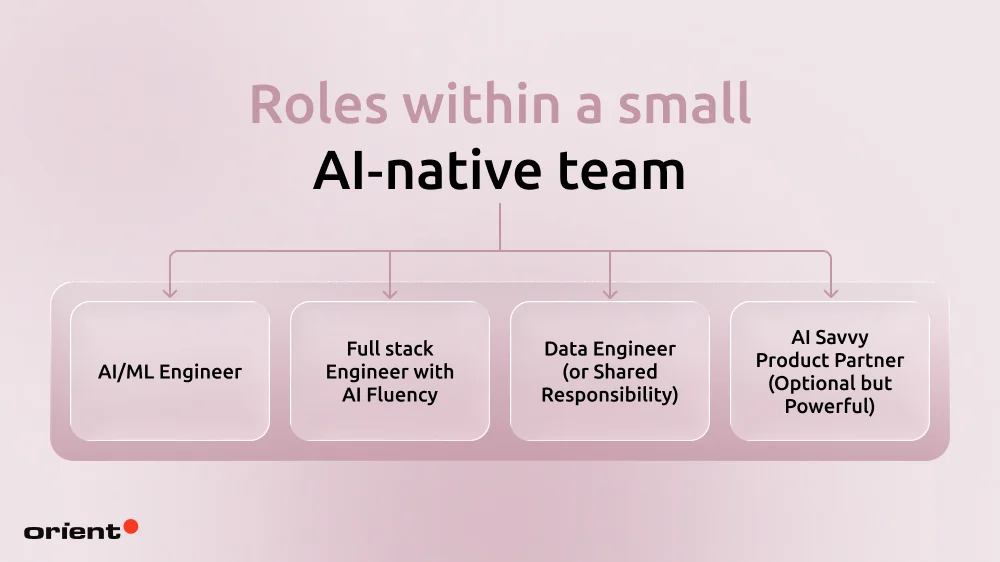
Even with fewer members, all the key roles in the team must be covered. The key difference is that there are no rigid boundaries between positions. In AI-native engineering, the roles are created for the system, not to restrict the engineers. The roles may overlap, but responsibility is never ambiguous. Each person needs to be broad enough to understand the whole system and deep enough to make meaningful contributions in their own area.
AI/ML Engineer: The AI/ML engineer is the technical foundation of the team’s intelligence layer. They develop, fine-tune, and evaluate models, construct retrieval and orchestration systems, and guarantee a reliable behavior of the AI in production.
Their work includes:
- Choosing and embedding foundation models.
- Development of pipelines for fine-tuning, RAG, and evaluation.
- Installation of guardrails, safety layers, and monitoring.
- Quick experimentation to test feasibility and model behavior
This role is crucial in an AI-native team, as it transforms the power of the model into the intelligence of the product.
Full‑stack Engineer with AI Fluency: This engineer brings the product to life. They create the user-facing experience, the backend systems, and the “glue” that ties the application to the AI layer. “AI fluency” means they know what prompt engineering is, understand the limitations of models, understand latency, and know how to design UX around probabilistic systems.
Key responsibilities include:
- To develop the basic elements and interfaces of the application.
- Connecting AI endpoints, vector stores, and orchestration logic.
- Creating UX patterns to deal with uncertainty, retries, and failure.
- Ensuring performance, security, and maintainability are a reality.
This is the person who will most likely deliver the majority of the product surface area in an AI-native team.
Data Engineer (or Shared Responsibility): Data is the fuel of an AI‑native product, but in a small team, this function can be lightweight or shared. The goal is to provide the team with clean, structured, high signal data to train, test, and enhance models.
Responsibilities may include:
- Establishing pipelines for logging, labeling, and feedback loops
- Handling vector databases, embeddings, and data quality.
- Ensuring privacy, compliance, and governance
- Supporting evaluation data and ongoing improvement
This task can be a shared responsibility for AI/ML engineers and full-stack engineers if the team size is small.
AI‑Savvy Product Partner (Optional but Powerful): This position is not mandatory, but if it’s present, it can be a huge boost to the team. This individual is a combination of product strategy, user comprehension, and AI intuition. They assist the team in figuring out what’s possible, useful, and distinctive.
They contribute by:
- Translating user needs into AI‑shaped product opportunities
- Establishing success measures and evaluation criteria
- Managing the trade-off between modeling and UX design
- Staying on track for user-visible value
What matters most is not that everyone is an expert in one area, but that the entire team can handle the work end-to-end: from data to models to implementation. This minimizes dependencies and ensures a smooth workflow, particularly when the team is working through numerous development cycles quickly.
Ownership‑driven organizational design
In AI-native engineering, organizational structure does not revolve around roles or processes. It revolves around ownership. Rather than waiting for requirements to be passed down from above and then executing tasks one by one, AI-native engineers are encouraged to proactively examine the system, see what problems they can find, and offer solutions. They are very involved in the development of the solution from concept to working code in production.
This change has a definite effect on motivation. If a member truly owns a problem, they will test their own logic, test, track errors, and repeat until satisfactory. The concept of ownership is now a reality. It is demonstrated in the way they carry out the work, going through several stages of the software development lifecycle. This also helps to lower intrateam dependencies. This streamlines the process and is a significant benefit in the fast-paced world of AI-driven development.
The leader acts as a problem unblocker and strategic guide. They provide enough context, resources, and direction for the team to make their own decisions. If the team gets to a point where something is blocked, the leader steps in to clear the blockage. When the team goes off track, they make adjustments at the strategic level without interfering in detailed implementation.
The power of an AI-native team does not come from tight control. It is derived from the proper delegation of authority. If ownership is delegated to the right level, the team can achieve high speed, high quality, and low risk throughout multiple development cycles without increasing the number of management levels.
Minimal meetings, maximum alignment
An effective AI-native team does not require a lot of meetings, but they do require a level of alignment that doesn’t impede workflow.
The majority of the team’s time should be spent on building, running tests, handling errors, and iterating through development cycles. Meetings are only necessary when they address a problem, such as a system bottleneck, or when a fast decision must be made on an important issue. If meetings are for status updates, then it’s a good indicator of some problems in the workflow.
High ownership also means fewer meetings. Each person will be fully responsible for their own share and will review, test, and make sure that the output is within requirements before passing it on. No need to have a management layer between to control each and every step.
This leads to a more streamlined process, reduced downtime, and uniform velocity. The team doesn’t require a lot of meetings to get going. They should have a system that is clear enough that they don’t need to meet very often.
Tools and technologies for AI‑native teams
The key to an effective AI-native team isn’t about the quantity of tools. They require a clear stack:
- Frameworks for building,
- Databases for retrieval,
- Platforms for running models,
- Tools for fast coding, testing systems for quality control,
- And observability for monitoring.
If these components are strongly integrated, the team can build, test, and iterate quickly while maintaining system stability.
At the foundational layer, the use of LLM frameworks such as LangChain, LlamaIndex, or Haystack is employed to create context processing pipelines, manage AI agents, and integrate models with data. These allow teams to deploy use cases such as chatbots, document QA, or automation without having to develop the entire orchestration layer from scratch.
These are accompanied by vector databases like Pinecone, Weaviate, or Milvus. The retrieval problem is addressed by these tools, which allow for the fast storage and semantic retrieval of embeddings. They are the basis for RAG systems, where models must be able to extract relevant context from the text rather than just using their internal knowledge.
At the inference layer, platforms like OpenAI API, Anthropic Claude, or self-hosted options like vLLM enable teams to bring models to production. They take care of scaling, latency optimization, and cost management, and let the team concentrate on logic instead of infrastructure.
AI coding tools are the main contributors to the difference in speed. Engineers can now use tools like GitHub Copilot, Claude Code, or Cursor to write code faster, with code implementations and code refactoring, and even to assist in debugging. They work well for any repetitive tasks or boilerplate code, saving time in each development cycle.
But speed is only meaningful if it’s accompanied by quality control. This is where automated testing tools come in handy. The frameworks (Pytest and Jest) and code coverage tools (Coverage.py) provide adequate coverage for unit tests and test suites. Testing is no longer simply a matter of passing tests, as more and more AI-generated code is being used. It is basically about detecting errors at an early stage, before they can impact the whole system.
Furthermore, rapid prototyping environments like Jupyter Notebook, Google Colab, or in-house sandboxes enable teams to test their ideas, validate their logic, and rapidly prototype without having to deploy the full product from the beginning.
At the observability layer, tools like LangSmith, Weights & Biases, or Prometheus are used for tracking model, agent behavior, and system performance. They enable teams to see what the system is actually doing in actual conditions, identify anomalies, and get to the bottom of a problem in a swift time.
Common pitfalls and how to avoid them
Common mistakes in AI-native engineering rarely come from technology itself. They come from how engineering teams operate when facing a new environment.
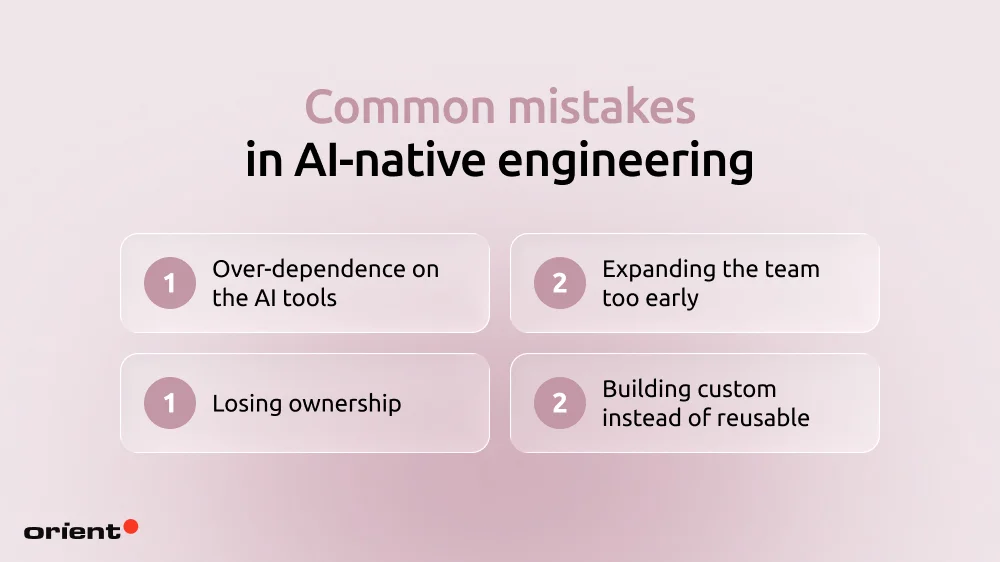
A frequent mistake is over-dependence on the AI tools without solid foundations. While AI coding can accelerate the coding process, the team may not be able to fully grasp the cause of errors that occur or test failures. Once the AI starts to become a burden instead of a benefit, it is no longer leveraged. Developer teams that speed up without compromising quality always have solid software engineering principles, ranging from the logic they use to the way they design systems to how they debug.
The other pattern is expanding the team too early. Adding more people to an organization, in an attempt to “catch up with AI,” simply raises the overhead throughout the entire workflow. The process is slowed down from the planning stages to code review to testing because there’s more alignment needed. This results in more resources and lower speed. The typical effective team is petite and expands only after they have found a highly effective manner of working.
Losing ownership is another common problem in many teams. If work is delegated so finely that no one assumes responsibility for the whole process, it doesn’t get done. This can be even more harmful in systems employing AI, where mistakes can be difficult to spot and propagate quickly. A workflow for a well-operated team typically involves having one engineer own a task, from conception to completion, until working code is running in production.
Building bespoke solutions instead of reusable systems. As there is a new implementation for each problem, the codebase becomes scattered, the test suite becomes scattered, technical debt accumulates, and project development slows down. In contrast, AI-native teams prioritize creating reusable systems that can be extended and used repeatedly, including the use of AI agents, data pipelines, testing frameworks, and more.
These problems cannot be solved by adding more processes or more tools. They need to be solved at a fundamental level by resorting to basic elements: make the team lean to minimize squabbling, have solid technical foundations to ensure quality, and create clear ownership so that every part of the system has someone responsible for it. If used properly, AI does not need to be “managed.” It’s part of how the team develops, tests, and evolves.
Conclusion
Cultivating an AI-native engineering team has morphed from an experiment into a tried-and-tested best practice. It is imperative in today’s age of AI, where how quickly you learn and adapt to the changing needs of the business is the competitive edge. The organizations that move fast are not the ones that reach for more tools, but rather the ones that are able to restructure their teams to operate with these AI tools effectively.
In reality, while many engineering leaders are not struggling because they lack tools, they are struggling because they do not know how to get started, or lack experience when it comes to correctly designing an AI-native system. This is when leveraging external expertise becomes a smart move.
Now, if you feel you are lacking the bandwidth to evaluate your current readiness, want to develop internal expertise, or indeed need to have an AI-first engineering team to supply full services for end-to-end implementation, Orient Software is a reliable partner. Our hands-on experience with custom software development and the integration of AI solutions can assist you in speeding up the trial-and-error process and help you jump directly to an efficient operation.
AI will be continually enhanced. But, depending on the way you structure and build your AI-native engineering team today, it will define whether you stay ahead of the game or fall behind.