A software development project is a complex web of decisions and logic to solve specific problems. It’s almost like building a castle - each focuses on building specific parts of the foundation or walls. Then suddenly, one member decides to quit, and suddenly no one knows why the foundation or window was built the way it was built, or how to proceed with the towers without risking collapsing the entire structure.
Information fragmentation is a common problem with expensive consequences. To be specific:
- 53% of developers report losing valuable time waiting for answers to questions from colleagues that are critical to their work.
- 68% of developers encounter a disruptive knowledge silo at least once every single week.
This can be solved with proper knowledge management skills. More than simple centralized documentation housekeeping, knowledge management serves as a core organizational resilience strategy.
If you are a tech lead, an engineering manager, or someone about to hire a software outsourcing buyer, you’ll find this guide:
- How to effectively manage knowledge across the SLDC
- The tools and implementation of knowledge management
- A practical rollout roadmap
- A look at in-house and distributed teams
Let’s dive right in!
Key Takeaways:
- Knowledge management is the practice of capturing and organizing explicit, implicit, and tacit knowledge.
- Some of the most valuable knowledge in a software project exists only in developers’ heads. Without a way to capture and share it, organizations risk losing critical context that could benefit the entire team.
- There are plenty of tools available to aid the process of knowledge capturing. However, what matters is how you build a strategy and culture revolving around knowledge sharing.
- To effectively implement a knowledge-sharing culture, the company also needs to carefully audit the existing gaps, gradually build the foundation for a KM system, and scale the system as it goes.
- Knowledge management can become more complex when an external party is involved - the information becomes even more siloed. By clearly outlining the kinds of documentation the partner needs to deliver, you ensure long-term control over systems instead of dependency on one individual.
What knowledge management means in software development
Definition
Knowledge management (KM) in software development is the systematic process of gathering, curating, organizing, and sharing both explicit and tacit information across an engineering organization.

Far beyond a simple repository of links, effective KM is about actively capturing, maintaining, and operationalizing engineering knowledge, blending documented process models with the real-world, experiential insights of developers and method engineers.
It acts as a multi-step framework that requires consistent participation from everyone on the team to structure, document, and preserve critical process assets. Ultimately, strong KM guarantees that stakeholders can always find, consume, and apply the exact technical insight they need in the right format. By turning individual “know-how” into accessible team intelligence, it reduces costly rework, refines software process improvement (SPI), and continuously accelerates the entire development lifecycle.
The three types of knowledge in software teams
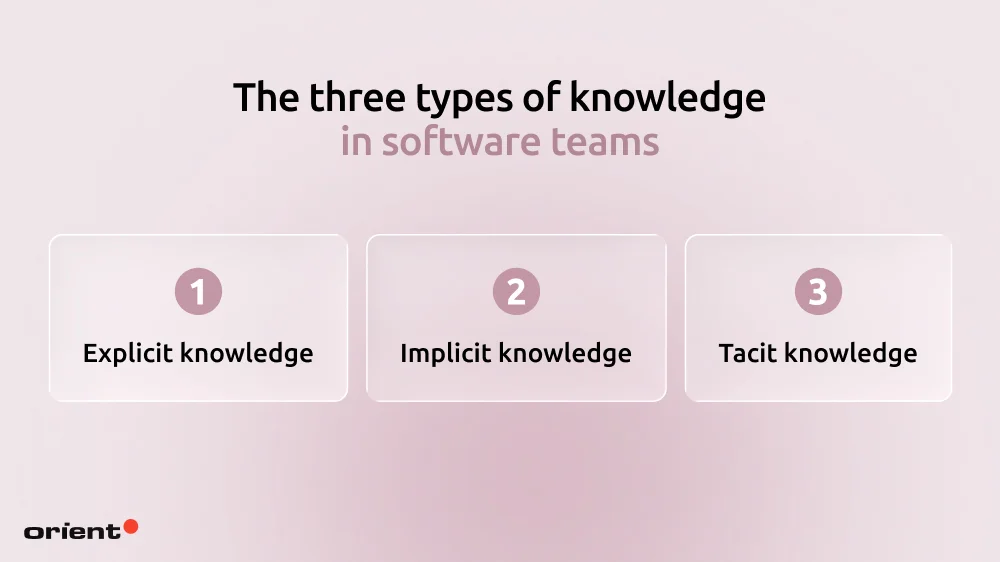
There are three main types of knowledge in the realm of software development that every team needs to know:
- Explicit knowledge: Explicit knowledge refers to knowledge that is black-and-white, written down, or digitally recorded. Classic examples of explicit knowledge include company policies, reports, white papers, step-by-step guides, or even technical documents like ADRs documenting architecture decisions.
- Implicit knowledge: Implicit knowledge emerges from applying explicit knowledge. In other words, it is built when someone applies learned information, and it is often acquired through experience and practice. This type of knowledge is not easily recorded, and often, subject matter experts are the ones who hold this type of knowledge. For example, a senior core team member has an unwritten deployment rule to “never deploy on Fridays”, based on past projects and experiences.
- Tacit knowledge: Tacit knowledge can be considered to be the purest form of wisdom. By learning the explicit knowledge, then gaining implicit knowledge from applying it in reality, and eventually, from years of practice, the employee forms an intuition-based knowledge that is difficult to put into words. Think of specific choices a team leader makes in a project, e.g., choosing event sourcing over REST, or why a UX designer seems to “capture” an aesthetic faster.
This dynamic is exactly what is captured by the SECI model, a seminal framework developed by organizational theorists Ikujiro Nonaka and Hirotaka Takeuchi (1995). The model argues that engineering knowledge isn’t static; it constantly spirals through four conversion stages:
- Socialization: sharing raw tacit wisdom via pair programming,
- Externalization: converting that intuition into explicit documentation,
- Combination: organizing various technical docs into a unified knowledge platform, and
- Internalization: developers absorbing those docs back into their own practice.
Ultimately, it ensures your team’s collective brainpower keeps growing.
Why knowledge management matters for software teams
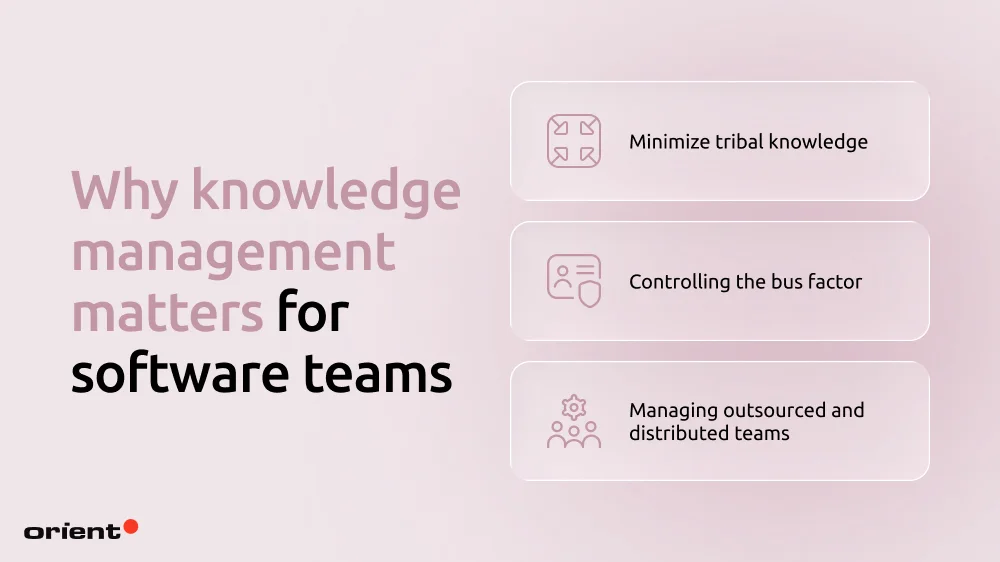
The hidden cost of tribal knowledge
Working in a company, you have probably encountered the phrase “That’s just how it’s done here” at least once. If you ask why, they’ll probably just tell you something along the lines of “We tried this specific solution 5 years ago, and it didn’t work”, or perhaps they’ll give you no clear answer at all. However, in no documentation will you be able to find this experience, or other related enablers or project blockers, or even the explanation of a particular internal setup. It is just a known fact shared between a certain group of people.

This is known as “tribal knowledge” - undocumented and practical, yet valuable information that people gathered by working on a job for years. At a glance, this doesn’t seem like a big problem. Evidently so, as the consequences of tribal knowledge are often cumulative.
- The first problem is with its inconsistency. Tribal knowledge is often transferred verbally, so two employees might have two different understandings of the same topic. And if a new hire is trained by these two employees, he or she will be left completely confused.
- Next is that employees have no standard or guide to refer back to. They are left to learn through trial and error.
- Last but not least, when a key employee takes a vacation or leaves the organization, all the valuable knowledge is gone with them. As a result, teams suffer from delays, unhappy customers, and they need time to regain the precious knowledge from scratch. Did you know that replacing a key engineer can cost up to 213% of their annual salary due to recruiting fees, training, and the lost productivity during onboarding. All in all, a knowledge management system is valuable as it not only captures standard explicit information but tries to standardize tribal knowledge as well, boosting efficiency and overall productivity.
The bus factor problem
The bus factor is basically a risk assessment tool to figure out how easily your project would collapse if a key team member got hit by a bus (or, less morbidly, won the lottery and quit). It calculates your system’s stability based on just how concentrated, or safely spread out, your team’s critical technical knowledge really is.

It helps you identify how dependent the project is on key individuals and uncover the holes in your project, processes, or approach. The lower the bus factor, the higher the risk. The worst scenario is when the bus factor is one, meaning only one team member holds most, if not all, core knowledge of the project. It is ideal to have a higher bus factor.
Here is a quick summary of how you can calculate bus factors:
- List out all your active projects or client accounts, ideally ordered by their priority and revenue value.
- Identify the lead owner and every team member for each project. Note down who could realistically step up as an immediate backup.
- Detail exactly what unique tasks, knowledge, and talents each individual owns that the project relies on.
- Record how many hours per week each person spends on those specific tasks to reveal where the true technical dependencies live.
- Group your core tasks, add up the total hours spent on them, and count how many team members can actually do that work. If a critical task only has a count of 1 person, you’ve just found your danger zone.
Knowledge management for outsourced and distributed teams
In outsourced and distributed software teams, knowledge is often divided: clients own business and domain expertise, while vendors understand the technical implementation. Without strong knowledge management, these gaps can lead to unnecessary misunderstandings, delays, and dependency on specific individuals.

Effective teams reduce this risk by documenting both business context and technical decisions from the start. Clients should capture workflows, goals, and product rules in shared repositories, while vendors should maintain standardized technical documentation covering architecture, APIs, deployment processes, etc. Regular workshops, shadowing sessions, and recorded walkthroughs also help transfer tacit knowledge that is difficult to document and encourage knowledge sharing.
At project completion, structured handoff processes, including access transfer, codebase documentation, and support training, help internal teams maintain continuity after the vendor exits. Having an effective knowledge management process in place is how companies prevent information silos or hyper-specialization.
Knowledge management across the software development lifecycle: an SDLC map
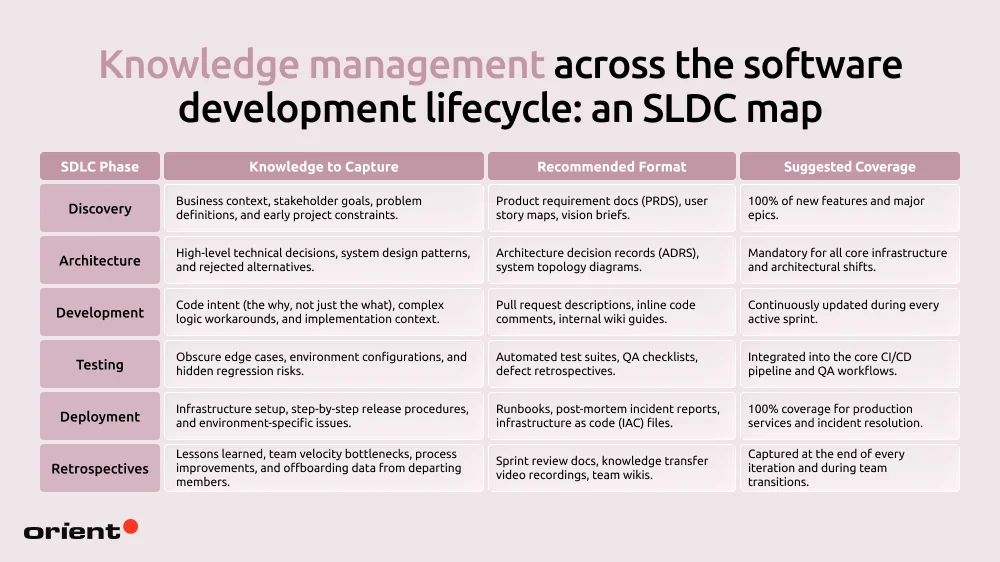
Most software teams fall into a classic documentation trap. We tend to only write things down during the development and deployment phases, usually as a mix of raw code comments and late-night system runbooks.
But here’s the reality: critical knowledge is generated at every single stage of the Software Development Lifecycle (SDLC). When you neglect your documentation during discovery or testing, you create massive information gaps. The result? Massive technical debt, endless redundant meetings, and your team making the same mistakes over and over again.
To build a resilient engineering culture, knowledge management can’t just be an afterthought. It must be integrated directly into every phase of the lifecycle. Here is a breakdown of the knowledge you need to capture, recommended ways to format it, and the coverage your team should aim for.
Knowledge management best practices for dev teams
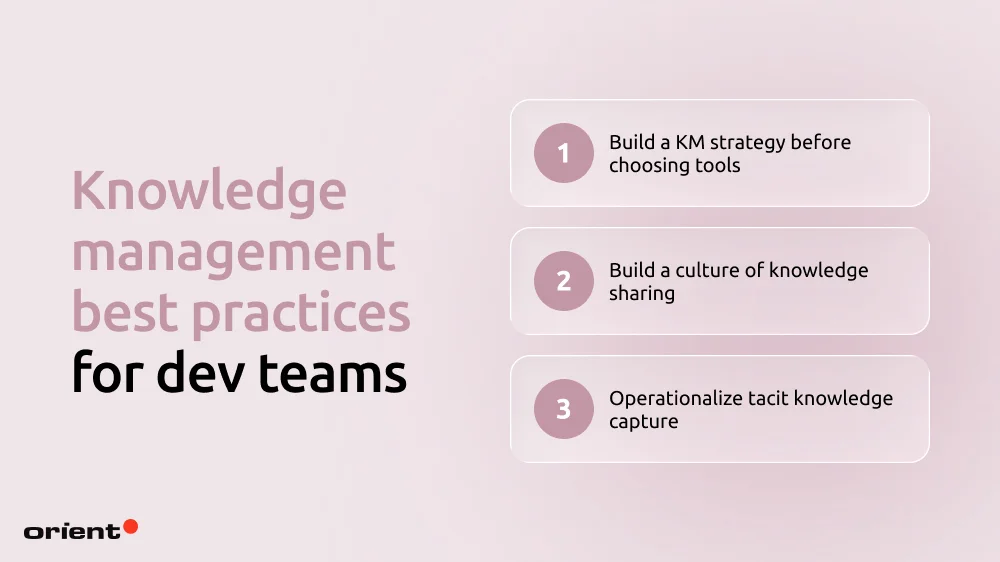
Build a KM strategy before choosing tools
Even the best tools fail when there is an absence of a proper knowledge management strategy.
Knowledge management should be given a strategic position in the overall business goals, meaning it shouldn’t be treated as an afterthought or simply thought of as a tool-buying step.
A knowledge management strategy is how you transform it from a document repository into a value-generated asset, e.g., facilitating faster bug fixes or development cycles.
Instead of blindly recording information, a proper strategy is to help staff understand the “why” behind each documentation effort and ensure that they understand that each document has its purpose.
Build a culture of knowledge sharing
A strong knowledge-sharing culture is where you put the strategies and tools into actual practice. A culture that values information sharing moves away from hoarding data to actually sharing it, with the mindset that “shared knowledge is power”.
You can create a culture where everyone is willing to share knowledge instead of tightly guarding it.
- Encourage senior developers and team leads to share insights and celebrate contributions like documentation and mentoring publicly.
- Simplify the process of intellectual capital by integrating documentation workflows. Lower the contribution friction as much as possible.
- Create a culture where employees are encouraged to ask questions, participate, and feel safe to share knowledge, uncertainties, and mistakes.
- Emphasize the personal benefits of knowledge sharing, such as enhanced reputation and shorter time to solve complex problems.
Operationalize tacit knowledge capture
The knowledge a senior developer holds, especially the tacit knowledge, is priceless. Once they walk out the door, it’s a huge loss for the team and organization.
While explicit knowledge is easy to capture, tacit knowledge is much harder to put on record. In order to capture it effectively and encourage the practice of sharing, there are a number of practical steps one can take:
- Make knowledge sharing as convenient as possible. Integrate the process into workflows by including it in key development of the lifecycle events. Use simple and friendly templates for different scenarios, such as “Lessons from this project” or a “Project debrief” checklist. Include simple and straightforward questions: “What was the goal? What could have been done better?”
- After each sprint, have a sit-down and a brief review. Go over:
- Key decisions that were recorded
- Request templates
- Exit interviews, if there are any team members leaving.
- Accept the fact that you won’t be able to capture every single piece of knowledge. Work with team leaders to identify the most critical knowledge, or if any team has the bus factor problem. Focus on those domains first to minimize risk and maximize efficiency.
How spec-driven development strengthens knowledge management

It is easy to blame the failure of knowledge management practices on cultural factors: developers simply never enjoyed writing documents. However, the issue of knowledge management lies in the structure, not the culture. Traditional documentation can quickly become outdated as software evolves. Even minor code changes may create gaps between documented requirements and the actual implementation. Spec-Driven Development (SDD) helps prevent this issue by treating specifications as the authoritative source of truth, with code developed and maintained according to those documented requirements.
Adopting Spec-Driven Development does not mean manually documenting an entire legacy system. Modern SDD tools can analyze existing codebases to automatically generate structured, version-controlled specifications, including data models and API endpoints. This helps teams uncover undocumented business logic, reduce knowledge silos, and preserve critical system knowledge when experienced developers leave.
The compounding benefits of structured specifications include:
- Prevention of documentation drift: specifications remain synchronized with the codebase since changes must be reflected in both sources.
- Creating a reliable source of truth: teams can confidently rely on a single and up-to-date record of system requirements and business logic.
- Speeding up onboarding: new developers can understand the system much faster instead of relying on tribal knowledge.
- Reducing knowledge management overhead: documentation eventually becomes part of the development process, rather than a boring chore.
SDD allows organizations to both preserve critical knowledge while also making it easier to maintain and scale software systems.
Choosing the right knowledge management tools for developers
How to choose: decision framework

While knowledge management might seem like a complex system, there are three key factors you need to focus on: audience, ecosystem, and maintenance effort.
- Audience: Keep the users at the front of the tool selection process. Who will be using this documentation? Internal knowledge sharing between developers, testers, project managers, and other relevant stakeholders requires easy access and collaborative editing efforts. For customer-facing documentation, there needs to be publishing controls and version controls.
- Ecosystem: The best tool is the most suitable tool. It should fit naturally into your existing workflow. Let’s say your team is already familiar with platforms like GitLab or Jira; it is best to look for solutions that integrate seamlessly with the mentioned platforms. Otherwise, a lot of time and effort will be needed to get used to completely new tools.
- Maintenance effort: Documentation is only valuable when it is kept up to date. Prioritize tools that support automation: automated updates, AI-powered information extraction, etc.
These three categories allow your organization to focus on solutions that support the team’s workflow rather than getting distracted by other shiny feature lists.
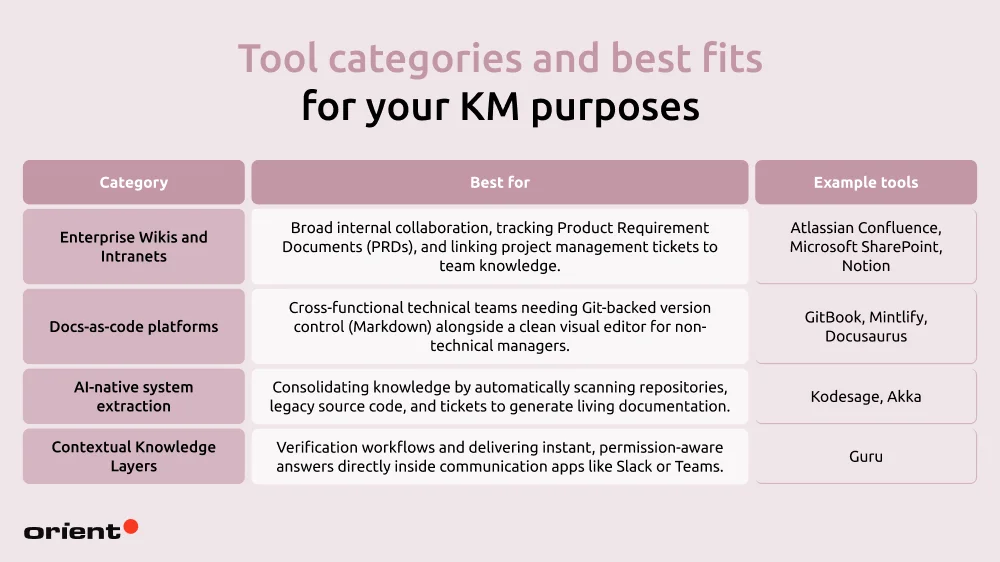
Tool categories and best fits for your KM purposes
To help map out your technical landscape, modern software knowledge tools generally fall into four key categories. Choosing the right category ensures you buy only what your team’s development workflow requires.
How to implement knowledge management in software teams
Managing knowledge in growing organizations is critical. It is how you fight documentation decay or knowledge rot, where valuable insights get lost when an employee leaves the team. There are many reasons behind knowledge loss; it might be that the knowledge is only transferred on a one-to-one basis, the transfer process might be disruptive to the development process, or that the transfer does happen, but only once. Here are key steps an organization can take to implement knowledge management effectively and sustainably.
Phase 1: Audit existing knowledge and fix critical gaps

As we mentioned earlier, buying a fancy tool alone is not the first step in implementing KM. Your team needs to map the current situation. In other words, start by conducting an internal knowledge audit to locate all the dangerous silos. After all, most information stays in developers’ heads. Work with project managers to look at the issue trackers and deployment logs.
- Where are the bottlenecks? Do they happen because only one person understands the legacy codebase?
- Identify “documentation debt”, or the missing API specs that might be dragging down the team’s speed.
- Try to identify the key problem areas. By focusing on the 20% of missing knowledge that causes 80% of your delivery delays or onboarding friction, you secure immediate, measurable ROI without trying to document everything at once.
Remember: your goal isn’t perfection or completely covering every risk under the sun; it’s about mitigating risk and uncovering what the team actually knows.
Phase 2: Build the knowledge management foundation

Once you have a good idea of what information might be missing, it’s time to establish the company’s single source of truth. This would require choosing a strong centralized knowledge repository, like SharePoint, and building it as a system to capture explicit knowledge.
To ensure the success of your strategy, you need to make it easy for both your technical and non-technical stakeholders to find the required information. A functional and efficient platform should meet the following criteria:
- Standardized templates for system architecture, runbooks, and post-mortems. This is to reduce as much friction as possible when developers are creating new content.
- Assign content ownership explicitly.
- Assign a gatekeeper to manage content quality and archive old documentation to avoid documentation decay.
Avoid a chaotic data dump and figure out an effective way for a metadata tagging system, categorization based on project type, tech stack, and so on.
Phase 3: Scale knowledge sharing across teams

After the audit is done and the system is set, make sure to foster a strong and consistent knowledge-sharing culture. Make knowledge sharing as convenient as possible by integrating the process into everyday workflows (don’t turn it into a chore). Encourage social learning formats such as “brown bag sessions” or cross-functional architecture reviews where team members share what they’ve learned from the most recent projects or deployments.
Encourage knowledge sharing by using incentive systems, formal recognition, or performance metrics to show that documentation is valued just as much as smart code liens.
Lastly, track the adoption of knowledge management through analytics. Monitor KPIs like time-to-insight to continuously evaluate the KM strategy and make timely adjustments. Scaling takes time and is an ongoing commitment to make sure the knowledge grows alongside the organization.
Knowledge management in outsourced software development
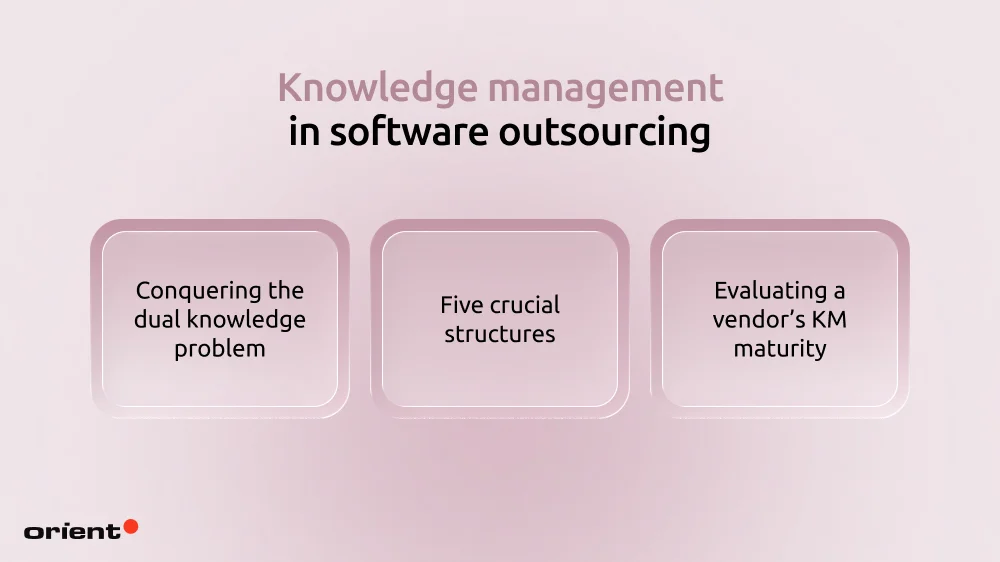
The article has only discussed knowledge management in an in-house setting so far. What happens when you introduce an outsourced partner to a project? There are a number of issues that the company needs to pay attention to.
The dual knowledge problem
Outsourcing software development introduces a unique bottleneck known as the dual knowledge problem. While in a traditional in-house setting, the team shares an understanding regarding business goals and technical stacks, having an external partner on board requires knowledge to be successfully shared in two different directions, crossing the boundaries of an organization.
- First, the client must transfer domain knowledge. This involves the business logic, regulatory constraints, and user personas, so the vendor is certain they are building the right product for the right people.
- Next, the vendor must also continuously document and transfer technical knowledge: code dependencies, system configurations, or any other relevant technical decisions, back to the client.
When business knowledge is not effectively transferred to the vendor, the result may be a technically functional product that fails to meet business needs. Conversely, when technical knowledge is not documented and shared back to the client, organizations can become overly dependent on the vendor for maintenance, updates, and future development. Maintaining a two-way flow of knowledge is therefore one of the most important responsibilities when managing outsourced software development projects.
The five documents every outsourced project needs
Bridging the dual gap requires software managers to enforce five structured artifacts instead of demanding team members endless hand-written manuals.
- Software requirements specification (SRS): Documents business requirements, user journeys, and project goals so the vendor understands what to build and why.
- System architecture document (SAD): Outlines the system architecture, data models, technology stack, integrations, and infrastructure dependencies.
- API documentation and contracts: Defines how different services and applications communicate, helping distributed teams integrate components consistently.
- Deployment runbook: Provides instructions for deployment, environment configuration, CI/CD workflows, monitoring, and recovery procedures.
- Handover and offboarding checklist: Documents code ownership, access permissions, knowledge transfer activities, and responsibilities during project transitions.
With these five structures, you can ensure that knowledge management remains a crucial part of the development process and not simply an afterthought.
Evaluating a vendor’s KM maturity
It is crucial to evaluate the vendor’s internal knowledge management maturity, or KM, before signing with a partner. You can use the Capability Maturity Model Integration (CMMI) framework to determine how a vendor handles intellectual property protection.
Vendors with low maturity often rely heavily on individual developers’ expertise. In these environments, critical knowledge may exist only in engineers’ heads, creating risks when team members leave or change projects.
In contrast, mature vendors typically operate systematically at an optimized level.
- They have dedicated wiki structures
- Have standardized documentation templates
- Actively integrate automated documentation that reflects code changes
Try asking your potential partner practical questions:
- How long does it typically take a new developer to become productive on an existing project?
- How is project knowledge documented and maintained?
- How do teams ensure documentation remains up to date?
- What knowledge transfer process is followed at project handover?
Conclusion

All in all, knowledge management isn’t about building a massive encyclopedia. It’s about protecting your team’s collective intelligence. From defining core strategies, understanding existing gaps, to choosing the right tool, effective knowledge management is a structural solution to a structural problem.
Don’t overwhelm yourself by trying to do everything at once. Pick just one critical knowledge silo and start from there. You can also find a partner to help you with taking that first step, like Orient Software. With two decades of experience, we will help you identify all the critical gaps and an efficient timeline and plan to patch them. Contact us today!