
Application modernization is the process of updating an existing legacy system so that it meets modern business requirements and user expectations. This typically means updating the legacy system’s core infrastructure, including its features and user interface, plus user experience (UI/UX). It also means transitioning an on-site legacy system to the cloud so that it can use cloud native capabilities, such as microservices and containerization, for greater scalability and reduced fault tolerance.
Despite the advantages, application modernization challenges still occur. These include technical challenges, like finding experienced developers who can modernize outdated technical stacks, and they include business challenges, like keeping downtime to a minimum to ensure user satisfaction and regulatory compliance. Learning how to avoid these challenges is key to a successful digital transformation strategy.
Read on to discover what application modernization is, why it’s harder than it looks, and how spec-driven development can help address the root cause of its problems.
Key Takeaways:
- Application modernization is an effective way to increase the scalability, accessibility, and competitiveness of existing legacy systems.
- Common application modernization challenges include technical debt, labor shortages and skill gaps, and poor organizational culture.
- Spec-driven development helps alleviate the issues with application modernization by converting technical informational intent into action.
Why modernization is harder than it looks
Application modernization is harder than it looks because the practice incurs a number of upfront and underlying issues. These issues include legacy and technical debt, integration and architecture debt, organizational and people challenges, and financial and risk management challenges. Such issues make it difficult for individuals and organizations to execute successful digital transformation strategies without experiencing setbacks.

56% of individuals cite security concerns as their biggest application modernization challenge. On the other hand, 48% of organizations cite legacy system complexity as their biggest hurdle. Competing priorities, difficulty determining the right approach, integration challenges, lack of training or knowledge, and resistance to change are also widespread issues.
AI readiness is another application modernization challenge, where individuals and organizations fail to incorporate AI-driven capabilities, such as design for real-time access and API-driven architecture, into their modernization strategies, necessitating a new modernization strategy right after the previous one.
Legacy and technical debt challenges
Technical debt is the cost of addressing shortcomings and sub-optimal decisions made when producing code, prioritizing market acceleration over quality. Legacy debt, on the other hand, is the cost of deliberately holding onto legacy systems (powered by outdated code) to maintain business continuity even at the cost of competitive loss.

Undocumented and tangled codebases
Most legacy applications run on outdated, undocumented code. They are built on programming styles inconsistent with the individual or organization’s modern standards – the product of many years of handovers from one developer to another.
Limited documentation makes it difficult for new developers to grasp the code’s architectural context, increasing post-deployment maintenance costs. Approximately 40% of infrastructure systems across asset classes have technical debt concerns, according to Gartner.
Legacy infrastructure dependencies
Legacy systems typically operate on niche licensing or without any licensing at all. That means legacy users often receive minimal or no security updates, technical support, and general quality of life improvements. Many vendors also charge a premium to keep supporting legacy software, regularly increasing fees without offering anything new in return.
Containerization is an effective way to migrate legacy applications to the cloud, while eliminating vendor lock-in and unlocking cloud native capabilities. Incrementally migrating legacy applications to the cloud, via the Strangler Fig Pattern, allows legacy users to gradually replace pieces of functionality with new applications and services with minimal risk.
Outdated frameworks and languages
Outdated frameworks and languages may be incompatible with modern application standards, including API integration and microservices architecture. This makes it difficult to migrate applications running on legacy languages to embrace cloud native functionalities.
As programmers age and move on to different projects and organizations, their legacy framework and language knowledge follow them. These talent and skill gaps make it difficult to maintain applications running on legacy frameworks and knowledge.
Missing or inadequate documentation
Legacy developers who never documented their code risk making it harder for new developers to manage and update their work. Without comments and documentation, new developers must devote additional time and resources to understanding the decisions behind the code.
Discovery sprints, architectural mapping, and technical archeology are three effective ways to address missing or inadequate documentation. Discovery sprints are week-long sessions dedicated to addressing at least one or more substantial risks in your product’s definition. The benefits of completing discovery sprints include challenging assumptions, bringing on early expertise, and defining, refining, and even expanding briefs.
Integration and architectural challenges
Integration and architectural challenges occur when software applications, old and new, encounter communication difficulties. Early intervention makes it easier for development teams to know what to do before writing code.
Integrating legacy systems with modern architecture
Old systems and new systems speak different languages. COBOL (common business-oriented language), a legacy language used in core government and private sector functions, can handle huge processing volumes but has wordy syntax and slow compilation times.
However, economic pressures and a declining pool of COBOL developers have caused many government and private organizations to migrate to Java to integrate with modern cloud-native applications.
Middleware and API layers, as well as ESBs (Enterprise Service Buses), help bridge the gap between legacy and modern systems. Middleware and API layers help facilitate communication and data transfer between disparate platforms, while ESBs help integrate multiple enterprise applications and systems with different protocols and data formats.
Data migration complexity
Migrating data from one environment to another poses a number of issues related to data volume, format differences, and potential data loss during transfer. Mixed data ownership, where multiple teams and units are responsible for different data groups, may necessitate more complex technical planning and coordination overhead.
Reconciling records, encrypting data in transit, and parallel testing are effective ways to combat data migration complexity. Data reconciliation compares data sources, ensuring consistency and accuracy. Data encryption converts plaintext data into unreadable ciphertext, preventing unauthorized access in transit.
Avoiding ‘Cloud Shock’ lift-and-shift without transformation
Lift-and-shift is a popular and cost-effective approach to application modernization. It involves migrating on-site legacy systems to the cloud while retaining their core code and functionality. ‘Cloud shock’ is when individuals and organizations realize the cost of cloud hosting is higher than they envisioned.
True modernization prioritizes architectural transformation over infrastructure migration. It involves investing in more effective, long-term solutions, including factoring and rebuilding.
The 6R decision framework
Below are the six most commonly used modernization strategies:
- Retire – Decommission an application that is no longer needed.
- Retain – Continue to use critical applications as they are until they need refactoring.
- Rehost – Also known as the ‘lift-and-shift’ approach, where an application is migrated to the cloud with minimal changes.
- Replatform – Optimize applications to run in the cloud without changing the core application code and architecture.
- Refactor – Re-architect applications to be cloud-native, typically done through containerizing workloads or moving them to serverless architectures.
- Repurchase – Switch from the license of one SaaS (Software-as-a-Service) model to the license of another SaaS model.
Organizational and people challenges
Success in application modernization is more than a technical upgrade. It’s also a foundational shift in how your people approach and use technology. Failure to consider modernization’s effect on your people results in change resistance and skill gaps.

Change resistance
Legacy programmers with years, possibly even decades, of experience may resist the idea of migrating to modern frameworks and languages. Transparent communication, early intervention with skeptics, and demonstrating quick value (through MVPs) can help ease doubts and concerns about the unknown.
At Orient Software, we regularly develop MVP’s to quickly demonstrate the commercial value and potential ROI of business ideas. Our viable, cost-effective solutions help demonstrate the tangible and intangible benefits of your application modernization – minus the risk of entering full production.
Skill gaps
There’s currently a huge expertise shortage in modern technologies, including cloud and AI. 94% of leaders face AI-critical skill shortages, with one in three reporting gaps of 40% or more, according to a global survey of 1,010 C-suite executives.
Cross-training, seeking external expertise (during transition), and setting realistic expectations for teams learning new patterns can help address skill gaps. For example, cross-training involves having star performers train new developers on best practices. By passing down knowledge of legacy frameworks and languages to future generations, they can more effectively maintain on-site and hybrid environments.
Competing priorities and bandwidth
According to research, 44% of individuals cite competing priorities as a common barrier, with 42% of organizations citing the same reason. Competing priorities and bandwidth make it difficult to manage legacy systems and modernize at the same time.
Separating teams into dedicated maintenance and modernization groups can help manage competing priorities. This involves a well-considered change management plan, where your transformation initiative considers not just your technology and processes but also your people.
Mapping dependencies can also help by visually showing teams what systems are communicating with one another, providing a ‘big picture’ overview of every interaction and result.
Financial and risk management challenges
Software application modernization projects pose a number of upfront and hidden financial and compliance risks.

Cost underestimation
Legacy application modernization and cloud migration projects can quickly spiral out of control. They can cost anywhere from 30,000 USD to 300,000 USD, depending on the enterprise size and project scale.
Training and upskilling, refactoring old applications, and compliance are common hidden cloud migration costs. The cost of running two parallel groups (maintenance and modernization) can also inflate cloud migration budgets.
Budget for technical clean-up time to avoid cost underestimation. Use online calculators to gain realistic estimations based on application source-to-destination pathways, timeline, server, and data volume, and strategy (e.g., lift-and-shift, refactor). Also factor in the cost of migration tools, refactoring licenses, and licensing for cloud-native applications.
ROI uncertainty
ROI uncertainty often stems from an unclear definition of success. It fails to define the key metrics you need to measure in order to precisely achieve results. The result? Unclear roadmaps, constantly-changing priorities, and frustrated teams.
Define the measure outcomes that matter to your business. Set precise goals related to time to market, cost per deployment, and system availability (uptime). At Orient Software, we can develop an MVP that helps you better understand the potential ROI on your idea. This gives you the knowledge and confidence to either move ahead or to step back, re-evaluate, and return with a different approach.
Compliance and security exposure
Most legacy systems do not meet today’s compliance standards, including the GDPR in Europe and the CCPA in the United States. Therefore, the continued operation of legacy systems incurs compliance debt, where the gap between what the system can do and what current regulations want it to do increases slowly.

Shift-left security, early threat modeling, and the principle of least privilege help ensure modernized applications comply with current standards. Shift-left security integrates security early into development, enabling early vulnerability and misconfiguration correction. Automated threat modeling solutions can achieve a 49% reduction in security vulnerabilities during the development phase.
Vendor lock-in
Vendor lock-in occurs when the functionality and security of your software applications are tied to a single vendor. This makes it difficult for you to switch vendors, as doing so typically results in high cancellation and license transfer fees, potential business disruption, and labor or skills shortages for potential new vendors. The result is that you stick with the same vendor even if they do not best meet your needs.

Smart IT vendor management can help. Multi-cloud or hybrid cloud strategies are an effective way to gradually move away from individual vendors. By reducing your dependence on a single vendor, you gradually regain control over your infrastructure and the flexibility to choose more cost-effective and tailored solutions.
It is worth noting that switching from a legacy vendor to a cloud vendor does not equate to modernization. It simply means you have changed hosting environments, otherwise known as the ‘lift-and-shift’ approach. You can still move an outdated application from an on-site environment to a cloud environment, and encounter the same issues you had before the move.
The emerging challenges of AI readiness
Many software application modernization efforts fail to consider AI readiness. This means they won’t be able to use advanced features, such as streamlined or orchestrated data flows, standardized API’s, or deployment patterns with rapid iteration and testing. As a result, many individuals and organizations will be forced to undergo additional modernization if they are to embrace the latest AI technologies.

Incorporate AI readiness into your modernization strategy. Ask questions like “Can our architecture support real-time inference? Does it have data layers that modern AI tools can use?” Approach a trusted technology partner like Orient Software for a comprehensive AI readiness assessment. You’ll know exactly where your organization stands and how to successfully implement and adopt the latest AI technologies.
Self-assessment frameworks
Self-assessment frameworks are a vital component of any modernization strategy. They help you evaluate which systems to modernize first, how to do it, and what strategies to use. You then have a solid digital transformation plan to follow and reference.
When using self-assessment frameworks, a good starting point is to base your questions around the four challenge categories: legacy and technical debt, integration and architecture, organizational and people, and financial and risk management.
For example, if your most pressing concern is integration and architecture, then consider exploring solutions like API-layer modernization and incremental modernization (as opposed to rip-and-replace).
How spec-driven development addresses the root cause
Spec-driven development is a software methodology where you transform your specifications into actionable documentation. It operates as an executable contract that defines what your AI agents generate. This improves the odds of AI agents delivering software that both passes unit testing and complies with architectural patterns.

What a specification is (and is not)
Specifications capture what a software application does, the definition of a successful deployment, and the boundaries that the application must not cross. Specifications do not represent past beliefs, coding standards, or one-time deliverables. They evolve with projects, acting as a singular truth source for the application’s entire lifecycle.
How the spec addresses each challenge category
Use the table below to understand the benefits of governing specifications for different challenge categories.
| Challenge category Undocumented codebases | How governing specifications help Surfaces intended vs accidental behavior |
|---|---|
| Knowledge concentration | Structural knowledge in spec, not in people’s heads |
| Integration complexity | Explicit boundary definitions, failures are caught before production |
| Migration risk | Acceptance criteria defines ‘done’, is not a constantly-moving target |
| Change resistance | Both businesses and engineers read from the same document, singular source of truth |
| Compliance exposure | Formal criteria makes system behavior easy to audit |
Two practical paths to spec-driven modernization
- Path 1 (for apps 5-10 years old) – Define whether the system is losing clarity, where legacy knowledge is drifting and declining, and if it still provides the necessary information for a governing spec. Define the system’s value, verify its value with evidence, and decide what to change.
- Path 2 (for apps 10+ years old) – If previous modernization attempts have stalled or failed, determine if any approach can be trusted to break the cycle, not restart it.
These paths help identify which challenges are most relevant and determine which starting point makes the most sense.
Conclusion: Choose Orient Software for effective legacy modernization
Application modernization challenges can be difficult to overcome. Legacy and technical debt, people and organizational challenges, and security and compliance concerns can derail any modernization project.
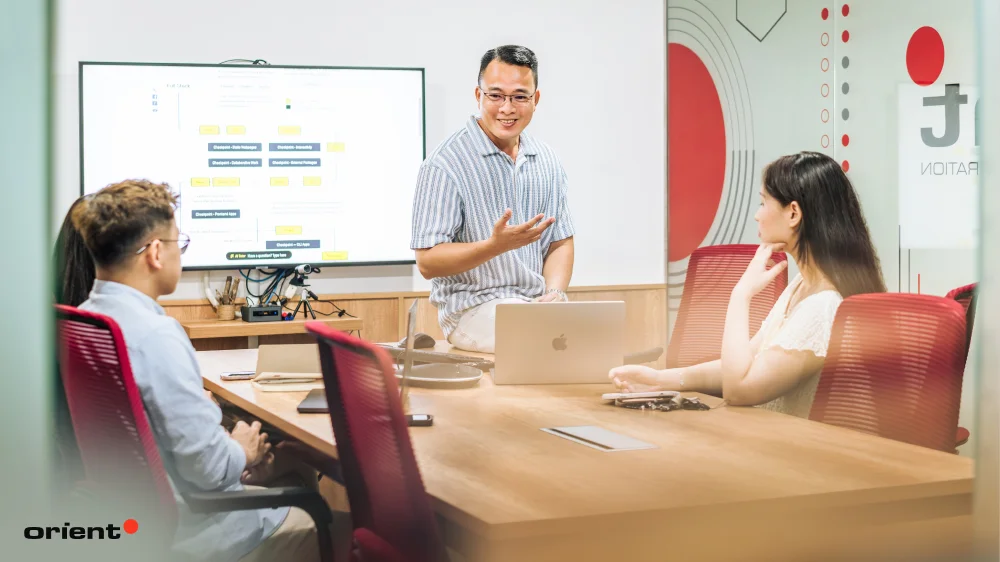
At Orient Software, we have provided application modernization services to clients around the world in various industries, from health and technology to government and private sectors. Our 300+ team of highly-skilled developers offers solutions to common modernization challenges, including outdated tech stacks and technical and legacy debt, enabling your business to grow with a forward-thinking approach.
Contact us today. Discover how our application modernization services can help your enterprise prepare for tomorrow.