

Every year, billions of dollars are poured into digital transformation efforts and software engineering projects. However, only a few of them can see the light of day. Most of them get canceled midway, while many others are delivered late, over budget, and underwhelming. According to PMI’s 2025 Project Success report, only half of all software projects globally are considered successful by the stakeholders.
What makes it worse is that the people closest to the sinking projects often saw failures coming; still, they chose to neglect the quiet conviction and proceeded anyway. Budgets get approved, timelines get committed, and the development team gets assembled, all while the quiet conviction that something will go wrong sits in the room, unspoken. Then, who is to blame? The project managers, product managers, or developers?
The answer is never about who. What really matters is understanding the primary reasons why a project falters. Perhaps you don’t know that software project failure almost always follows a pattern. The earlier you realize it, the more preventable the risks become. Consider this article your honest guide to all the root causes behind a software project failure and how to rescue yours if caught in them.
Key Takeaways:
- Software project failure almost always follows a pattern. The root causes are more predictable than most teams realize, and what is predictable can be prevented.
- Business and planning failures start before the first sprint. Poor planning, unclear requirements, scope creep, unrealistic timelines, and misaligned stakeholders are the conditions that make failure inevitable before execution even begins.
- People and process failures build silently from within. Lack of ownership, skill gaps, poor communication, and burnout are not soft issues. They are delivery risks that compound until they cannot be ignored.
- Technical failures are the most expensive to address because they only become visible under real production pressure. Getting involved early in architecture, testing, and dependency decisions is not optional for a product manager.
- Recognizing the warning signs early is what separates a project that recovers from one that does not. The signals are almost always there before the damage becomes undeniable.
- When a project is already at risk, the right response is an honest audit, a root cause diagnosis, and a realistic reset. Not more velocity.
- Not every project is worth saving. Knowing when to stop is as strategically important as knowing how to recover.
Why software projects fail – Identify the root causes
In reality, every failed project has its own story. Behind it lie different reasons. Some collapse because of technology, while the failures of many others have nothing to do with code. But beneath those individual stories, the root causes are more consistent than most teams expect. They cluster around three distinct layers:
- How the project is planned and defined initially
- How the people and processes inside a project function
- How technical decisions are made and executed.
Business & planning causes
These represent the earliest forms of project derailment, often described as “the fire” that starts before the project does. Some even refer to them as silent killers. Such failures look like reasonable decisions made under pressure. The result is a software development project that begins with confidence but without the essential foundation to develop real products and deliver value.
Poor or no planning
Project planning is the structural blueprint that governs how a software project runs from start to finish. It involves defining the scope boundaries, resource allocation, role ownership, risk management approach, and delivery sequencing before execution begins.
Insufficient planning is often considered the root of all causes that happen later on. If planning fails from the outset, execution is set to fail as well.

When the planning phase is skipped or rushed, the development team inherits the consequences instead of context. They have to move fast without a fully mapped direction. They are handed a backlog without boundaries, a timeline without grounding, and responsibilities without clear ownership.
Since there is no structural decision-making process, the team is forced to improvise, and decisions get made in the middle of execution under pressure, with less information and at a much higher cost.
Practical tip: Do not mistake a rushed or incomplete planning phase for time-saving. It borrows time from the later stages of the development process. What is skipped in the name of speed will cost you both principal and interest in the form of rework, misalignment, and decision-making under pressure. Enforce a documented project plan that defines scope boundaries, resource allocation, role ownership, risk approach, and delivery sequencing. Make sure it is clear, agreed upon, and accessible to everyone on the team.
“The wrong problem, built right.”
This failure has nothing to do with poor execution or inadequate preparation. The project team picked a problem worth noting and solving, understood it, designed an appropriate solution, and executed it well. However, the solution was right while the chosen problem was not.

It happened because the project team did not validate whether the problem they selected was the one that actually mattered most to the users they were building for. As a result, they ended up taking the wrong turn in the first place without knowing.
Practical tip: Treat validation as a non-negotiable checkpoint before committing to a problem statement. Make sure you validate your ideas with genuine users. Shift from creating something functional to building something that really matters to users.
Unclear or inaccurate requirements
Unlike the validation problem, this failure usually begins with the right reason. The development team knows what they are supposed to build and has the correctly mapped direction to follow. However, the requirements describing it are vague or contradictory, often misunderstood by the people who are responsible for executing them.

The consequences are slow, accumulative, and expensive, but what will come is a chain of invisible damage. For example, an ambiguous requirement in week one forces an engineer to make an assumption in week two. That assumption continues to produce a misbuilt feature in week five. The misbuilt feature triggers a rework cycle in week seven. The rework surfaces a missed stakeholder expectation in week ten. And by week fourteen, a failed review meeting reveals that what was delivered was never what was intended.
Such a failure often occurs in complex projects where documentation and communication are more challenging to handle.
Practical tip: Before any requirement enters the backlog, apply a simple readiness test. Ask the person responsible for execution to explain back what success looks like in their own words without referencing the original document. If the answer differs from what was intended, the requirement is not ready.
Scope creep
It is also known as requirement creep or kitchen sink syndrome – one of the primary reasons that can take the whole thing down. When scope creep happens, the project keeps getting bigger than what was originally estimated, but unfortunately, without getting more time, money, or resources to match.
In most cases, scope creep happens as a result of many small, reasonable-sounding decisions made over time without a formal process to evaluate their collective weight. Every project starts with a defined scope. Then reality sets in. A stakeholder wants one small addition. A client asks for a minor tweak. A team member spots something that was overlooked in the original plan. None of these requests feels significant on its own, and that is exactly the problem.

What is dangerous about scope creep is that the damage does not show up immediately. It arrives later and with full force. The team is delivering something significantly larger than what was scoped, on a timeline that was never updated, and a budget that was never revised to reflect the additional work. Deadlines begin slipping not because the team is underperforming, but because the work itself quietly outgrew what was originally agreed.
Stakeholders who approved each small change along the way are now surprised by delays they did not see coming. And somewhere in the middle of it all, the original definition of success has shifted so many times that nobody can clearly articulate the desired outcome anymore. The project is still moving. But it has long stopped moving toward the right destination, which is somehow deemed a failure.
Practical tip: Whether it is a minor change request or not, treat it as a formal conversation. What is being added, what needs to be adjusted in return, and who is signing off on it? Implementing a simple, consistent process for evaluating changes does not slow down a project. It keeps the project honest as it moves forward.
Unrealistic timelines and padded estimates
A project is set to fail if the deadline was never realistic to begin with.
An unrealistic timeline is one set by what the business wants rather than what the work requires. A launch event, a client contract, a promise made before the scope was understood. And suddenly the project is already behind before it begins. Padded estimates compound the problem. When teams quietly add buffer to protect themselves from delivery pressure, planning becomes a negotiation rather than an honest assessment of what the work actually demands. Neither side is working from reality. Both sides are working from what they hope is true.

This mistaken calculation of time majorly happens when the work is not analyzed and understood thoroughly, and it may transcend what you anticipate. What awaits you is a chain of uncomfortable results. Discovery gets compressed. Testing gets shortened. Quality decisions get deferred. The team starts optimizing for the appearance of progress rather than the integrity of what is being built. By the time the deadline arrives, the choice is between shipping something that is not ready. Poor quality software is the inevitable result.
Practical tip: Don’t set a timeline based on what the business wants. Focus on what the work demands rather than just meeting targets. Present the realistic estimate alongside the requested date, name the trade-offs clearly, and let the right stakeholders make an informed decision. Remember to be realistic.
Misaligned stakeholders
One of the main causes of project failure is the lack of stakeholder engagement. This is when you set your project to fail even when everything is still on paper. Without the involvement of key people, the project moves forward on assumptions that only those people could have corrected. And the most dangerous part is that misalignment rarely makes noise while it is being built. On the surface, everything appears to be in order. But beneath that surface, different stakeholders are holding different versions of what the project is supposed to deliver.

When the silence breaks, the demo fails, and the final delivery gets rejected. By the time the product considered complete gets sent back for fundamental changes, realignment is at its most expensive. Moreover, it also damages the trust and confidence of the team after spending months on building the failed outcome.
Practical tip: Do not treat stakeholder alignment as a kickoff activity. Treat it as an ongoing responsibility throughout the entire project lifecycle. At every major milestone, directly confirm the definition of success with key stakeholders through a direct and explicit question: What are you expecting to see at the end of this phase, and does what we are building reflect that?
Absence of clear project success metrics
A project without defined success metrics does not just risk failing at the end. It is designed to falter even before the work begins because nobody agrees on what actual success looks like. There needs to be clarity not only on how a project is considered a failure but also on how success is defined. Without that, the team is not just working without a measuring stick. They are working without a shared destination.

Without clear metrics, the result is hard to assess. Milestones get hit, features get shipped, deadlines get met. However, stakeholders still walk away from the same delivery with entirely different conclusions about whether it succeeded. Without defined outcomes, course correction during execution is nearly impossible because there is no signal to act on and no agreed-upon standard to resolve disagreements when they surface.
Practical tip: Before execution begins, align all key stakeholders on three things: what success looks like, how it will be measured, and by when those signals should be visible. Keep those metrics visible throughout the project and revisit them at every major review.
People & process causes
A brilliant idea can fail entirely due to poor execution, management, and operation. The best-planned project, with the clearest requirements and the most realistic timeline, can still unravel when the human and operational layer breaks down. Operational failures caused by various reasons:

- Poor project management & lack of ownership: When nobody truly owns the outcome, everybody owns the excuse. Poor management creates an environment where tasks get assigned, but results go unowned, decisions get delayed because nobody has the authority or conviction to make them, and accountability exists only when something goes visibly wrong. A project without strong management at the center does not just slow down; it drifts. And unfortunately, drifting projects rarely find their way back without a high cost.
- Skill gaps & shortage of talent: A project can have the right plan, the right process, and still fall short when the people needed to execute it are either not available or not capable enough for what the work demands. Skill gaps emerge when the technical or domain expertise required by the project exceeds what the current team can deliver. Talent shortages compound the problem even further when critical roles go unfilled or are staffed with whoever is available rather than whoever is qualified. The gap between what the project needs and what the team can provide becomes a quiet but consistent drag on every deliverable.
- PM and development team disconnect: Product managers and developers are meant to work as one unit. In practice, they often operate in parallel lanes. Requirements get handed over a wall rather than being built together. When product and engineering operate as separate functions rather than a shared unit, the project pays the price of two teams solving the same problem differently.
- Process without discipline: Many teams adopt Agile in name while practicing waterfall in behavior. Standups become status theaters. Retrospectives produce observations but no real change. When a process exists only as a ritual rather than a genuine operating discipline, the team looks organized on paper and feels chaotic in practice. And that gap is where delivery quietly breaks down.
- Poor communication: Communication failures rarely look like silence. They look like status updates that report activity without surfacing real blockers, and meetings that consume time without producing decisions. When the team is talking but not truly aligning, critical information gets lost, assumptions go unchallenged, and the gap between what different people believe widens until it becomes a problem nobody can ignore.
Practical tip: The causes related to people and processes are hard to diagnose as they rarely announce themselves. Addressing them before they surface is the only way to prevent failure. Establish clear ownership before the first sprint begins, not just who does the work, but who is accountable when it goes wrong. Hire for the specific demands of the project, not for availability. Build communication habits that surface real problems, not just status. Close the gap between product and engineering by making collaboration the default, not the exception. Protect the team from an unsustainable pace the same way you protect the timeline, because a burned-out team is a delivery risk.
Technical causes
Not all project failures trace back to planning or people. Some originate in the technical layer through the decisions made about how the product is built, tested, and shipped. These failures are particularly expensive because they only surface under the pressure of real users and real production environments, where fixing them costs significantly more than preventing them.

- Poor architectural decisions and wrong tech stack: Choosing the wrong architecture or technology stack early is one of the most expensive mistakes a team can make, as these decisions are rarely easy to reverse. What feels like a practical choice in the early stages becomes a structural constraint that limits scalability, performance, and every technical decision that follows.
- Insufficient and improper testing: Testing pushed to the end of development is not testing. It is damage control. When quality assurance is treated as a final step rather than a continuous discipline, bugs accumulate silently over time and show up all at once before release, creating a false sense of readiness that the product has not earned.
- Unmanaged technical debt: Every shortcut, quick fix, and deferred refactor adds to a balance the team will eventually have to pay. Left unmanaged, technical debt spreads, slows velocity, and makes the codebase progressively harder to work with. The longer it is ignored, the more expensive it becomes to address.
- Over-reliance on key individuals: When critical system knowledge lives in one or two people’s heads, the project carries a risk that no sprint plan accounts for. If that person becomes unavailable or leaves, the team loses not just a contributor but the context and judgment that kept the project moving, and no onboarding process replaces that quickly.
- Underestimated third-party and integration dependencies: APIs, legacy systems, and external dependencies are consistently underestimated as a source of risk. A third-party service that changes without notice or an integration that works in staging but fails in production can derail a delivery that was otherwise on track.
- Poor deployment and release management: A well-built software product can still fail at the point of delivery. Without proper deployment processes, environment parity, and a clear rollback plan, the release itself becomes a high-risk event, and when it goes wrong in production, the cost is measured in downtime and user trust that is hard to recover.
Practical tip: These causes demand early involvement, not late reaction. Get into architecture and tech stack conversations before decisions are locked in. Push for testing throughout development, not at the end. Keep technical debt visible and on the roadmap. Note that deferred debt always resurfaces at the worst moment. Map dependencies before they become blockers. And never let critical system knowledge sit with one person.
The cost of unsuccessful development projects
When a software development project fails, the first and foremost damage is financial. However, business leaders who frame failure as a budgetary loss are only seeing the tip of the iceberg. The final cost of an unsuccessful project can extend far beyond what appears on a financial report. What goes wasted can also be time and effort, considered hidden or “soft” costs.
Direct costs
In the simplest terms, direct costs are the money you lose, and they are visible by nature. These are immediate, measurable financial losses that a failed project leaves behind. The numbers surface in post-mortems and budget reviews as the investments in the work delivered incorrectly, the resources wasted, and the unrecoverable expenses.

- Financial loss: The most immediate damage a failed project leaves behind is financial. Budgets get consumed without delivering what was promised. The further into execution the failure occurs, the less of that investment can be salvaged. A significant portion of what was spent simply disappears with nothing to show for it.
- Wasted engineering hours: Behind every failed project is a team that spent months building something that never delivered. Every engineering hour consumed on canceled, reworked, or abandoned work cannot be recovered or reassigned.
- Potential legal and compliance fines: Not every consequence of project failure shows up in a budget review. It shows up in a legal notice. Missed deliverables trigger penalty clauses. Rushed development that causes a data breach attracts regulatory action. In sectors like fintech, healthtech, or government, shipping non-compliant software is not just a technical failure. It is a liability that can cost far more than the project itself ever did.
Indirect costs
Aside from the financial impact reflected by numbers on the invoice, indirect costs are everything else that the failure causes you to lose silently. For instance, the opportunities you missed, the reputation you damaged, the team morale you lost, the market ground you gave up to a competitor, and more. These non-financial losses are often called hidden or soft costs.

- Opportunity cost: A failed project does not just consume resources. It consumes the time window in which those resources could have been used to build something that worked, enter a new market, or outpace a competitor.
- Reputational damage: When a failed project becomes public knowledge, it creates a direct negative impact on the company’s reputation. This is considered a significant loss as it becomes harder to recruit talent, retain client trust, or win contracts. Reputation takes years to build and very little time to damage.
- Reduced team morale and talent loss: Failures do not cost you just money or time. They take a toll on people. Engineers, PMs, and leaders who carried the weight of a struggling project walk away drained. Eventually, in most cases, they leave. When they do, the institutional knowledge they carry walks out with them, and no hiring process replaces that quickly or cheaply.
- Wasted strategic momentum: While the project was failing, the business was standing still. Competitors were not. The cost of catching up is almost always higher than the cost of getting it right the first time.
Do not make the mistake of underestimating indirect costs simply because they are harder to quantify and slower to surface. On the business side, the non-financial losses outlast the financial ones, and they are far more difficult to recover from.
Early warning signs: Is your project heading for the rocks?
Many projects reveal potential signs of failure long before they are officially considered at risk. The early indicators are there, but the leaders and their teams tend to overlook or dismiss them as temporary setbacks, normal growing pains, or issues that they will work through later. Recognizing the warning signs early can save you from expensive lessons shown as the reasons or excuses in the post-mortem. Reading the right signs does not require prediction. It asks discipline to look honestly at what the project is telling you.

- Missed deadlines: A single missed deadline can be an anomaly. A pattern of them is a signal that the project was never properly set up to deliver on its commitments. When dates keep slipping without a formal reassessment of scope, capacity, or timeline, the project is not running behind. It is running on hope.
- Budget overruns: When spending consistently exceeds what was planned, it rarely means the estimates were slightly off. It usually means the scope grew; the plan was never realistic, or both. Left unaddressed, budget overruns do not stabilize on their own. They compound, and by the time they become undeniable, the options for course correction have significantly narrowed.
- Scope keeps expanding without formal approval: When new requests, changes, and additions keep entering the project without going through a defined process, the original plan is no longer the real plan. The team is building something different from what was agreed, and nobody has formally acknowledged it yet.
- The team stops raising concerns: A “too quiet” team is not always a confident one. When engineers, designers, and product members stop surfacing blockers, flagging risks, or pushing back on decisions, it often means they have stopped believing it will make a difference. That silence is one of the most dangerous signals a project can produce.
- Requirements keep changing mid-sprint: Requirements that shift constantly mid-execution are a clear sign that the discovery phase was never completed properly. The development team cannot build with confidence when the target keeps moving, and the rework generated by late-breaking changes erodes both velocity and morale.
- Stakeholders are disengaged or hard to reach: When the people whose approval and input the project depends on become difficult to access, decisions stall, and assumptions fill the gap. Stakeholder disengagement is rarely about a lack of interest. It is usually a sign that confidence in the project has already begun to erode.
- Rework is becoming the norm: When the team spends more time fixing and rebuilding than moving forward, something upstream must be broken. Persistent rework is almost never a craftsmanship problem. It is a requirements problem, a communication problem, or a planning problem, and it will keep generating the same cost until the root cause is addressed.
- Nobody can clearly define what success looks like: If you ask three people on the same project what a successful outcome looks like and receive three different answers, the project is in trouble. Without a shared definition of success, the team cannot align on priorities, stakeholders cannot evaluate progress, and nobody will agree on whether the final delivery achieved what it set out to do.
Crucial steps to save a project at risk
When IT projects start showing the signs, your worst response is to keep moving and hope things stabilize on their own. Unfortunately, they rarely do. What a struggling project needs is not more velocity. It needs an honest intervention – a deliberate pause that stops the bleeding before it becomes fatal. Do not leave your project to chance; you need a business strategy. If the warning signs are already there, these are the steps that give it a real chance of recovery.
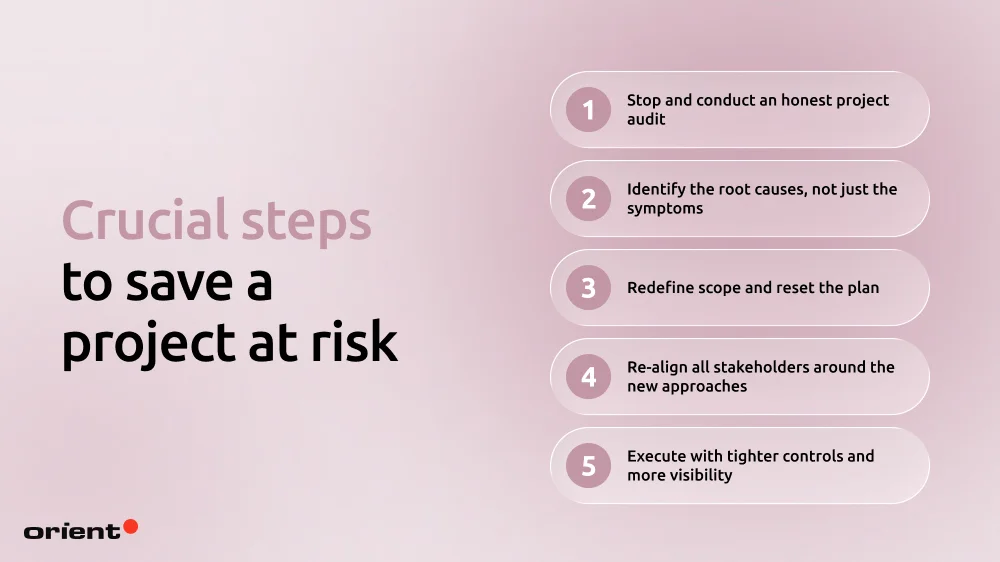
Step 1: Stop and conduct an honest project audit
Before doing anything else, stop. Not indefinitely, but long enough to get a clear and unfiltered picture of where the project actually stands. Assess the current state of scope, the total cost, timeline, team capacity, and stakeholder alignment without the bias of wanting things to be better than they are. The audit is not about assigning blame. It is about establishing an honest baseline from which recovery can actually begin.
Step 2: Identify the root causes, not just the symptoms
A delayed timeline is a symptom. A disengaged team is also a symptom. The root cause is what created those conditions in the first place. Without identifying it, any recovery effort will fix the surface while the underlying problem continues to generate the same damage. Ask why the project is in trouble, not just what went wrong.
Step 3: Redefine scope and reset the plan
Once the root causes are clear, rebuild the plan around what is realistically achievable with the time, budget, and team that actually exist, not what was originally hoped or expected. This may mean descoping features, extending timelines, or making difficult trade-off decisions. A plan grounded in reality, even a reduced one, is always more valuable than an ambitious one that cannot be delivered.
Step 4: Re-align all stakeholders around the new approaches
A revised plan means nothing if the people with decision-making power are still operating from the original one. Bring key stakeholders into an honest conversation about what happened, what has changed, and what success now looks like. Get explicit agreement before execution resumes. Misalignment at this stage will undo everything the previous steps accomplished.
Step 5: Execute with tighter controls and more visibility
Once the revised plan is in place and stakeholders are aligned, resume execution but with shorter feedback loops, clearer ownership, and more frequent checkpoints than the project had before. The goal is to catch drift early, surface problems before they compound, and rebuild the trust and confidence the project lost during its struggle.
The bottom line
Software project failure is not a mystery. It is a pattern. And like every pattern, it becomes preventable the moment you learn to recognize it. The root causes covered in this article are not rare or unpredictable. They are the same conditions that have quietly derailed projects across industries and team sizes for decades. None of them is inevitable. All of them are addressable when caught early enough.
For product managers and product owners, this is where the real weight of the role sits. Not in managing the backlog or running the sprint. But in seeing the conditions for failure before they compound into something harder to recover from. A failed project is always a signal that something in the foundation was never properly built. Build it right from the start. The rest follows.

If any of the root causes in this article are familiar, you are not alone. And you do not have to navigate the next project without support. Building that foundation right is easier when you have the right partner from the start. Orient Software can help. Our team brings the technical depth, delivery experience, and honest guidance that struggling or high-stakes projects need. And if you are not sure where the gaps are, that is exactly the kind of conversation Orient Software can assist with. Tell us about your project.