
Agile is commonly misconstrued as simply a set of processes that involve sprints, daily standups, and backlogs. In practice, Agile does not deal with arranging work in a particular manner. It is essentially a system that reduces the feedback cycle between building, measuring, and learning. It is not about working faster but learning faster, which is less risky and where the value provided is maximized.
A classic example is Spotify. Rather than viewing Agile as a prescriptive process, Spotify designed its whole organization around squads, tribes, and chapters. This made Agile a really versatile operating system. As a result, the company is able to release hundreds of times a day and maintain high quality.
This article is not just another explanation of what Agile software development life cycle (SDLC) is. We aim to break up each stage one by one, outline the most popular misconceptions, and, most crucially, demonstrate how one can practically introduce Agile in order to make it a concrete competitive edge to rely on, not another buzzword.
What is the Agile software development life cycle?

The Agile software development life cycle is a methodology of software development life cycle wherein a product is not created at one time up to completion. Rather, it is built up in a series of brief cycles known as iterations during an iterative development process. In every iteration, the development team goes through a full cycle of planning, building, testing, and releasing working software. This part is then presented to obtain user feedback or stakeholder input, and the lessons learned are used to adjust the direction for subsequent iterations.
The critical point here is that Agile software development is not just a way to break down work. It is a method within the software development process to minimize risk by continuously verifying the product’s direction. Agile enables teams to identify deviations at the earliest stage and make corrections to a product in real-time by providing feedback regularly, as opposed to waiting until the completion of a software development project to find out whether a product is correct.
But this definition is frequently taken at a shallow level. The common opinion among many software development teams is that Agile merely consists of breaking sprints, user stories, and working at a faster pace. In reality, Agile methodology does not lie in those surface activities. It is a dynamic approach based on continuous decision-making driven by real feedback. The essence of Agile is not speed, but the ability to learn faster, improve continuously, and reduce errors as early as possible.
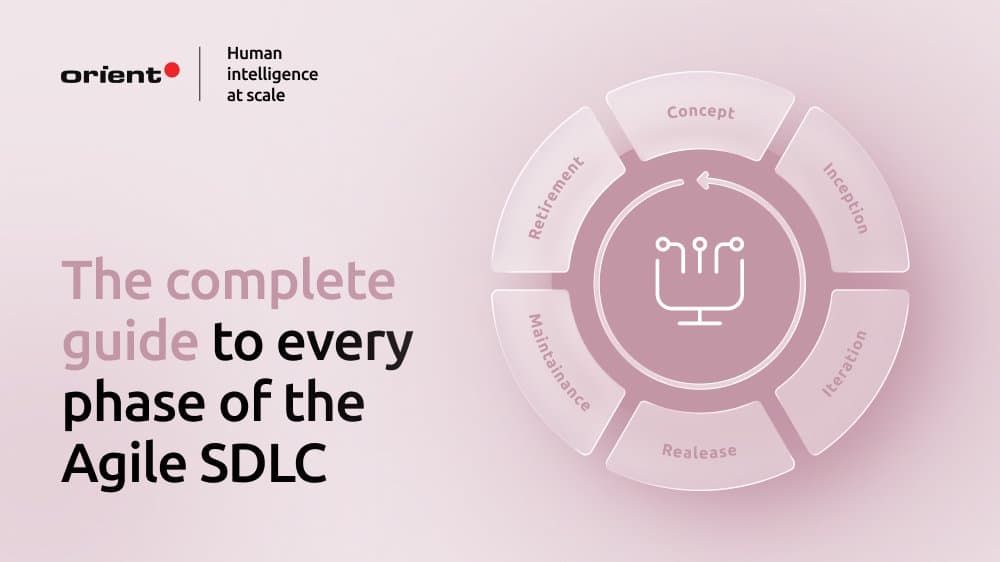
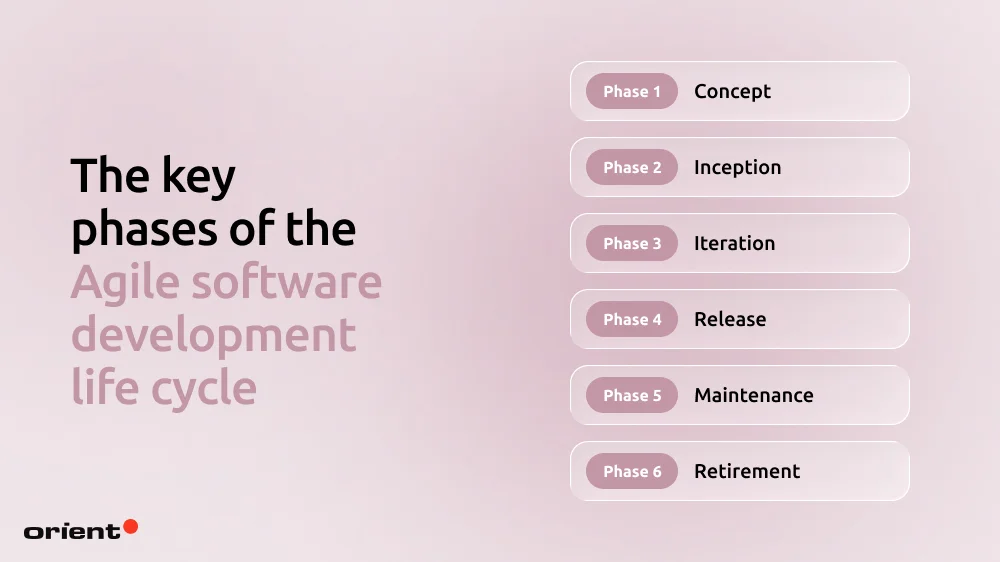
Despite its flexibility, the agile software development lifecycle is not an unstructured development process. It still includes clear stages such as concept, inception, iteration, release, maintenance, and retirement. The distinction lies in the fact that these phases are not pursued in a conventional approach in a strict linear sequence. Rather, they are linked together using continuous feedback loops, which assist the teams in making real-time adjustments and enhancements to the development life cycle.
The key phases of the Agile software development life cycle
Phase 1: Concept
The Concept phase is usually neglected since there is no code or running sprint, but it defines 70% of project success.
The main aim at this stage is not to establish product specifications but to find the right problem to address. One of the pitfalls is to write comprehensive requirements initially. Although this gives an illusion of clarity, it is, in fact, limiting creativity and flexibility.
Agile is more oriented towards high-level goals and success measures. As an example, instead of merely making a declaration such as “build feature X”, the objective should be to “cut the time to onboard a user to two minutes”. The main point here is that the success measures should be quantifiable and directly attributed to the business value. Without this alignment, a team can develop the product well, but they do not deliver any real value.
Feasibility assessment in Agile also differs from traditional methods. It is not aimed at proving that everything is possible, but at finding the riskiest assumptions. These assumptions are then given precedence to be validated in the first sprints.
Lastly, the alignment of the stakeholders is not just about the scope agreement. It is the activity of developing a mutual understanding. Agile will not work at all if the stakeholders have opposing visions of the product, despite how well the process is followed.
Phase 2: Inception
The Inception phase is a stage where Agile changes mindset into action. Here, it is not detailed planning but rather putting a foundation that enables the team to learn fast.
Creating an Agile team is not only a matter of giving roles. A good team should be cross-functional; literally, it should be able to provide a complete increment without depending on the external departments. One of the most important, yet neglected, aspects is that the speed of learning is directly influenced by the team structure. Teams based on particular functions form bottlenecks, which slow down the crucial feedback loop.
User stories are not just simplified requirements. They are tools used to maintain a constant focus on user value. A well-written story describes more than just a feature; it captures the underlying reason why that feature needs to exist.
Acceptance criteria serve as a formal agreement between business and engineering. If these criteria are vague, a sprint can fail even if the code itself is complete. Similarly, estimating effort is not about predicting an exact completion date. Instead, it establishes a baseline for the team to improve its forecasting over time. In this context, velocity is a learning tool rather than a KPI.
Phase 3: Iteration
Agile is all about iteration. However, viewing sprint cycles merely as fixed timeframes of one to four weeks is insufficient. A sprint is actually a system for testing assumptions.
Within each sprint, the team is doing more than building features. They are trying a hypothesis: the opinion that a particular feature will raise retention by 10%. A sprint lacks a proper hypothesis, making it nothing but a small-scale waterfall process.
Continuous integration and testing serve a purpose beyond simple quality assurance. They act as mechanisms to reduce the cost of change. When code is integrated continuously, defects are identified early when the cost of fixing them is at its lowest. A critical insight is that the cost of change increases over time without a rapid feedback loop. Agile exists specifically to break this cost curve.
Delivering a working increment at the end of every sprint is not just for a routine demonstration. It is the only true reality check. If the increment is not usable, the team is accumulating technical debt without realizing it. A common issue arises when teams focus on output instead of outcomes. Completing a high number of story points does not automatically equate to creating value. Genuine Agile measures outcomes, not just output.
Phase 4: Release
Release in agile software development is not a rare event. It is a fundamental part of a continuous flow within the agile process.
Final testing and quality assurance should not be done at the very end of the software development life cycle. If this happens, the development team is reverting to traditional methods. True Agile spreads QA activities throughout all sprints by doing continuous testing.
User acceptance testing is more than a final check. It is a chance to prove market requirements and product suitability on a mini-scale. When user feedback is negative at this point, the problem may be in the early project requirements, but not necessarily in the code itself.
Deployment in Agile increasingly moves toward continuous delivery within the software development process. This approach reduces the risks associated with a large release. A massive release is like committing everything at once, whereas Agile spreads that risk into smaller, manageable increments.
The most valuable learning point is that a release is not the last stage of a software development project. It constitutes the beginning of another iterative development cycle that is propelled by constant feedback.
Phase 5: Maintenance
Maintenance is often viewed simply as the stage for keeping the system running within the software development life cycle. In agile software development, however, this is where real value is optimized.
Fixing bugs involves more than just repairing errors. It acts as a signal of where the system is struggling. A strong development team analyzes patterns to improve the overall development process rather than only addressing individual issues.
Enhancing features based on real usage is one of the biggest advantages of the Agile process. Data from actual users and customer feedback is always more reliable than initial assumptions. Similarly, monitoring software performance is not just about uptime. It helps teams understand the real user experience, since even well-designed features can fail if they perform poorly.
The point is that maintenance is not only an expense in a software development project. It is an essential element of the continuous improvement and continuous product development in the Agile software development life cycle.
Phase 6: Retirement
Retirement is a phase many organizations tend to avoid because it is associated with ending something that once required significant resources. However, no product or feature lasts forever. Proactively designing a retirement strategy is a clear sign of an Agile organization’s maturity.
Sunk cost bias is one of the largest obstacles in making a decision to retire a feature. When a team has put a lot of time and money into it, they will always be willing to retain the feature even in case its value has substantially decreased. Retaining features that are not working makes the system more complex and adds technical debt, which will reduce the rate of development in the future.
Therefore, retirement should not be viewed as a failure but as a value optimization decision. A feature should be retired when it no longer contributes to business goals or when more efficient solutions become available.
The strategy of how to stop is just as important as the decision of when to stop. The process of migrating users to a new system should be well-thought-out. When the transition experience is poor, it may cause users to feel compelled or lost, and they may churn. On the other hand, a successfully carried out migration makes the users realize the worth of the change and embrace it intuitively.
This involves a blend of a number of factors: gradual implementation to minimize risk, continuing to use the old system in a transition period should there be a need, and effective communication about the advantages of the change. Migration is not only a technical job; it is a user experience and trust challenge.
The last step is the final retrospective. This does not constitute a sprint-level review but a high-level overview of the entire product life cycle. It enables the team to generalize what worked well, what failed, and most significantly, derive lessons to be applied to the next projects.
Skipping this step makes an organization lose institutional knowledge and thus is likely to repeat the same mistakes in the subsequent cycle. A grave-end retrospective is a basis to enhance not only the product but also the whole process of working of the team.
In a nutshell, the most important insight of this phase is that ending a product correctly is just as vital as building it. In Agile, value lies not only in creating something new but also in knowing when to stop with purpose.
Agile SDLC vs. traditional SDLC: key differences
Approach to requirements
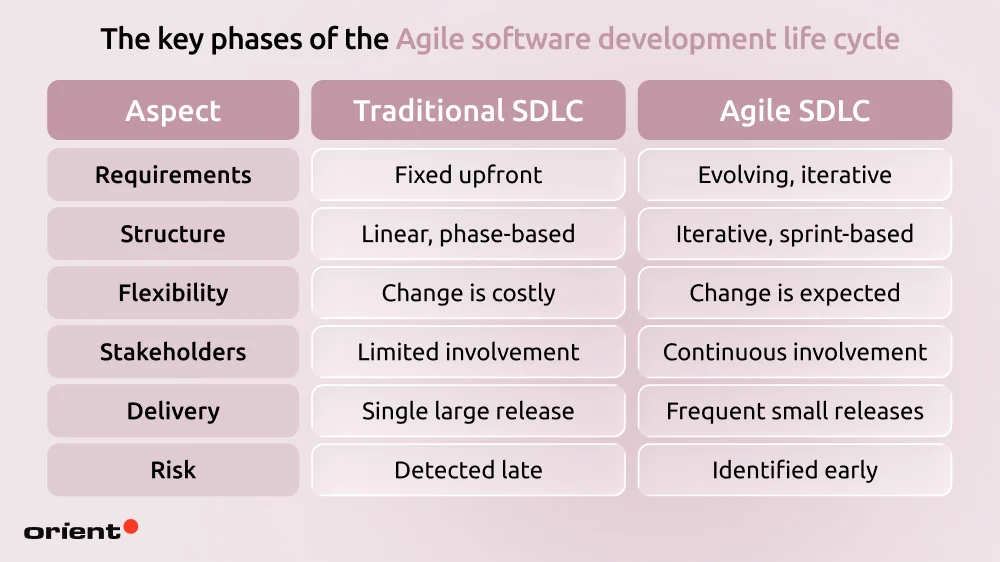
The fundamental dissimilarity between Agile and traditional models starts with the requirements approach. A conventional model would have fixed requirements at the outset, and they are usually described in great detail. This gives one a feeling of control, but it is dependent on an unrealistic assumption since the requirements keep changing according to the market trends and the behavior of the users.
Agile, on the other hand, accepts change as a fact of life. The requirements are not frozen, as they are constantly updated with user stories and backlog refinement. This will help keep the product in line with real needs as opposed to a mere reflection of first assumptions.
Project structure
The traditional SDLC follows a linear model in which one phase has to be completed before the next. This poses a major delay in feedback, where the team is only able to test the product in reality at the later stages of development.
In contrast, Agile uses short iterations to break down the development process. Every sprint is not only a step towards the product but also a learning loop. By reducing this feedback loop, the team can detect problems early and change their course early.
Flexibility and change management
Traditional models tend to be expensive in terms of change since they affect the whole laid-out plan. Such a tendency causes teams to avoid changes even when they are needed.
Agile is geared towards adaptation. Agile makes the cost of change significantly cheaper by subdividing the scope and applying iterations to do work. Change is no longer perceived as a significant threat but is considered a part of the development process.
Stakeholder involvement
Another difference is the stakeholder involvement. In a traditional SDLC, stakeholders are usually only involved during the initial stages to state the requirements and during the final stages to accept the final product. This usually creates a great disparity between expectations and the real outcomes.
Agile combats this challenge by engaging the stakeholders in the whole development process. Stakeholders can also provide continuous input, as the product can be modified at any time based on the input provided by the stakeholder through regular review and feedback processes.
Delivery timeline
The delivery schedule is a clear indication of the philosophy of the two models. Traditional SDLC is optimized to have one large release and a long development cycle. This implies that value is not created until the project is approaching its completion.
Agile, on the other hand, is centered on the many small releases made during iterations. This will enable the product to reach users faster, and also, the team will be able to keep on learning as well as continuously improving according to the real-world response.
Risk management
Agile is at a definite advantage in risk management. Conventional paradigms of risk find it very difficult to detect risks at an early stage when they can be corrected at a very low cost.
Agile and its iterative character and ongoing validation enable the detection of risks at a much earlier stage. Every iteration is considered to be a testing cycle, and it assists the team in minimizing uncertainty in the long run.
One important lesson is that Agile is not only quicker to develop, but it also allows smarter risk management by making continuous learning an integral process.
How Agile SDLC improves project success
Agile enhances the success rates of projects not because it is intrinsically superior, but because it is better suited to the dynamic nature of software development. Agile is not supposed to be designed to cover all the variables at the beginning of the process, but to evolve, learn, and keep on optimizing all the variables of the entire product life cycle.
Delivering working software in a shorter time
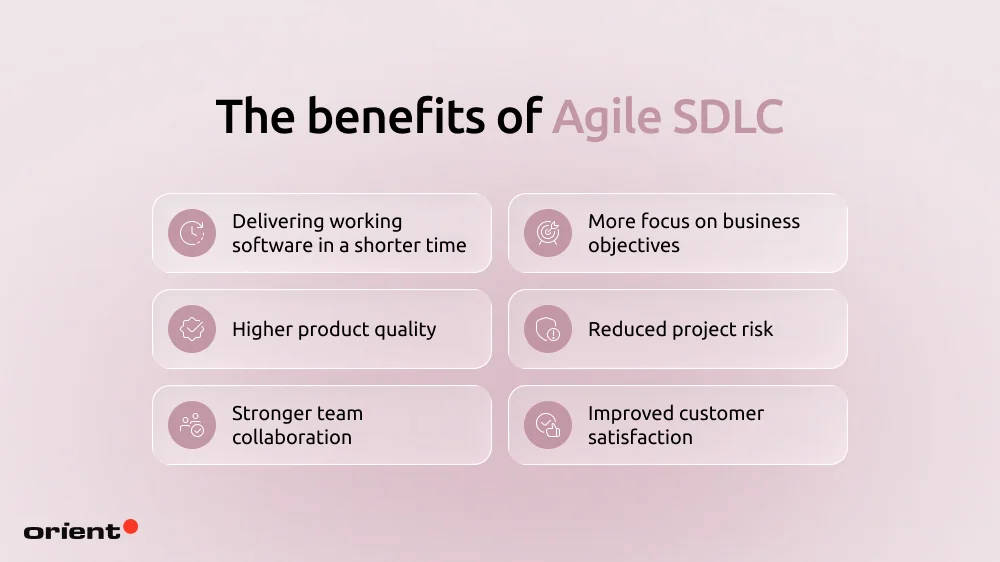
Among the most apparent advantages of Agile, one should mention the possibility of providing the working software within a shorter time frame. But it is not only about going fast but also about delivering the right things faster that matters.
By use of incremental releases, the product is divided into components that can be deployed on a one-on-one basis. This enables the users to be rewarded with value, instead of waiting to get a single massive release. At the same time, the team obtains feedback much earlier, which allows the team to modify the course of development before going too far off the mark.
More focus on business objectives
Agile reduces the distance between business and engineering with constant stakeholder engagement. Stakeholders are also involved in the development process in a regular review and feedback process, rather than being presented at the start and the end of a project.
Subsequently, the team does not merely create the product based on the specifications but makes the product in line with the changing business objectives. The flexibility to change according to real-time feedback enables organizations to respond more quickly to the market, rather than being bogged down by old-fashioned plans.
Higher product quality
Product quality in Agile does not stem from more formal testing, but rather from identifying issues earlier. In short cycles, the testing is done throughout the iteration rather than at the end of the project as the cycles go by.
This method makes sure that bugs are identified and resolved before they grow and become bigger. Early detection not only saves money but also greatly diminishes the chances of affecting the whole system when compared to the discovery of defects at a late stage in a traditional model.
Reduced project risk
Agile neither removes risk but simply decomposes risk into small bits. With a project broken down into short iterations, each sprint is a limited-scope testing unit.
Should a sprint face problems, the team is able to adapt instantly in the following cycle without affecting the whole project. Simultaneously, keeping a transparent track of progress will enable all stakeholders to have a clear picture of the project’s state, and all risks can be identified and mitigated much earlier.
Stronger team collaboration
Agile enhances teamwork by eliminating the old departmental boundaries. Teams no longer work separately by function, but become cross-functional groups responsible for a common goal.
Daily standups and sprint reviews are some of the activities that may establish a constant stream of communication, making everyone aware of what the other is doing and making decisions more quickly. This not only increases the work performance but also the quality of decisions made through the entire development process.
Improved customer satisfaction
The customer satisfaction in Agile is not achieved by collecting more opinions but by being able to react to feedback more quickly. The regular demos and releases allow the users to get hands-on experience of the product and also to contribute to the process of its development.
As a result, features are influenced by real needs and not preconceptions. Not only does the end product perform well technically, but it is also actually solving the correct problems for the user.
Popular Agile frameworks and how they fit into the SDLC
The choice of a framework is not only about selecting a set of rules but rather about the correct manner of structuring a value stream in the context of the peculiarities of a specific project. Here is a detailed look at the most common frameworks:
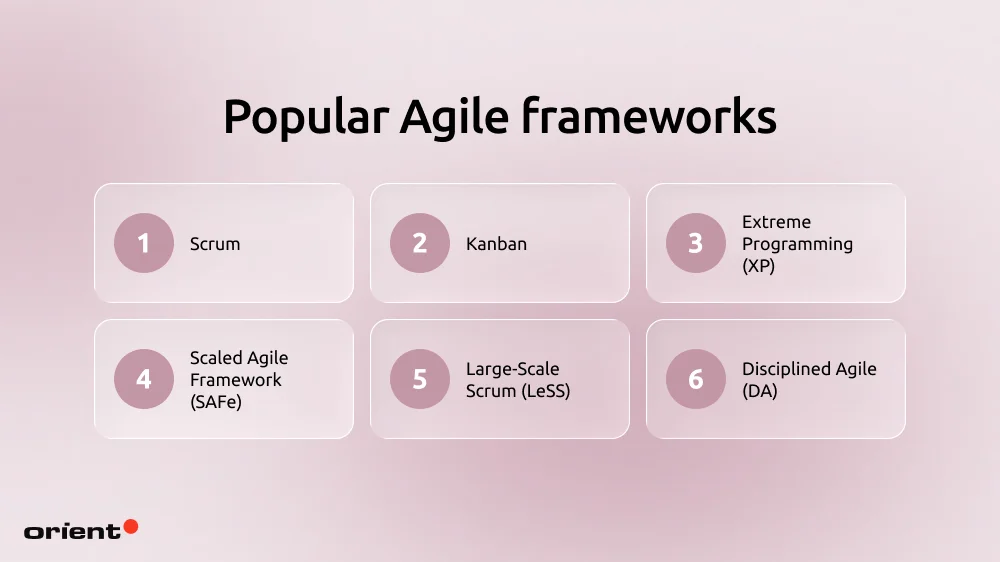
- Scrum: This is the most popular framework, which breaks down the development lifecycle into brief cycles, known as sprints. Every sprint is a mini SDLC, which involves all the planning, testing, and review. Scrum is very good at reducing the time it takes to get feedback, but the most significant danger is that teams may adopt rituals in a mechanical way (doing Scrum) without adopting the underlying flexible mindset.
- Kanban: In contrast to Scrum, Kanban emphasizes the continuous flow of work rather than fixed timeframes. Kanban is used to optimize the throughput and pinpoint the bottlenecks by visualizing the tasks and applying WIP limits (Work in Progress). This renders it a perfect option during maintenance stages or technical assistance.
- Extreme Programming (XP): XP places a great emphasis on engineering practices at the development stage and testing phases. Methods like TDD (Test-Driven Development), pair programming, and continuous integration guarantee high code quality and minimize technical debt. This gives the technical discipline that many Agile teams lack by focusing on speed only.
- Scaled Agile Framework (SAFe): SAFe offers further management layers, such as Program and Portfolio, to coordinate strategy when an organization has dozens of teams working on one product. However, the trade-off is the complexity of the process and the risk of additional bureaucracy.
- Large-Scale Scrum (LeSS): As a leaner version of SAFe, LeSS uses fundamental Scrum principles for a group of several groups. The essence of this is to have one product backlog that keeps the teams focused on one product objective without the need to have too much middle management.
- Disciplined Agile (DA): Unlike a formal process, DA is a toolkit that helps a team select the most effective way of operating in the context of their situation. This requires a certain level of maturity in Agile thinking to make the right decisions.
True value does not come from strictly following a framework but from understanding the project context to choose the right tools. Whether using Scrum, Kanban, or SAFe, these tools only work when guided by a genuine Agile mindset that prioritizes adaptation and practical value over rigid procedures.
Conclusion
Agile SDLC is not a set of procedures to be followed strictly, but a framework that is aimed at making decisions in volatile environments better. Working faster is not necessarily the main benefit of Agile, but the flexibility to change course before costs are prohibitive.
Nevertheless, there is a wide gap between the knowledge of Agile and its adoption in practice. Most organizations implement frameworks without enhancing speed, quality, or collaboration, as they do not have any practical implementation experience or a clear roadmap.
This is where a partner can help shorten the trial-and-error process. Orient Software does more than just provide software development services; they accompany businesses in designing, implementing, and optimizing an Agile SDLC tailored to specific contexts.
This is where one partner can assist in reducing the trial and error. Orient Software not only offers software development services but also helps businesses design, implement, and optimize an Agile SDLC to fit given circumstances.
If you are willing to go beyond merely doing Agile and get Agile working, then it is time to begin. Form a partnership with Orient Software to create a flexible, sustainable, and value-driven development process.