

f you have worked on fintech systems long enough, you have probably noticed that the product lifecycle is not linear.
What looks like a release is usually just the start. Fintech platforms do not move cleanly from development to release and then maintenance, but keep evolving under continuous changes – under scaling demands, integration requirements, and regulatory compliance updates.
For fintech companies, managing this evolution is always one of the biggest challenges. No matter how well-prepared the plans and solutions are, fintech systems rarely behave exactly as expected once they are in production. Sudden spikes in transaction volume start to expose scaling limits. Regulatory changes force updates under tight timelines. Integrations introduce dependencies that are difficult to control. When all processes are delayed because your platform wasn’t designed to handle constant pressure, you’re left behind in the competitive fintech sector.
This is where DevOps comes in – not as a set of tools, but as a way to manage continuous change without introducing unnecessary risks. Instead of looking at the general benefits of DevOps in fintech, this article examines how it supports each stage of your software development life cycle: when building the system, releasing it, running it in production, and adapting it over time.
Why traditional software delivery struggles in fintech
In a rapidly evolving industry like fintech, the stages of software delivery don’t have clear boundaries and often run in parallel with each other. The release doesn’t mean the software delivery is complete. Instead, the process continues and changes due to real-world pressure to keep up with the industry’s fast pace.
However, things are quite the opposite with traditional software delivery. In the traditional process, financial institutions build, release, and then operate the banking app, for example, in separate steps. Each stage has its own function and usually doesn’t overlap. When one stage is complete, the next begins, until they have the final product. While this approach offers a clean flow, it cannot meet the fast pace of the fintech industry because it wasn’t designed to handle this challenge.
To better understand why traditional methods are unsuitable in the financial sector, we need to take a closer look at the nature of the industry.
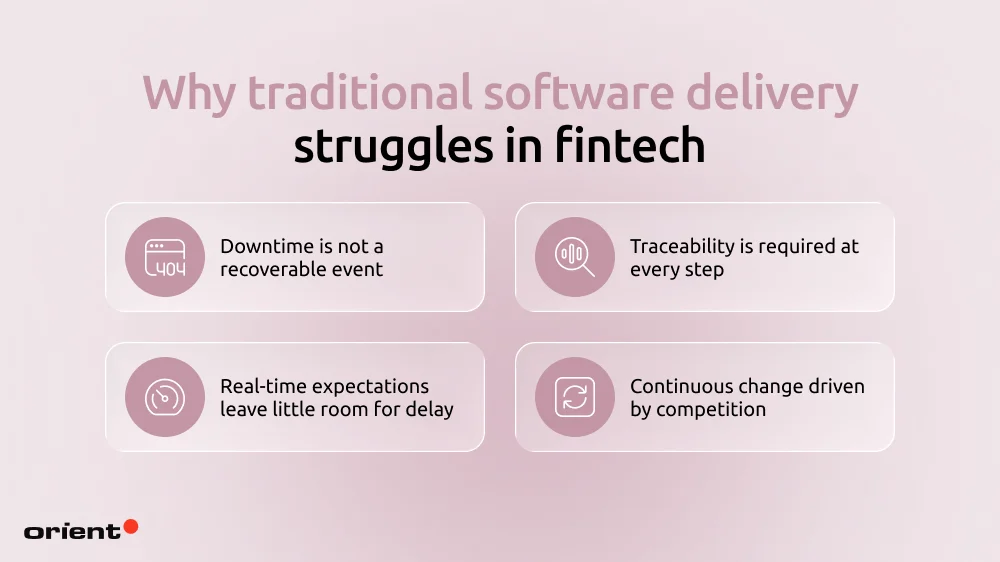
Downtime is not a recoverable event
In many systems, such as internal tools or content sites, downtime is simply a temporary interruption that users can easily resolve by waiting or restarting. While this might be slightly inconvenient, as you could lose some requests, it’s generally acceptable.
However, in fintech applications, downtime is not just a technical issue or “service unavailable”; it’s a business and trust risk. When a customer experiences a payment issue due to your system failures, you, as the provider, cannot simply “undo” the payment since money has already been transferred and transactions processed. In many cases, even short interruptions can block transactions, delay settlements, or create inconsistencies in financial data. Recovery becomes much more complex, where a restart or rollback might be insufficient.
Teams may need to reconcile states, verify transactions, check data integrity, and ensure nothing is lost or duplicated – all manually. Because of this, scheduled downtime and manual deployment become risky and difficult to implement. As a consequence, this pressure leads to requirements that traditional software delivery cannot meet, like:
- zero-downtime deployment
- safe release strategies (gradual rollout)
- strong observability
- data integrity guarantees
- idempotent operations (no duplicate effects)
Traceability is required at every step
Traceability is the ability to answer questions like:
- What changed? (code, config, infrastructure)
- When did it change?
- Who made the change?
- Why was it changed?
- What version is running in production right now?
And in fintech, traceability is required at every step. Because your system is responsible for users’ money and identity, traceability in fintech is considered mandatory and subject to strict regulatory requirements like KYC, AML, PCI‑DSS, and local financial laws.
Every change, from code updates to configuration changes, needs to be tracked and documented. During audits, if you fail to answer the questions asked, the authorities may assume you have violated policy requirements and take appropriate action, including suspending your business. However, untracked changes or a missing audit trail are unavoidable if you continue to follow informal or inconsistent delivery processes.
Real-time expectations leave little room for delay
Users today don’t just expect an application to perform its functions; they expect it to perform reliably in all situations. For financial systems, “good” typically means the ability to process transactions in real time, along with high accuracy and strong data consistency. Unfortunately, this is precisely what traditional software delivery approaches struggle to achieve.
Fintech traffic is unpredictable, so users might suddenly make thousands of transactions per second during salary day, holidays, or market events. At the same time, customers expect real-time services to instantly complete successful transactions; systems with slow feedback cycles, delayed testing, and manual monitoring struggle to handle spikes safely or even simply keep up with this pace. Traditional delivery often assumes that testing happens before release, monitoring is reactive, and responses can take time, causing the process to always be “one step behind”. By the time your teams react to the issue, users are already impacted, and the damage is already done.
Continuous change driven by competition
Fintech products are under constant pressure to evolve, and changes are something that does not happen occasionally but continuously.
Unlike many other domains, financial products operate in a highly competitive environment where new features and faster services can quickly become differentiators. At the same time, fintech industry regulations evolve, market conditions shift, and partners introduce new integration requirements. All these factors make change and adaptation to new conditions essential for retaining users. Change here doesn’t mean changing just one of many, but changing everything within short timeframes – without breaking what is already working.
This is a truly significant challenge for less critical systems following traditional delivery models. As older apps rely on longer planning cycles, manual steps, and clear separation between development and operation, they collapse when changes need to happen continuously.
What is DevOps in fintech?

Most readers already have a vague idea of DevOps, which is often described as a combination of development and operations practices that enable faster and more reliable software delivery.
At its core, DevOps creates a workflow where:
- Code is built and tested automatically
- Deployments happen frequently with minimal risk
- Systems are continuously monitored
- Teams collaborate instead of working in isolated silos
But in fintech, this definition only tells part of the story.
Fintech firms often operate under a different set of expectations, as mentioned above. They are always active, continuously processing transactions, and are expected to maintain high levels of accuracy, consistency, and availability. In other words, unlike other software, fintech systems need to change frequently but cannot afford instability.
In this context, DevOps is not simply about speeding up delivery. Rather, it is about enabling continuous change. DevOps in fintech is a technical approach that integrates software development, IT operations, and automated processes to ensure that financial applications are delivered quickly, securely, and reliably.
By introducing automation, consistency, and visibility into the delivery process, DevOps practices address most challenges found in traditional delivery models. Automation reduces the risk of human error. Standardized environments minimize discrepancies between development and production. Continuous integration ensures that issues are identified early, before they reach live systems.
Today, DevOps often extends into DevSecOps. Since fintech platforms must comply with security and regulatory standards, many teams also adopt DevSecOps, which adds automated security checks into the pipeline. This ensures vulnerabilities are caught early, long before they can impact customers or financial transactions.
Benefits of DevOps in fintech: Where DevOps impacts the fintech lifecycle
The DevOps market size is expected to grow from USD 16.13 billion in 2025 to USD 19.57 billion in 2026 and is forecast to reach USD 51.43 billion by 2031 at 21.33% CAGR over 2026-2031. Over the years, DevOps has been applied as a way to bring more structure into how (fintech) software is built and delivered.
However, people often mention the benefits of DevOps in financial software development in a general way. To better understand how DevOps culture truly transforms and enhances fintech businesses, we need to anchor everything to real situations in the fintech lifecycle.
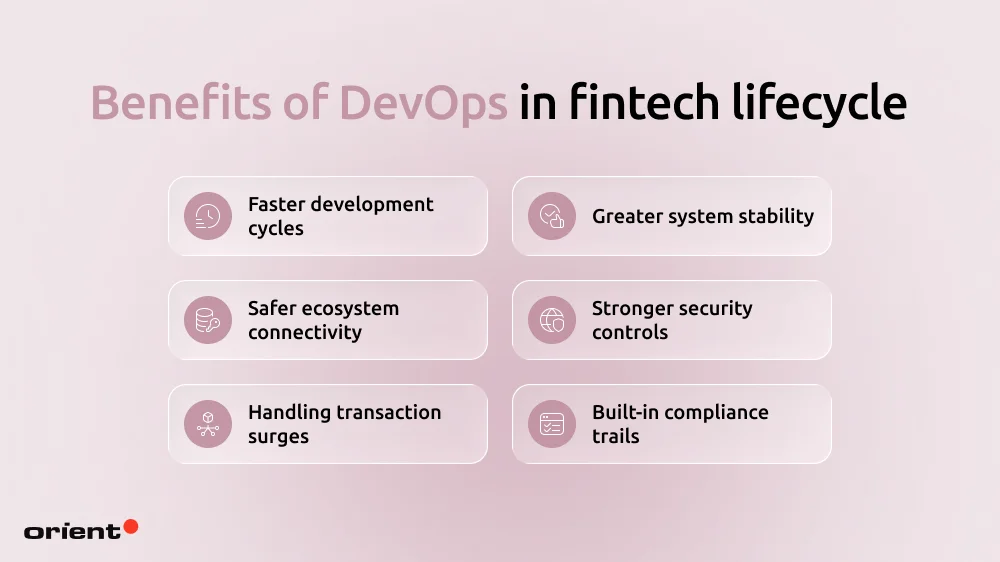
When financial products are built: faster development cycles
In fintech, development doesn’t start from a blank slate. From the beginning, systems are shaped by strict requirements around compliance, security, and reliability. Financial regulations and security measures are not layers added later. Instead, they influence how the system is designed at its core. As a result, complexity is introduced early, long before the product reaches production.
Without a structured approach, deployment processes can be slowed down due to inconsistent environments, manual setup, or integration issues between development teams. Small differences between local, staging, and production environments can also lead to unexpected behavior later.
Implementing DevOps into processes from the beginning shifts this left. With standardized environments (e.g., infrastructure as code), automated builds, and continuous integration, issues are exposed earlier, when they are cheaper to fix. Code is validated early and continuously, reducing rework and making delivery both faster and more predictable. What improves is not just speed, but the reliability of progress.
When transactions are processed: greater system stability
Once the fintech system is live, it continuously processes real transactions. At this stage, changes do not stop. Updates, fixes, and improvements still need to be deployed while the system is running. There is no clear boundary between “running” and “changing” when they literally happen at the same time.
Handling multiple tasks simultaneously means the real risk here is no longer simply deployment failure, but subtle inconsistencies. Even a small issue in a release (e.g., duplicated transactions, partial updates, or state drifting across services) can undeniably negatively impact live user transactions, as there is little room for error and limited ability to pause operations.
The DevOps strategy introduces control into this process. Through controlled release strategies (e.g., rolling deployments, feature flags), automated security testing, and real-time observability, downtime and errors during transactions can be detected and rolled back quickly, and stability becomes something actively maintained, not assumed. This is one of the key factors that helps payments, transfers, and real-time balances run smoothly even under heavy load.
When financial APIs are integrated: safer ecosystem connectivity
Most fintech systems are only as stable as the services they depend on. By relying heavily on external APIs such as banks, payment gateways, and identity providers, there is significant variability beyond the in-house team’s control. External systems can change, fail, or behave unpredictably. They introduce a layer of uncertainty that includes not just failures, but also silent changes in behavior, latency, or data contracts.
DevOps helps manage all of this by creating more controlled and observable integration processes. Instead of treating integrations as fixed connections, DevOps in the world of financial technology treats them as moving parts. With contract testing, sandbox environments, and monitoring of external dependencies, integration points become testable and observable, rather than blind spots in the system. Deployment pipelines also make it easier to update integrations safely without affecting the rest of the system. As a result, DevOps engineers can now validate API behavior and detect failures or performance issues in real time before they spread across the system.
When financial data is handled: stronger security controls
Fintech systems handle a vast volume of sensitive financial data such as account details, transaction records, and personal information. Any weakness in how this data is managed can lead to serious security risks and compliance issues.
However, the difficulty here is that personal data in banking apps, for example, often doesn’t follow a straight line but moves across multiple layers, including application logic, storage, pipelines, and logs, and during development, testing, deployment, and operation. Without consistent controls, it becomes challenging to ensure that data is always protected.
DevOps addresses this by embedding security into the delivery flow itself. Unlike older methods, in which testing and changes are applied at the end of development, DevOps enables fintech organizations to test changes earlier, deploy in smaller increments, and monitor in real time. By applying access control, secret management, and automated checks across environments, fintech companies reduce the risk of human error and ensure that security is maintained even as the system evolves.
When systems must scale: handling transaction surges
In the financial services sector, unpredictable spikes in usage are extremely common, if not widespread. For example, during peak payment periods or large-scale events, transaction traffic can spike sharply, sometimes reaching multiple times the normal volume. These spikes can quickly push the system beyond its expected capacity. And of course, fintech companies don’t always anticipate this.
If the system cannot handle the load, it may slow down, fail to process transactions, or become unavailable. This directly impacts users and can lead to financial and reputational damage.
DevOps changes the approach from reactive to proactive. By enabling systems to adjust dynamically through automated infrastructure, load testing, and continuous monitoring, DevOps helps teams prepare for and respond to changes in load more effectively. Instead of reacting after failures occur, teams can scale systems proactively and maintain performance under pressure.
When regulators ask questions: built-in compliance trails
In fintech, it is not enough for systems to behave correctly. They must be able to explain themselves. Fintech operations, regardless of type, are all required to have proofs, and it is the team’s responsibility to show not only how the system works, but also how it has changed over time.
Without proper tracking, it is difficult to answer questions about past changes, deployments, or system behavior. The audit process becomes time-consuming and error-prone, increasing the compliance risk.
With the help of DevOps tools, traceability is embedded directly in the delivery process. Every change is recorded through version control, build pipelines, and deployment logs. This creates a clear, consistent history of the system, making it easier to provide evidence during audits and reducing the effort required to maintain compliance.
DevOps in practice: the Netwealth case study

Over the past 20 years, Orient Software has supported a wide range of software development initiatives. Among them, Netwealth, a well-established wealth management platform in Australia, stands out as one of the largest engagements, with a dedicated team of more than 120 engineers.
As a leading player in the fintech space, Netwealth faced the same pressure seen across the industry: the need to continuously expand its platform while maintaining stability in a live financial system. This required a way to introduce changes without disrupting existing functionality – a challenge that aligns closely with the role of DevOps.
To address this, Orient Software introduced DevOps automation to bring enhanced security, more structure, and control into the delivery process.
Build and deployment workflows were standardized through automated CI/CD pipelines, removing manual steps and making releases faster and more consistent. Continuous integration ensured that changes were validated early, reducing the risk of defects reaching production.
At the same time, automated monitoring provided real-time visibility into system behavior, allowing teams to detect issues early and respond before they impacted live transactions. Deployment pipelines also created a clear and traceable history of changes, improving both incident response and auditability.
What changed was not just the speed of delivery, but how change was managed. Releases became smaller, more predictable, and easier to roll back when needed, reducing the risk of disruption in a live environment.
This reflects a broader pattern in fintech: the challenge is not simply moving faster, but managing continuous change without compromising system stability. DevOps provides the structure that makes this possible.