
The insurance sector is changing fast due to evolving customer demands, the increasing level of competition, and the increasing constraints of legacy technology. Previously utilized systems are slowing down carriers now, establishing data silos, making innovation hard, and making it difficult to provide the smooth digital experience policyholders seek. Modernization is not only a plus but a necessity among the insurers striving to remain afloat in a fast-paced market.
Fortunately, the modern world of technology provides effective solutions. Cloud-based systems, integrations based on APIs, automation, AI, and modern data structures provide insurers with the resources to simplify operations, enhance security, and open new business opportunities. However, it takes more than just technology. Effective change must be done with the correct expertise, the correct strategy, and the correct development partner who is knowledgeable of the intricacies of the insurance business and capable of steering the carriers through the modernization process with confidence.
This article discusses the issue of the burden caused by legacy systems, the benefits of insurance software development, and the competitive advantages of the development of custom solutions. It further describes what insurers need to seek in a development partner so that their modernization process is smooth, secure, and aligned with strategy. To carriers willing to develop, this guide offers a definite point of departure in constructing the future of insurance.
What are legacy systems in insurance?
Legacy systems within the insurance industry refer to the outdated technological platforms that are still operational in powering the main business operations, although they are multiple generations out of date with the current software standards. Legacy insurance systems are sometimes decades-old technology platforms, still being used to support the basic business processes like policy administration, claims processing, billing, and customer data management.
Many of these systems were constructed on COBOL mainframes, early-generation Policy Administration Systems (PAS), or siloed databases that had never been intended to be connected with the current digital tools. They are likely to be highly customized, tightly coupled, and hard to modify, rendering them indispensable and problematic simultaneously. These systems are the foundation of the day-to-day business of most insurers, despite the technology having existed before the internet age.
The logical question is: if these systems are such a burden, why do insurers still rely on them? The reason why insurers remain stuck with legacy systems is that they are tightly coupled with business processes and have long been reliable. Millions of policies and claims have been processed consistently on these platforms, and the replacement might seem risky, costly, and disruptive.
Resource constraints are also a challenge to many insurers: institutional knowledge to modernize or migrate systems is constrained, and the cost of an all-out transformation can be high. Due to this, organizations tend to repair and update old systems instead of replacing them, particularly when they are still doing the essential tasks that the organizations require.
The biggest problems caused by legacy insurance systems
Legacy insurance systems create a wide range of operational, financial, and strategic challenges that directly impact an insurer’s ability to compete in a digital‑first market.
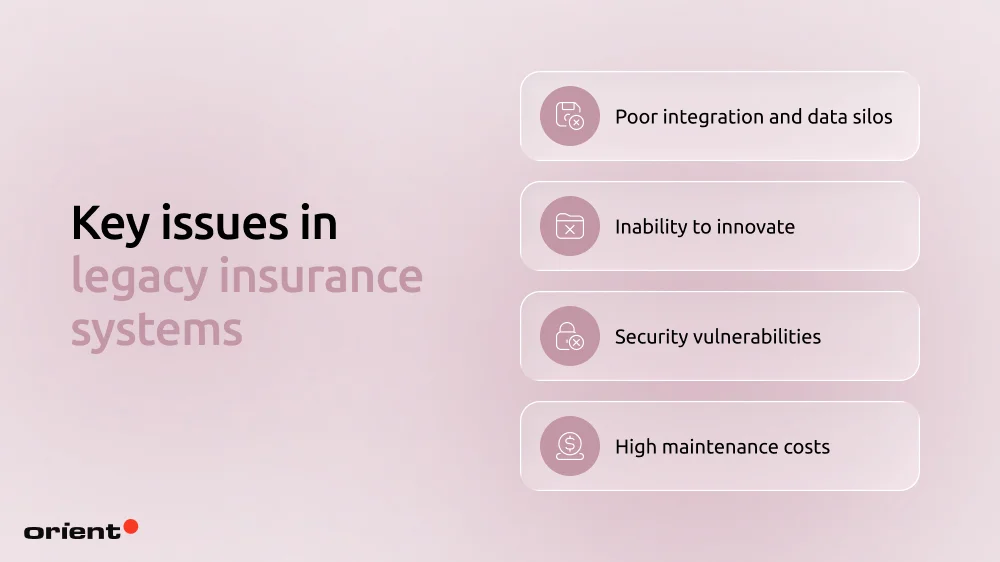
Poor integration and data silos
Legacy platforms were developed a long time before the current interconnected digital ecosystem and, as such, are not often compatible with other systems. This usually leaves the insurers with disjointed customer records that are stored in various policy, claims, billing, and document depositories. This fragmentation complicates the creation of a unified customer view and slows down underwriting decisions, claims management, and customer interaction.
These legacy systems also have trouble integrating with new APIs or third-party data sources, including telematics providers, credit bureaus, fraud-detection services, or digital distribution partners. Devoid of seamless integration, insurers would lose opportunities to gain real-time insights and automation that their competitors are enjoying. The absence of interoperability is then a significant obstacle to the digital transformation.
High maintenance costs
It is costly to keep obsolete technology up-to-date, sometimes much costlier than insurers think it will be. Old hardware and programming languages need special support in the legacy system, which can be expensive to support and difficult to replace in the event of failure. A lot of insurers are just maintaining these systems and thus do not have a lot of IT budgets to innovate.
The other emerging issue is the decreasing number of skilled developers who are familiar with legacy languages such as COBOL. With the retirement of these professionals, insurers have to contend with rising labor expenses and a growing risk in operations. Even minor changes in the system may require months, since the skills that are required to change the code are limited and costly.
Security vulnerabilities
The older systems could not be used to combat the contemporary cyber threats. They tend to rely on outdated security measures, lack encryption standards, or cannot implement current authentication. This increases their vulnerability to breaches, ransomware attacks, and unauthorized access.
Moreover, legacy systems may introduce compliance risks, particularly with a changing regulatory requirement. When systems cannot be easily updated or monitored, maintaining audit trails, ensuring data privacy, and meeting reporting standards will be more difficult. In the long term, such weaknesses may cost insurers monetary fines, their reputations, and loss of operations.
Inability to innovate
Perhaps the most strategic disadvantage of the legacy systems is their influence on innovation. The inflexibility and slowness of transitioning to these platforms mean that insurers find it difficult to launch new products fast; frequently, it takes months, maybe years, to launch new products. Such a lag disadvantages them in a market where customer demands and competition are changing fast.
The ability to implement new insurance models, including usage-based insurance (UBI), embedded insurance partnerships, or AI-based underwriting, is also hard with legacy systems. These models are based on real-time data, customized product design, and sophisticated analytics functions that cannot be provided by the outdated systems. This means that the insurers are at risk of being left behind by competitors who are more flexible and can easily adjust to new trends.
How modern insurance software development solutions fix these issues
The limitations of the legacy systems are directly tackled in modern insurance software development, which adopts adaptable, scalable, and intelligent technologies. Such innovations not only remove traditional operational bottlenecks but also help insurers to innovate at a more rapid pace and provide customers with better experiences.
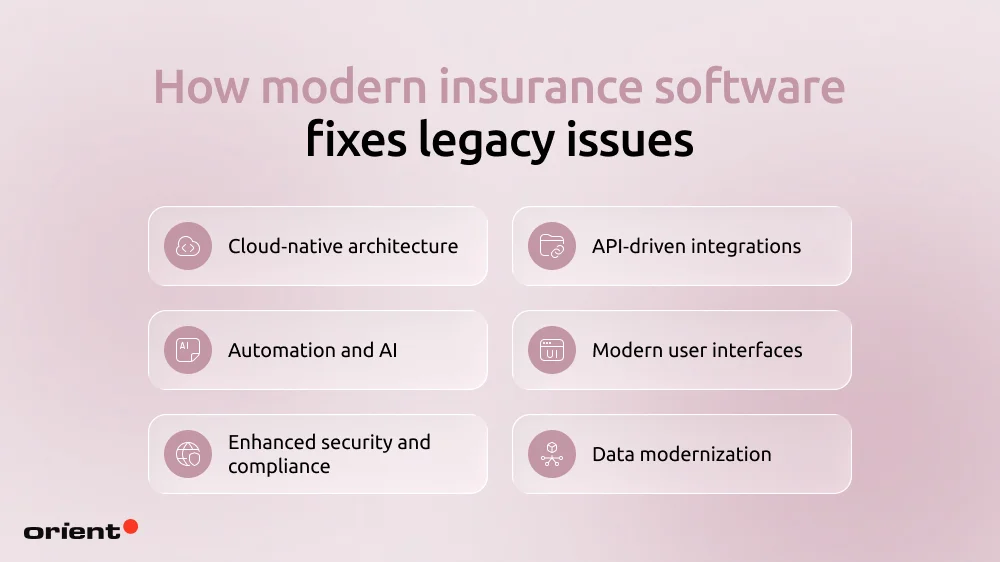
Cloud‑native architecture
Cloud-native platforms are revolutionizing the way insurers are implementing and operating their core systems. Through distributed cloud infrastructure, insurers can enjoy on-demand scalability, which means that they can manage peak workloads, e.g., catastrophe events or seasonal renewals, and still maintain their performance without deterioration. This responsiveness allows elasticity in the systems that are still responsive during high demand.
The cloud environments also minimize the use of costly on-premise hardware, thereby minimizing the cost of infrastructure. Rather than having aging servers and data centers, insurers only pay as they utilize them. This change liberates IT budgets to strategic projects instead of maintenance.
The other significant benefit is reduced deployment cycles. Cloud-native systems can facilitate continuous integration and continuous delivery (CI/CD), which allows insurers to implement updates, new functionality, and product improvements in days, not months. This flexibility is necessary to be competitive in a fast-changing market.
API‑driven integrations
Connection between modern insurance platforms is made easy and efficient with API-first architecture. APIs enable insurers to be easily integrated with CRMs, billing software, document management tools, and third-party data providers. This removes data silos that were formed by the old systems and provides a single, end-to-end workflow.
Using APIs, insurers will be able to facilitate real-time information exchange and retrieve data on telematics devices, IoT sensors, credit bureaus, or fraud-detection services immediately. This connectivity in real time improves the accuracy of underwriting, increases the speed of claims decision-making, and improves customer interaction on digital platforms.
The ecosystems based on APIs are also more convenient in terms of cooperation with insurtech partners and distribution platforms, embedded insurance providers, which are also new sources of revenue and new business models that cannot be facilitated by the legacy systems.
Automation and AI
The use of automation and artificial intelligence is reshaping the insurance processes by substituting manual and repetitive workflows with smart ones. The current systems can be used to process claims automatically, in which data extraction, validation, and decision rules are executed automatically. This saves days to minutes of processing and enhances accuracy.
AI also improves underwriting with insurance AI-driven risk assessment, powered by machine learning models to process large amounts of data, driving more accurate pricing and quicker quote generation. These features enable insurers to provide customized products and to act swiftly to market changes.
Fraud detection is also supported by advanced analytics and pattern recognition, and it detects suspicious claims or anomalies in real time. This minimizes the financial loss and enhances compliance activities.
Modern user interfaces
The transition to intuitive and user-friendly interfaces is one of the most obvious advances in modern insurance platforms. Agents enjoy having simple dashboards that are used to hold policy, claims, billing, and customer information in one place. This saves time on using various systems and enables teams to make decisions more quickly and more informed.
To customers, the modern systems allow self-service portals where they can manage their policies, make claims, change their personal information, and check the status of their claims without calling an agent. This not only enhances customer satisfaction but also minimizes workload for insurers.
Also, today’s platforms are designed to have mobile-first experiences, which allow agents and policyholders to get the services at any time and place. It can be a field adjuster taking pictures in the field or a customer looking at their coverage on the smartphone; mobile access has become an essential requirement, and the new software can provide it flawlessly.
Enhanced security and compliance
One of the premises of contemporary insurance technology is security. New platforms have modern encryption standards, multi-factor authentication, and access controls that legacy systems may not have, and in many cases, these systems use newer protocols that are not based on obsolete ones. These steps greatly decrease the chances of unauthorized access and breaches of data.
It is also more easily managed in compliance. New systems also have in-built regulatory updates, which help insurers to remain up to date with the changing needs, like data privacy laws, solvency laws, and reporting regulations. Auto compliance and audit trails help save manual processes and prevent insurers from paying high fines.
Modern software is a more secure and resilient operational environment because it combines proactive security features with automated compliance capabilities.
Data modernization
One of the most radical features of modern insurance software is data modernization. Rather than using fragmented and siloed databases, insurers can bring together information in centralized data lakes. This single data platform underpins more coherent and clean information in underwriting, claims, customer service, and analytics.
Centralized data comes with the capability to conduct real-time analytics, which allows the insurers to track trends, identify anomalies, and make quick decisions. Real-time insights provide insurers with a competitive advantage, whether seeking to determine emerging risks or to improve pricing strategies.
Predictive modeling is also enabled on modern platforms, where machine learning is used to predict the likelihood of claims, customer churn, and risk of fraud, among others. These predictive functionalities enable insurers to move beyond reactive business approaches to proactive, data-intensive approaches to enhance profitability and customer results.
Key competitive advantages of custom insurance software
Custom insurance software development provides carriers with a strategic advantage by matching technology to their business model, operational processes, and future growth strategies. Unlike off-the-shelf platforms, which compel insurers to be accommodating to generic features, custom solutions are constructed to correspond with the unique processes of the carrier, leading to increased efficiency, quicker innovation, and connectivity of an ecosystem.
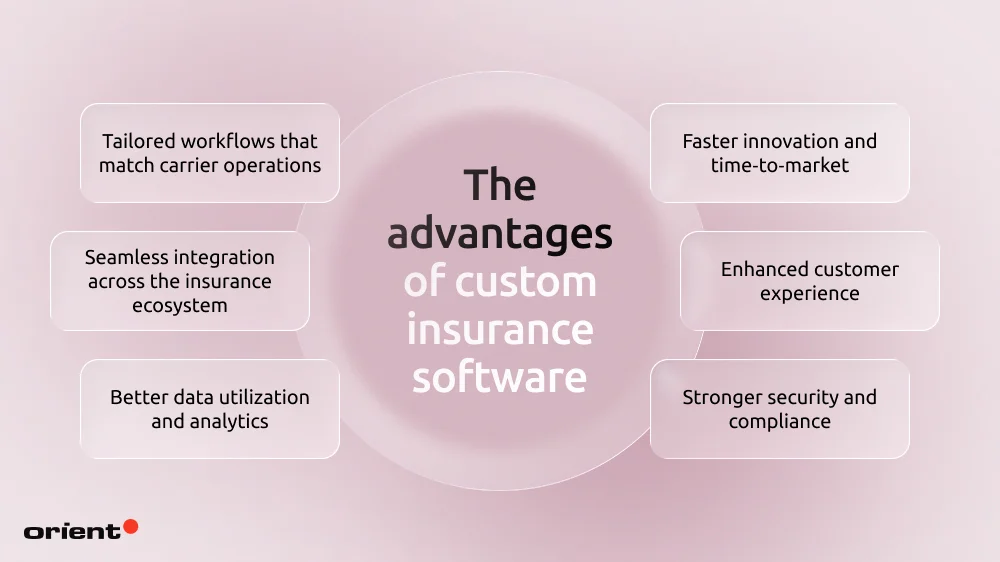
Tailored workflows that match carrier operations
The possibility of creating workflows that accurately reflect the functioning of a carrier is one of the strongest benefits of custom insurance software. Rather than adapting processes to meet the system of a vendor, insurers can develop technology that advantages their underwriting philosophy, claims strategy, and compliance needs.
Custom platforms enable insurers to implement proprietary underwriting rules based on proprietary scoring models, niche risk sets, or specialized product lines. This makes the underwriting decisions consistent, accurate, and in line with the risk appetite of the carrier.
Personalized claims processes are also beneficial to claims operations. Steps that carriers can automate include document intake, fraud checks, assigning adjusters, and communication workflows specific to their service standards and regulatory environment. This results in increased cycle time and improved customer experiences.
Custom systems can also include automated compliance processes to make sure regulation checks, audit trails, and reporting needs are directly integrated into day-to-day processes. This saves time and effort as well as lowers the chances of compliance lapses.
Faster innovation and time‑to‑market
Custom software development is an extremely quick way to make a career more innovative. Since the platform is owned and operated entirely by the insurer, new products can be launched on the platform without the need to wait until the vendor issues a roadmap or generic feature releases. This flexibility is essential in a market where customer expectations and competition are changing at a high rate.
Carriers may also rapidly iterate on new coverages, new pricing models, or new distribution strategies and roll out updates on a short cycle. Such autonomy of vendor ties enables insurers to adapt to the new developments, like embedded insurance, usage-based models, or parametric products, at their own speed.
The outcome is a reduced time-to-market, increased experimentation, and competitive position.
Seamless integration across the insurance ecosystem
Modern insurance processes are based on a complicated web of systems and data sources. Custom software allows a smooth connection of this ecosystem, allowing the flow of data and harmonized work.
Carriers can take their own platform and combine it with the core systems, including PAS, CRM, billing, and document management tools, and eradicate silos and enhance operational visibility. This integrated architecture enables quicker decision-making and productive work processes.
Custom insurance software solutions also provide easy connectivity with third-party data providers, such as telematics services, credit scoring services, catastrophe modeling tools, and risk-data aggregators. Real-time access to third-party information increases the accuracy of underwriting, fraud checking, and customer customization.
Lastly, tailored software is important in the modernization of legacy systems. Rather than replacing everything immediately, insurers can develop modern components that will be compatible with existing systems, where the old technology will be gradually phased out. This will mitigate risks, costs, and disruption and allow a seamless migration to a modern digital ecosystem.
Enhanced customer experience
Custom software development for insurance enables insurers to create digital experiences that are actually relevant to their customers. Self-service portals provide policyholders with the capability to operate policies, claim, upload documents, and monitor the claim progress without calling call centers. This minimizes friction and gives power to customers to access key services 24/7.
The insurers will be able to provide personalized policy advice that is based on the behavior of the customers, risk profile, and life events. Personalized product recommendations will not only enhance customer satisfaction but also contribute to cross-selling and upselling.
There is also support for faster claims resolution by custom systems due to automated workflow, real-time data validation, and simplified communication tools. Quick claims processing has a direct positive impact on customer trust and loyalty, which are two key differentiators in a competitive market.
Better data utilization and analytics
One of the most valuable assets available to an insurer is data, and tailor-made software will ensure that they can use it to its fullest capacity. Real-time dashboards provide teams with real-time access to essential indicators like claims volume, underwriting performance, customer behavior, and operational bottlenecks.
Predictive analytics of risk assessment are also supported by custom platforms, allowing insurers to predict the probability of a claim, high-risk customers, and price models. The insights assist the carriers in making better decisions and staying profitable in competitive markets.
Another significant benefit is fraud detection. Custom software with built-in machine learning models and anomaly-detection algorithms improves fraud detection, minimizes losses, and boosts the compliance initiative.
Stronger security and compliance
Custom security measures that are specific to the risk profile of insurers can be in place, such as advanced encryption, multi-factor authentication, and role-based access controls.
Specialized systems also enhance compliance with regulatory requirements in certain locations, so workflows, data storage, and reporting comply with the local regulations. This would be particularly useful to carriers whose operations span a number of jurisdictions that have differing regulatory needs.
Lastly, insurers lessen their exposure to vendor vulnerabilities by having the technology stack. They do not rely on third-party release schedules or security patches and have greater autonomy and a lower systemic risk.
How to Choose the Right Insurance Software Development Partner
One of the most strategic choices an insurer can make is to choose an appropriate software development partner. Not only must the ideal partner be well-versed in technology, but it must also be aware of the intricacies of the insurance sector, including its rules, processes, data issues, and customer demands. The right partner is like a part of your organization and would assist you in modernizing with confidence and innovating at a quicker pace.
Industry‑specific expertise: Insurance is a very specialized field, and general software development experience is seldom sufficient. A capable partner provides in-depth industry-specific experience, such as experience with underwriting practices, claims processes, policy administration, and regulatory demands. This means that they will be able to develop solutions that match the carrier operations in the real world and not put you into generic workflows. Insurance software development companies also expect pitfalls to be common, like data migration issues or compliance limitations, to save time and reduce risk when implementing the change.
Proven modernization frameworks: It is not easy to modernize legacy systems, and not all development companies have the approach to make it successful. Find partners that have demonstrated modernization frameworks that specify a clear path of assessment, migration, integration, and deployment. These models aid in reducing downtimes, maintaining data integrity, and smoothly migrating old systems to new ones. A partner that has a history of successful modernization projects will steer you through a series of rollouts, hybrid, and long-term transformation plans with confidence.
Security and compliance knowledge: Insurance carriers deal with personal and financial information that is sensitive, and therefore, security and compliance are not a compromise. The appropriate development partner must be highly skilled in security best practices, such as encryption standards, identity management, secure coding, and vulnerability testing. They also need to be aware of the regional and industry-specific compliance needs, including data privacy laws, solvency regulations, and reporting requirements.
Ability to integrate with legacy systems: Most insurers cannot simultaneously replace all legacy systems at once, thus making the integration capabilities necessary. An experienced partner must be knowledgeable in integrating contemporary applications with old PAS, billing, CRM, and mainframe systems. It encompasses working with APIs, middleware, data transformation, and hybrid cloud models. A partner with insight into legacy limitations can assist you in modernizing gradually with lower risk, but achieve immediate benefits by means of better workflows and data availability.
Long‑term support and maintenance capabilities: Insurance software is not a one‑time project; it requires ongoing updates, enhancements, and support. The appropriate partner will have the ability to maintain the product in the long term, such as performance, bug fixes, security, and feature improvements. They must be determined to back your platform as the rules change, your customers change, and other technologies are introduced.
Conclusion

Insurance technology modernization is not only a technical upgrade but also a strategic move since it dictates the ability of a carrier to compete, innovate, and serve its customers in the coming years. As discussed in the previous section, selecting the appropriate insurance software development services is crucial in successfully navigating this transformation. A team that has comprehensive industry understanding, demonstrated modernization models, solid security understanding, flawless integration capacity, and long-term commitment is needed.
This is exactly where Orient Software comes in as the best partner. Having vast experience in insurance technology, Orient Software possesses an unusual mixture of technical perfection and understanding of the domain. Our teams understand how to upgrade the old system without affecting the normal functioning, how to create secure and compliant systems specific to regional requirements, and how to create a custom workflow that will support the particular way each carrier does business. In addition to development, Orient Software offers continuous development and constant upkeep, making sure your systems evolve alongside your business and the broader insurance landscape.
To carriers willing to embark on or speed up your modernization process, engaging with Orient Software provides a clear direction. By having the right expertise, the right structures, and the right long-term thinking, Orient Software will assist the insurers to create future-ready systems that will boost your efficiency, improve customer experiences, and create more growth opportunities.