
Vibe coding is a term used to describe the process of interacting with an LLM, such as ChatGPT, in order to generate code that you can use to build a software application. By eliminating the need to manually write code from scratch or import third-party libraries and frameworks, even non-experienced developers can build, test, and deploy functional software.
While the promise of vibe coding offers numerous advantages, such as increased productivity and efficiency, reduced operating costs, and faster acceleration to market, the practice also risks introducing issues and vulnerabilities that could compromise security, performance, compliance, and user satisfaction. The result is code that is technically functional on its own but otherwise useless when deployed in a real-world setting.
In this article, we’ll discuss the business-level risks of vibe coding, what these risks mean for your business, and how alternative measures like spec-driven development can help you vibe code more safely and efficiently.
Key takeaways:
- Vibe coding is the practice of using an LLM to generate partial or entire sections of code in order to produce a functional software application.
- By eliminating the need to code manually from scratch, vibe coding makes software development more accessible to non-experts.
- Spec-driven development helps reduce and even eliminate the risks of vibe coding by giving greater context behind the instructions given to an LLM.
From developer trend to business decision
Since the term vibe coding was coined by computer scientist Andrej Karpathy in 2025, the practice has quickly grown from a mere curiosity to a major cultural shift, one that is changing how development teams build, deploy, and maintain their software. From start-ups and solopreneurs to global enterprises, organizations of all types and sizes are incorporating AI-generated code into their products and services.

For example, a quarter of the current Y Combinator startups use 95% of AI-generated code to build their products, according to CEO Garry Tan. This means that startups, which are often the most budget-conscious, no longer need to hire a large team of developers to bring their ideas to life. And they don’t have to raise as much capital, making it easier to pitch to potential investors.
Forecasts predict an increasing adoption of vibe coding techniques. By 2028, 40% of new enterprise production software will be created with vibe coding techniques and tools, according to Gartner. This means that companies that adopt vibe coding techniques – or clients that outsource their software development needs to teams that vibe code – sooner could gain a major competitive advantage over their peers.
That said, the same excitement and curiosity that comes with vibe coding also poses a number of serious risks, particularly in the form of security vulnerabilities. Here are five business risks of vibe coding to be aware of before you incorporate the practice into your workflows.
Risk 1: Security vulnerabilities
AI models have the potential to introduce a wide variety of security vulnerabilities. These vulnerabilities may appear in the form of broken authentication measures, incorrect token distribution, and unsanitized inputs. Such vulnerabilities increase the risk of your business being exposed to fines and penalties, reputation damage, lost investment opportunities, and reduced user loyalty.
Security vulnerabilities are more likely to be introduced when AI-generated code is pushed into production at a rapid scale and pace with minimal human oversight.

Why AI does not generate secure code
AI tools generate insecure code for a number of reasons. One of the major reasons is that the training data – the data that the AI is learning from in order to produce its outputs – may reference instances of code that are flawed.
AI code generation may not comply with a company’s internal coding practices, producing code that is consistent with the rest of the development team’s coding style. The code line may also feature security protocols and measures from outdated software applications, meaning that threat actors will have an easier time breaching the software.
Furthermore, it may import code from third-party libraries and frameworks that contain unresolved security vulnerabilities and compatibility issues, which will make the code incompatible with a full-scale production environment.
Five vulnerability classes most likely to reach production
Below are the most critical vulnerabilities to watch out for. They are in order of most severe to least severe.
- Unsanitized input: Allows users to perform actions that directly or indirectly expose the software application to harm. Input sanitation cleans and filters harmful data before it reaches your server, database, and browser inputs.
- Broken access control: When an authorization system fails to correctly determine who can and who cannot access a system, it allows threat actors to access, modify, and steal sensitive data within personal, business, and enterprise accounts.
- Insecure data handling: When sensitive data, such as personally identifiable information (PII), tokens, and login information, is transmitted between and stored in systems without proper encryption measures.
- Hardcoded credentials: When raw login details, such as passwords, usernames, and SSH keys, are embedded directly into the software’s source code, leaving it prone to malicious modification and theft especially when software versions are shared between developers, including Industrial Control Systems (ICS’s) and Internet of Things (IoT) environments.
- Vulnerable dependencies: When AI-generated code features third-party libraries and frameworks without verifying the quality of the security measures present in them.
What the evidence shows
Research shows that AI-generated code is prone to producing more bugs and errors than human-written code. A December 2025 report from CodeRabbit analyzed 470 open-source GitHub pull requests. AI-generated code produced 1.7 times more issues than human-written code, along with 2.74 times more security vulnerabilities and 75% more logic and correctness issues.
AI-generated code produced through vibe coding techniques poses real-world risks, too. The vibe coding platform Loveable, valued at $6.6 billion with over 8 million users, was hacked and its sensitive information stolen in early 2026. The cause of the hack was due to a Broken Object Level Authorization (BOLA) flaw, which was flagged on March 3rd, 2026, but ignored by the company for 48 days before it took action.
The regulatory multiplier: When security failures become legal events
For businesses that operate in industries that handle high volumes of sensitive user information, such as finance, healthcare, and government, the risk of deploying AI-generated code is enormous. Such businesses must comply with regional data privacy and protection laws, including the GDPR in Europe and HIPAA in the United States. Security flaws in these industries pose significant financial and reputation risks – far beyond those of most other industries.
When operating in these high-risk industries, it’s important to consider the pros and cons of working with AI-generated code. It’s also important to partner with the right software development team, one that can deploy AI-generated code safely, efficiently, and in compliance with client guidelines and regulations.
Risk 2: Technical debt
Technical debt is when a software development team intentionally pushes rushed, low-quality code into production with the sole purpose of prioritizing speed over quality. While most development teams assume a safe level of technical debt in most projects, vibe coding – where rapid, high-volume output is the preferred approach – increases the risk of generating large amounts of technical debt.
As a result, software development teams that vibe code excessively end up spending more time and resources on fixing broken, low-quality code than they would have if they had written the code themselves.

How vibe coding accumulates debt faster
Vibe coding accumulates technical debt faster than human-written code because it prioritizes speed over quality.
Each time a developer pushes AI-generated code into production, they risk introducing code that lacks a contextual, architectural understanding of the environment in which the code will exist. This increases the risk of the code being incompatible and potentially dangerous to use in a real-world setting.
AI-generated code also typically does not come with comments or explanations on how the code was created. This means the onus falls on the development team to figure out the logic behind the code, resulting in a lot of time spent on guesswork.
How the black box codebase is a business continuity risk
A ‘black box codebase’ is a codebase that has been abandoned by its original developer. This usually happens when the developer who produced the code moves on to something else, as opposed to staying on board to maintain the code they created. This makes the resulting code difficult to maintain, as whoever is brought on board to maintain it is responsible for figuring out the logic behind the code.
And, if the original developer used vibe coding to produce the code, and if they left no comments and explanations behind, then the new team member must work backward in order to understand the logic behind the code.
As a result, the time and resources spent on understanding the context behind the AI-generated code can, in theory, be more expensive than having manually-written code with comments and explanations.
Developer skill atrophy: the long-term HR risk
As developers spend more time using AI to generate code, they gradually lose the ability to analyze and problem-solve the code they generate. This means they become less efficient at maintaining the very thing they build. This has direct implications on not just how development teams approach their work, but also on how hiring managers hire, train, and retain new talent.
Risk 3: Accountability gaps and legal exposure
Another problem with having developers use AI to generate code is the inherent legal and accountability implications.
When everyone is vibe coding, generating partial and whole codebases built on training data from multiple data sources, then who exactly owns the code? When something goes wrong with the AI-generated code, who is to blame – the original developer, or the person in charge of maintaining the developer’s code?
Vibe coding risks introducing legal and compliance issues typically not present in human-written code. For example, AI-generated code is often trained on open-source libraries, frameworks, and repositories. Depending on the source, these preset codebases can be difficult to trace back to their original source. Companies that ship products with AI-generated code risk violating IP laws, which may cause financial and reputation damage later on.

IP and licensing risk with no clear legal answer
Below are just some of the many legal implications to consider when deploying AI-generated code into your systems.
Invisible compliance failures that remain hidden until audits
Companies that operate in regulated industries are required to comply with strict data privacy and security laws. These laws influence how these companies must collect, store, and dispose of sensitive data. Failure to do so can result in significant non-compliance fines and penalties. For example, minor GDPR violations may incur a maximum penalty of EUR 10 million or 2% of global annual turnover, whichever is higher.
Risk 4: Operational failures when prototypes become products
It is not uncommon for AI-generated code to pass for a prototype, but fail to perform for a final product.
This is because AI-generated code is often produced on a ‘base case scenario’ basis. It is designed to perform exceptionally well under strict, controlled circumstances. Unfortunately, those circumstances almost never replicate the nuances of a real-world setting, where other variables like third-party compatibility come into play.
For example, a prototype with AI-generated code may not account for users who enter unexpected inputs, increasing the risk of unsanitized inputs. If the same code were to remain in the final product, threat actors may be able to execute XSS and SQL injections (inject malicious scripts into the content), then steal user data, hijack user sessions, and even deface websites.

Product scenarios that AI does not write code for
Below is a list of common business consequences that come with AI code generation in software development. This list ranges from most severe to least severe.
- Network failure handling: When the AI fails to incorporate graceful degradation and retry logic into its codebase. This hinders the software’s ability to maintain limited functionality even when large portions of the software have been rendered inoperative. It also hinders the ability of a microservices architecture to remain reliable and stable.
- Concurrent user load: A sudden influx of new users (beyond the initial user limit of the prototype period) can trigger race conditions, resulting in incorrect or unpredictable results due to multiple processes and threads trying to modify the same data at the same time.
- Adversarial and edge case input: This occurs when the final product, which still contains code used in the prototype stage, is exposed to a real user, one who ends up performing an action that the development team did not anticipate. The result is user and attacker behavior that does not align with what the AI-generated code anticipated.
- Resource exhaustion: AI-generated code is unable to sufficiently optimize memory usage and queries, resulting in slow loading times and frequent crashes. The problem becomes significantly worse as the data volume grows.
- Error observability: AI-generated code fails to correctly perform instrument logging when failures occur, resulting in either non-existent or unusable diagnostic information.
The business cost when scaling hits these limits
When scaling hits its limit for software developed with AI-generated software, the following consequences can occur:
- Unpredictable cloud cost spikes: The sudden increase in user growth can lead to more insufficient queries, significantly increasing ongoing cloud hosting costs.
- Increased outage frequency: Outages are more likely to occur at crucial moments during the product’s deployment, including product launches, promotional campaigns, and periods of high press coverage.
- Emergency architecture costs outweigh original development costs: The cost of fixing problems present in the AI-generated code ends up costing more than using human-written code.
- Loss of customer trust: Customers are less likely to trust a company that deploys software in a broken, dangerous, or unsafe state, especially if such a launch leads to a catastrophic event like a major data breach.
Risk 5: The productivity illusion of vibe coding may cost more than it saves
Many vibe coding advocates point to the productivity-gaining benefits of the practice. However, the results often tell a different story. In reality, vibe coding risks making developers appear to be more productive than they really are.
Developers who vibe code risk being 19% slower than those who do not follow vibe coding practices, according to a 2025 METR study. The same study also found that vibe coders believed that AI helped them be 24% more productive, and even after experiencing a slowdown, they still claimed a 20% productivity boost. Much of this lost time was spent on verifying and correcting inefficiencies and inaccuracies.

Hidden cost stack vibe coding creates downstream
Below is a list, from most severe to least severe, of the hidden risks of the productivity illusion that vibe coding can create.
- Security remediation: AI-generated code requires more rigorous reviewing and correcting than manually-written code.
- Test coverage gaps: AI-generated code does not account for specific test cases and suites, of which these test cases must be written after the fact.
- Debugging unfamiliar logic: In complex systems, developers risk spending more time deciphering AI output than they save generating it. This problem is exacerbated by the fact that AI-generated code usually does not come with comments or documentation.
- Refactoring and architectural cleanup: AI-generated code must often be cleaned up to ensure compatibility with third-party tools and libraries, as well as complex architectural systems.
- Onboarding overhead: The cost of training new talent to understand AI-generated code may be higher than having them maintain manually-written code.
Why teams systematically underestimate these costs
If developers using AI-generated code overestimate their own productivity, then it stands to reason that team leaders may be easily fooled by their own teams’ productivity claims. Therefore, project managers must be rigorous when evaluating their team’s performance, ensuring their claimed productivity actually matches their expected output.
The root cause: Starting from the output, not from the definition
The problem with vibe coding is not that the AI produces bad code. The problem is that the people who use AI come at it from the wrong perspective.
Sure, a developer may submit a written request through a prompt to generate technically functional code. But when they fail to consider all the other aspects that come into using software in a real-world setting, such as performance, security, UX/UI design, and compatibility, they are left with code that only functions in an isolated instance and not in a real enterprise environment.
In a sense, the AI’s output is correct, but its lack of business, technical, and architectural context renders it unusable.

What a specification is, and why it cannot be restructured from code
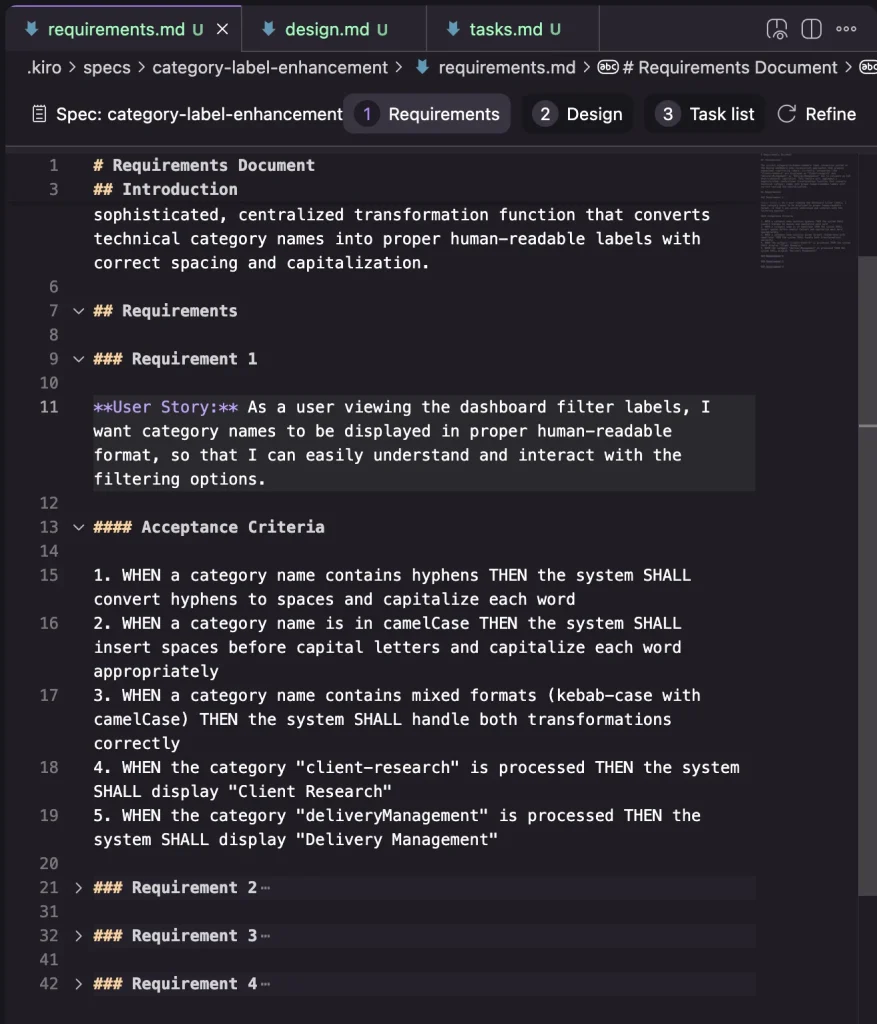
Source: Martin Fowler
A product definition, also known as a product specification, defines what a product must be. It also defines the type of constraints that the product must work with, and the state at which the product is “finished” before any code is written.
A specification cannot be restructured from code. That means the spec can influence the type of code that is produced. But only the spec can capture the business intent, technical requirements, constraints, and acceptance criteria. Therefore, the spec must be preserved as a permanent record.
At Orient Software, we use product specifications to record details like product summaries, business cases, user stories, and personas. These details enable us to accurately define the pain points we’re trying to solve, the challenges we may face along the way, and the audience expectations that we’re aiming to meet and exceed. In doing so, we have an ironclad document, one that we can reference during a project to ensure the final delivery meets your vision.
How to apply spec in a vibe coding workflow
Below is a step-by-step breakdown on how to incorporate spec-driven development into a vibe coding workflow. This involves going deeper than just submitting a vague request for an entire software application or feature. It involves giving the LLM a greater context behind a request, enabling it to deliver an outcome that more accurately meets user needs.
- Write spec before prompting: Before typing a prompt like “Build X …”, spend at least 30 minutes on a spec outlining what X must do, what it must not do, what constraints apply, and what it means to be complete. This turns the process of submitting prompts from guesswork into calculated building steps.
- Add the spec to your prompt, giving the AI context: Make the spec a core aspect of the prompt that you submit to the AI. Since the AI is receiving context beyond the surface-level request, it is more likely to generate code that accounts for architectural context, meaning it’ll more likely perform as expected outside of an isolated best-case scenario.
- Validate output against spec: Instead of guessing whether the output meets the desired expectations, go deeper. Ask, “Does this meet all the spec requirements?”
- Preserve the spec as a living document: Keep the document secure and easily accessible to those who may need it in the future, such as new developers (who did not generate the original code) who may be brought on to maintain and improve the code. They can then refer to the spec as a means to preserve the code’s original intent and functionality, while enabling them to scale in meaningful ways.
How spec-driven development directly resolves each business risk
Below is a useful table that you can reference to understand how spec-driven development directly solves unique business risks.
| Business Risk | How SSD Resolves It |
|---|---|
| Security vulnerabilities | Security requirements are specified before generation – not discovered after. |
| Technical debt | Architecture is planned before code is written – not patched in after. |
| Accountability gaps | Every decision traces to a named, reviewable specification. |
| Operational failures | Edge cases and failure modes specified AI generates for them explicitly. |
| Productivity illusion | “Done” has a verifiable definition, scope creep and rework are bounded. |
The main takeaway from this table is simple: SSD intervenes before generation, focusing on the only point where root cause correction is possible.
Conclusion: From vibe coding risks to business success
Vibe coding is an emerging practice that is influencing how companies build, test, deploy, and manage their software. While the practice offers numerous benefits, such as increased productivity and accelerated time to market, it also carries potential security, compatibility, and non-compliance risks. Partnering with the right software development team is crucial to reaping the benefits of vibe coding without falling for its inherent risks.

At Orient Software, our software development practices keep up with the latest trends. We work with utmost professionalism and dedication, ensuring our approach is not just up to date with modern standards but also grounded in evidence. We are honest and upfront about our workflows, giving you the assurance that you know exactly what goes into building, testing, deploying, and maintaining your software.
Contact us today. Learn more about how our software development services can give your business a competitive edge.