Are you facing these common enterprise digital transformation challenges?
Most organizations capture less than a third of the value they initially expected from digital transformation. The technology usually isn’t the problem. What tends to go wrong, and what can realistically be done about it, is what this article gets into.
Content Map
More chaptersDespite years of digital investment, many organizations still haven’t managed to move beyond experimentation into anything that actually changes how they operate. New platforms get deployed, data initiatives get launched, AI pilots get greenlit, and yet the business impact rarely shows up at the scale anyone projected. Digital transformation efforts stall well short of where they were supposed to land. According to research from McKinsey, 70% of digital transformations fail to achieve their stated goals, while Gartner reports that 85% of digital strategies fall short because of poor execution and weak organizational alignment. The standard explanation is that digital transformation is hard. That’s true, but it doesn’t tell you much. Difficulty is a symptom, not the root problem.
What’s more useful to understand is that the enterprise digital transformation challenges organizations run into don’t exist in isolation. Cultural resistance, legacy systems, fragmented data, cybersecurity complexity, skill gaps, these tend to get assigned to separate teams with separate mandates. But in practice, they push and pull against each other. A gain in one area gets quietly undermined by a weakness somewhere else, and digital transformation initiatives that don’t account for that dynamic tend to generate new problems about as fast as they clear old ones.
This article goes further than listing the most common digital transformation challenges. It looks at how these challenges feed into one another, why so many conventional responses fail to produce anything lasting, and what a more sequenced approach to the digital transformation journey actually looks like for organizations trying to get somewhere real.
Why do enterprises fail in digital transformation?
The digital transformation process will vary depending on the size of the organization, its industry, and the level of modernization it has already achieved. But beneath those differences, the challenges that stall initiatives tend to be fairly consistent. The following are the most common and potentially most damaging challenges if left unaddressed.
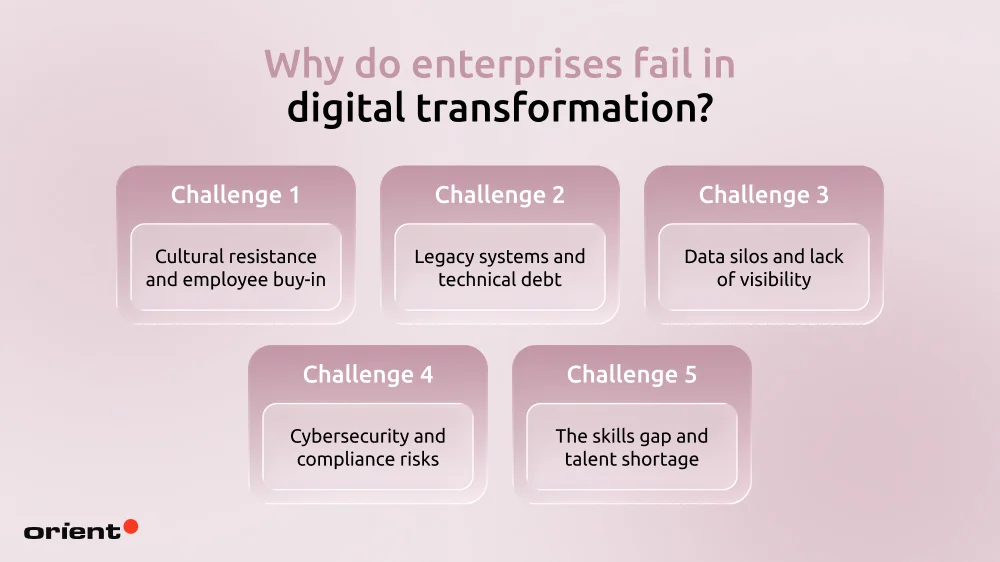
Challenge 1: cultural resistance and employee buy-in
Most organizations have run into some version of “we have always done it this way.” That reaction is almost never about stubbornness. Behind it is usually a workforce that learned to operate a certain way over many years, and nobody has shown them a convincing reason to stop. Change without context is just disruption.
Cultural resistance is slippery. There’s no memo, no pushback in the all-hands. Someone nods through the roadmap presentation and then goes straight back to the same spreadsheet they’ve relied on for years, because the new system exists, but nothing has actually changed in how people think about their work.
There’s another layer to this, too. Digital transformation doesn’t just change processes; it can feel like it’s questioning whether someone’s experience still matters. When the message from the top is mostly about what the technology can do, and very little about what happens to the people using it, employees start doing the math themselves. Automating routine tasks and data-driven workflows stops looking like progress and starts looking like a threat, especially when no one has explained where their role fits in what comes next.
Warning signs your organization is experiencing this:
- Teams log into new platforms regularly, but continue running critical workflows through spreadsheets and manual processes.
- Adoption metrics look healthy on dashboards, while actual behavioral change is absent on the ground.
- Employees build unofficial workarounds, side databases, personal trackers, and shadow reporting within months of a new system going live.
- Different departments maintain separate versions of the same data rather than trusting the central platform.
When that happens, the organization isn’t really transforming. It’s running two operating models at once, burning resources on both, and slowly letting the older one win by default.
Challenge 2: legacy systems and technical debt
Many organizations frame legacy systems as a technology problem. In practice, most legacy environments are governance problems wearing a technology costume.
Legacy systems frequently support critical business processes that were never properly documented, and the people who understood how everything fit together have since retired, moved on, or left the company entirely. What that creates is a particular kind of paralysis; every attempt to modernize looks riskier than just keeping things as they are, so nothing moves.
Breaking this cycle requires moving beyond hesitation. For example, Netwealth successfully navigated these exact challenges by partnering with Orient Software to modernize its legacy infrastructure. By transitioning from a monolithic system to a scalable, microservices-based architecture, they not only enhanced performance and streamlined operations but also proved that strategic technical renewal is the key to thriving in a competitive market.
An infrastructure dominated by outdated systems doesn’t just slow things down. It signals to exactly the people you need that this isn’t somewhere their skills will be put to good use. Meanwhile, existing staff stay locked into maintaining old infrastructure while newer capabilities sit disconnected from the business operations they were supposed to support. Instead of closing, the gap continues to widen.
Organizations that understand how to reduce technical debt before it starts are in a much stronger position. Those who have allowed it to accumulate over the years face far greater risks when making technology decisions, as even small mistakes can trigger disproportionately large consequences.
Challenge 3: data silos and lack of visibility
Data silos rarely emerge because organizations lack technology. More often, departments have simply built their information systems around their own objectives rather than enterprise-wide goals. Marketing, sales, operations, and finance each develop separate metrics and separate systems, and over time, that produces fragmented data and multiple versions of the same reality sitting side by side.
The ripple effects go well beyond reporting inconsistencies. Disconnected systems don’t just produce conflicting numbers; they obscure how different parts of the business actually affect each other. A decision that looks rational inside one function can create pressure somewhere else entirely, and nobody sees it coming because nobody has a view across the whole picture. Teams end up spending their time arguing about whose data is right rather than figuring out what to do next.
Digital transformation feels this in ways that are easy to misdiagnose. When AI outputs are unreliable or automation delivers less than expected, the instinct is to question the technology. Usually, the technology is fine; what’s broken is what’s feeding it. Fragmented, inconsistent data produces fragmented, inconsistent results, and customer experiences suffer for it in ways that show up long before anyone in leadership connects it back to a data infrastructure problem.
Fixing this isn’t just a matter of integrating more systems. Organizations need an actual shared source of truth, something that gives consistent data and real visibility across the enterprise. Not cleaner dashboards. A foundation solid enough that the rest of the transformation has something reliable to stand on.
Challenge 4: cybersecurity and compliance risks
Digitization isn’t what creates the cybersecurity problem. The problem shows up later, when cloud platforms, AI tools, third-party services, and interconnected systems have accumulated to a point where nobody has a complete picture of what’s running or who has access to what.
Each individual decision along the way looks fine. A permission that was supposed to be temporary just never got removed. A tool was adopted without going through the full approval process. Nothing dramatic, just small gaps that keep appearing until the distance between the written security policy and daily operational reality becomes impossible to close quietly.
Personal data accountability works the same way; GDPR and CCPA require organizations to know where sensitive data lives, how it moves, and who interacts with it, not approximately, but specifically and documentably. That’s manageable when data sits in a handful of systems. It gets harder in direct proportion to the number of departments, cloud environments, and third-party vendors through which data passes. And when something does go wrong, the fallout isn’t contained to the IT team. Customer trust takes a hit that marketing can’t easily repair. A reputation built over years gets associated with a single incident.
Challenge 5: the skills gap and talent shortage
The standard response to a technology skills shortage is to recruit harder or pay more. Both matter, and neither is enough on its own. The deeper issue is that the environments most in need of modern talent are frequently the least appealing to the people who have it. A senior ML engineer weighing up offers isn’t going to choose a role that means wrestling with decades-old middleware when better options exist.
Leaning on external consultants to cover digital skills gaps is tactically understandable, but it quietly creates a structural dependency that makes the underlying problem worse. Consultants come in, solve the immediate issue, and leave with the context of how they solved it. Internal capability doesn’t grow. The next problem needs another engagement, run that cycle enough times, and the organization stops building knowledge internally altogether, which is expensive, slow to activate when something goes wrong, and fundamentally at odds with any serious long-term capability building.
The link back to cultural resistance is where this gets self-reinforcing. Burnout among existing IT staff is a real and measurable pattern in transformation-heavy environments, and it drives out exactly the people who carry the institutional knowledge that makes modernization safe to attempt. Every departure stretches the remaining team further, accelerates the next round of attrition, and leaves leadership leaning harder on the legacy-domain experts who often have the most to lose from transformation moving quickly. The loop closes in the wrong direction.
How to assess where your organization actually stands

Most organizations face more than one challenge. The real question isn’t “what problem are we facing?” but “where do we begin when everything needs solving?”
The general principle is: the challenge hindering everything else must be addressed first. And in most cases, that’s a lack of consensus at the leadership level.
When senior leaders disagree on specific outcomes, every initiative below easily falls into different priorities. Data governance is developed, but no unified data is used to support decision-making. Talent is recruited, but it’s unclear what they will contribute. Cultural resistance is noted, but there isn’t enough authority to change how performance is evaluated. Without consensus, no priorities are enforced.
Once consensus is established, the next steps depend on the organization. If resistance is high, everyone’s first transition needs to be synchronized with everything else, because any tool deployed without acceptance is useless. If infrastructure is a barrier preventing any initiative from moving forward, then the architecture needs to be fully addressed to make room for others. If data is unreliable, AI or automation will exacerbate the problem instead of solving it.
The playbook below follows that same logic. Not a fixed sequence to apply rigidly, but a way of making sure each step builds the conditions the next one actually needs.
How to overcome these roadblocks (the strategic playbook)
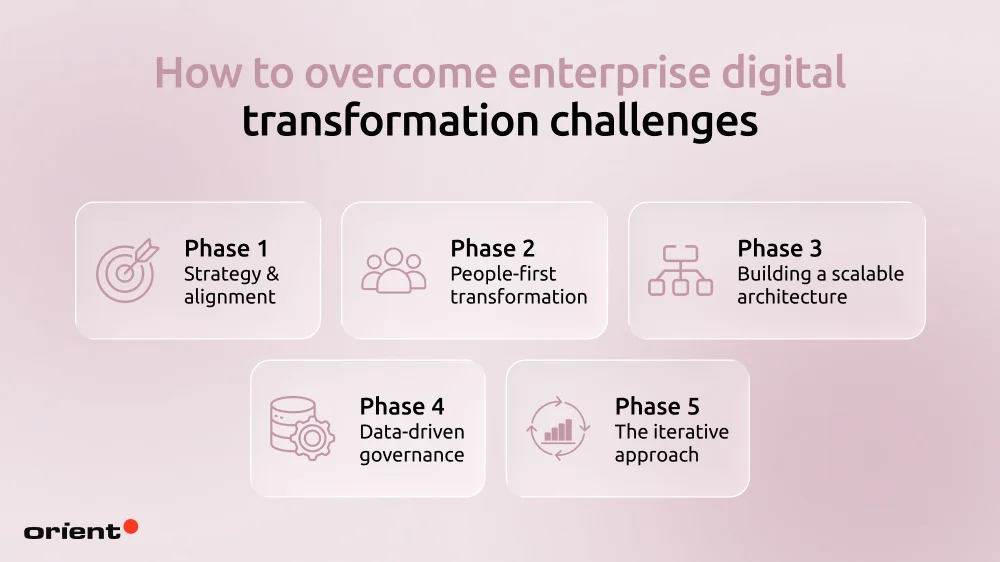
Phase 1: strategy & alignment
The problem it solves: Digital transformation requires a clear strategy and organizational alignment. Without that, teams naturally start pulling in different directions. Budgets get absorbed into work that doesn’t connect to anything broader, and somewhere down the line, nobody can say whether the effort moved the business forward or just kept people busy. This phase is meant to address exactly that. It works differently from most planning exercises; instead of starting with tools or systems, it pins down business outcomes first, then uses those to evaluate every decision that follows, technical or otherwise.
What this phase looks like in practice: Define two or three specific business outcomes before any architecture or vendor conversation starts, each with measurable indicators attached. Every proposed digital initiative then gets mapped to one of those outcomes. Anything that doesn’t map gets deferred or cut. From there, establish a cross-functional steering group with real decision-making authority, not just an advisory role, alongside a senior leader accountable for transformation outcomes rather than project delivery milestones. Then set a 90-day checkpoint where leadership reviews evidence of actual progress, not updated plans.
Phase 2: people-first transformation
The problem it solves: Installing new technology is the easy part; the harder question is whether people will actually use it after the system is live. This phase takes that issue seriously. Instead of viewing technology adoption as a problem that can be solved with a training session, this phase approaches change management as something that needs to be implemented throughout the initiative from the outset, with clear support from leadership, rather than being added after the system is already operational.
What this phase looks like in practice: Run an adoption risk assessment first, and treat it as a real exercise rather than a box to check. Which teams are taking the hardest hit? Where is resistance most likely to quietly take hold? That’s what needs answering before anything else moves. From there, change management gets applied at the team level rather than broadcast organization-wide, because what’s disruptive for a finance team looks nothing like what’s disruptive for operations. Upskilling programs get built around specific roles, not general digital literacy, and performance metrics get rewritten so that using the new systems is just how good work gets done, not an extra ask on top of everything else. Change champions sit inside each department rather than being managed from a central program office, and communication keeps running throughout the whole process, not just around the go-live date.
Phase 3: building a scalable architecture
The problem it solves: New technologies can only deliver value when the underlying infrastructure can support them. Legacy systems create a specific kind of drag; the older the foundation, the more effort goes into maintaining compatibility rather than building anything new. At some point, the workarounds cost more than the systems they’re holding together. This phase addresses that challenge by strengthening the technological foundation needed for sustainable transformation.
What this phase looks like in practice: Low-code and no-code platforms are part of the answer here, not as a shortcut but as a practical way to get more people building and iterating without everything running through the IT team. Cloud-native development handles the rest, new capabilities designed from day one to scale and adapt rather than being built on assumptions that stop being true the moment business requirements shift. The goal isn’t just to modernize what exists. It’s to stop making architecture decisions that solve one problem and silently create three more, which means every choice at this phase needs to hold up across the full end-to-end product development lifecycle, not just the part currently in focus.
Phase 4: Data-driven governance
The problem it solves: Fragmented data slows down processes and affects decision-making in subtle ways. If the same metric returns different results from the different data collection systems, trust in analytics rapidly diminishes, and people start following their hunches instead of analytics dashboards. This phase establishes the data basis for intelligent decisions, enterprise-level optimization, and effective implementation of AI.
What this phase looks like in practice: The first step is to establish shared data standards, definitions, and governance policies. Teams continue to utilize existing systems that are successful for them. However, the change here is that information from different departments can communicate with one another without creating additional confusion. This common base provides the leadership with a consistent perspective on operations, while not detracting from the way departments do their work. Once people start using AI, those governance principles extend naturally to inputs, outputs, monitoring, and accountability of the models, and the insights that come out are grounded in data that can be thoughtfully supported.
Phase 5: the iterative approach
The problem it solves: Long-term transformation programs have a characteristic failure pattern: when a problem occurs, a lot of things have piled up on top of it, so solving the problem requires going and tearing down the top layers. Shorter cycles don’t prevent problems from happening; it simply means that the time between when something starts to go wrong and when someone actually realizes it is shorter. This is the point of this phase: to divide the work into its component parts so that problems or pitfalls in the way the work is done become apparent as they happen, not after months of being hidden in the dark.
What this phase looks like in practice: Each initiative runs inside a specific business unit first, with defined objectives and a clear picture of what success looks like before anything launches. Results get compared against what was expected, not what was hoped for, and the people closest to the work get asked what they’re actually seeing. Whatever surfaces, good or bad, goes directly into how the next cycle gets designed. Earlier phases built the foundation, aligned leadership, trusted data, and modernized architecture. That is what gives iteration actual traction rather than letting it turn into churn. The overall effort follows evidence rather than a fixed path.
Looking ahead: why new era success requires “digital DNA”

Digital DNA is not a program, a method, or a platform. It is the ability of an organization to learn from change, quickly make decisions, and pursue new opportunities without having to approach each one as a special project that is measured by the set of reflexes that the organization has built over time.
A company with digital DNA does not talk about adopting technology. Technology is just how work gets done there. Problems get framed in terms of data and outcomes from the start. Feedback loops between teams are short. Decisions get made closer to where the information actually lives.
When a new thing comes along, a market change, a new capability, or a competitive threat, the difference becomes apparent. A company without digital DNA brings a working group together, discusses whether it should prioritize it, and after a few months, they come up with a recommendation. A company with it has already conducted a pilot within one business unit, assessed the outcomes, and is considering scaling. That gap is not primarily a technology gap. This is a capability gap that accumulates over time and becomes more challenging to bridge.
Building digital DNA follows the same logic as the playbook itself. Leadership holds teams accountable to outcomes rather than activities. A workforce treats a failed pilot as data rather than a setback. Architecture is designed to adapt rather than to last. Data governance makes information usable across the whole organization rather than owned by individual departments.
None of those things happens because of a single initiative. They accumulate through repeated cycles of doing the work, measuring what is real, and adjusting based on what surfaces. That is also why Phase 5 is not just a project management choice. It is the mechanism through which digital DNA actually gets built into an organization rather than just described in a strategy document.
The organizations that compound their advantage over the coming years are not necessarily the ones with the most advanced tools. They are the ones where this way of operating has become the default.
Conclusion

Digital transformation does not have a finish line. The organizations that treat it as a project with a defined end state tend to discover, a few years in, that the landscape has shifted again, and the investment they made is already becoming the new legacy.
It’s not any individual set of technologies or platform that compounds over time. Its organizational ability to accept change, make decisions quicker, and introduce new nuggets with speed, without any reason to disrupt any momentum. That capability is developed over time, sequentially using the same logic as the playbook states, and involves focusing on culture, architecture, data, and talent all at once, rather than in rotation.
This is what Orient Software has been doing with the enterprise teams for more than 20 years. That’s always the philosophy we take with our clients, and that’s how we work with them: not as an “installer” of a system, but as a “partner” in helping them create the conditions for each subsequent change to be navigable, rather than overwhelming. What differentiates us from teams considering this type of partnership is the same thing this article argues for: structure, sequencing, and the discipline to address root causes rather than surface symptoms.
For organizations still in the early stages of getting that foundation right, the most important thing is not to wait for perfect conditions. The reinforcing cycle described throughout this article does not pause while organizations plan. It compounds, and the cost of starting later is rarely lower than the cost of starting now.
FAQs
What are the biggest obstacles to digital transformation right now?
The most challenging aspects are not technological. In fact, issues of leadership misalignment, change fatigue, and a lack of trust in data are hurt far more by any individual platform limitation. The vast majority of organizations have all the technologies necessary. The issues are in the surroundings, below, where decisions are made, change is communicated, and where those closest to the work believe it’s worth engaging with change. It takes longer to rectify those conditions than to deploy a new one and will not be as satisfying. That’s also the very thing that actually identifies the success or failure of retention.
How can businesses bridge the gap between AI hype and real-world ROI?
Fix the data first. The issue with AI is not the quality of the models, but rather the quality of the input, which consists of pieces that are not managed properly. When pilots become products, it’s the result of good data management and standardization in data use.
How do I convince stakeholders to invest in long-term digital projects?
Ensure they tie the ask to business objectives they are already interested in, add key performance indicators to it, and establish a 90-day review mark where they have a clear gauge of success. It’s easier to agree to a shorter test than to a multi-year commitment.
What role does change management play in successful technology adoption?
It is not a support activity but the work itself. The decision of adoption depends on the understanding of the reason for change and the ease of use of new digital tools. If an organization thinks of change management as a communication exercise, its dashboards are healthy, but there is no change in behavior on the ground.