Have you ever wondered how many lines of code are in a typical enterprise codebase? It must be massive, but is there an exact number?
According to data from the Curated Industrial Developer Repository (CIDR) dataset, the average commercial repository contains approximately 153,000 lines of code, and because a single organization often maintains hundreds or thousands of these repositories, an entire enterprise system easily balloons into millions, or even billions, of lines of code.
This sheer number of code lines isn’t achieved overnight - it is often accumulated over years and years of work. The accumulation results in massive tech debt, difficult maintenance, scaling, and collaboration.
For these reasons, codebase modernization is no longer a simple chore merely involving rewriting the software. It has become a critical part of a business strategy, where the team needs to understand the actual system in order to make changes safely.
How does one go about making such safe changes? This article is meant to provide a clear and actionable guide for all the architects, tech executives, and engineering leaders regarding:
- Modernization approaches,
- AI-assisted tooling,
- Implementation phases and costs involved, and
- Factors that make or break a modernization project.
Key Takeaways:
- Enterprise codebase modernization is the process of transforming legacy software, architecture, and dependencies into a more scalable, maintainable, and future-ready system.
- Modernization is not the same as migration. Moving an application to the cloud does not automatically fix technical debt, poor architecture, or development bottlenecks.
- Velocity collapse, talent shortages, integration challenges, and security risks are often the primary drivers that force organizations to modernize.
- The most successful modernization projects prioritize understanding the existing system before making any structural changes.
- AI can dramatically accelerate code analysis, documentation, transformation, and testing, but human expertise remains essential for strategic decision-making.
- A phased modernization approach reduces risk by allowing organizations to modernize incrementally while keeping business-critical systems operational.
- Modernization projects succeed when organizations treat them as long-term business initiatives rather than short-term IT upgrades.
What enterprise codebase modernization is
Enterprise codebase modernization is the process of transforming an existing software codebase and its supporting architecture, infrastructure, and integrations to meet current business and technology requirements.
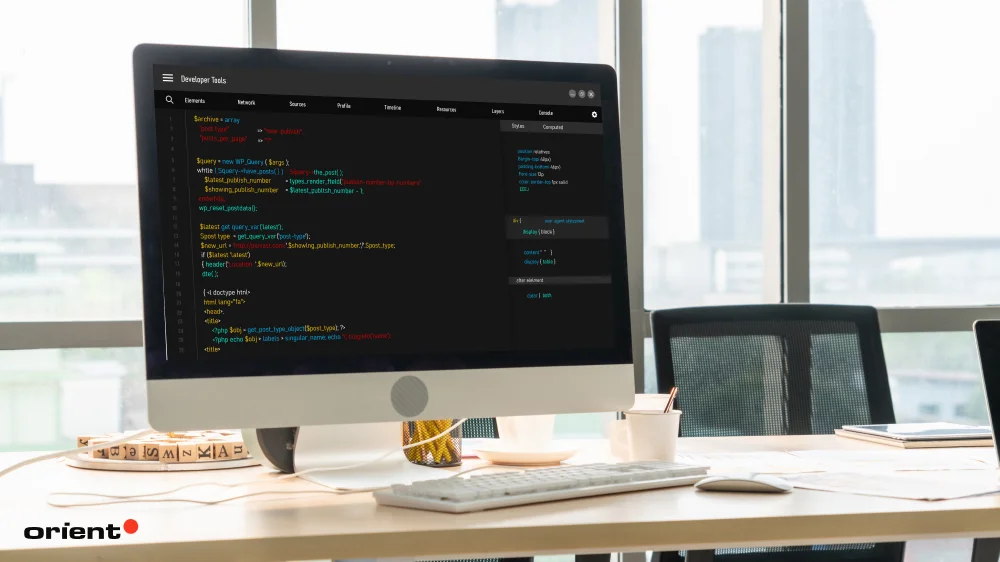
Unlike routine maintenance or incremental updates, modernization involves significant changes (such as re-architecting applications or improving security) to create a more scalable, maintainable, and future-ready system. The goal is to move the application from its current state to a more valuable future state that better supports business growth, operational efficiency, and emerging technologies.
Modernization spectrum
Modernization often happens across a technical execution spectrum defined by industry frameworks like the Gartner 7 Rs of Application Modernization, aiming to balance speed and the depth of technical restructuring.
- Rehost: moving the code to new infrastructure, like the cloud, with little to no modification to the codebase.
- Re-platform: Without altering the fundamental architecture, the team makes minor optimizations to the code to leverage the new platform, e.g., modifying databases for cloud-managed data layers.
- Refactor/Rearchitect: This approach involves the elimination of technical debt and optimization of scalability by restructuring the app into microservices.
- Rebuild/ Replace: The legacy codebase is completely rewritten from scratch with modern frameworks or deprecating it entirely in favor of a modern SaaS tool.
Quick comparison: modernization vs migration vs. digital transformation
| Codebase modernization | Migration | Digital transformation |
|---|
- Focus on improving existing software codebase to better fit future business needs
- Focuses on updating code, dependencies, and architecture | - The process of moving apps, data, or workload from one environment to another
- Focuses more on relocation rather than improving existing software. | - A business strategy
- Focuses on changing the way the business operates and delivers value.
- Codebase modernization is one such technical initiative to support this broader transformation. |
The scope of codebase modernization
To manage expectations, it is helpful to clarify what codebase modernization addresses.
- Architectural bottlenecks: Breaking down rigid monoliths into agile frameworks or microservices.
- Security and compliance foundations: Removing legacy vulnerabilities, updating and embedding cloud-native security postures.
- Development velocity: Integrating automated CI/CD metrics and standardizing code patterns.
However, modernization does not include the following:
- Routine maintenance: modernization is not a replacement for regular maintenance.
- Flawed business logic: no amount of modernization will fix a fundamentally broken workflow or unfit product.
- Data cleansing: while modernization does restructure data pipelines, it cannot fix data that is corrupted, duplicated, or badly governed.
The business drivers that force the decision to modernize
Did you know that 70% of Fortune 500 companies are still running their core businesses on software systems and codebases that are over two decades old? The reason that was given? “The current system still works.” However, this mindset often overlooks the growing risks hidden beneath the surface, risks that eventually become the very factors driving enterprise codebase modernization.
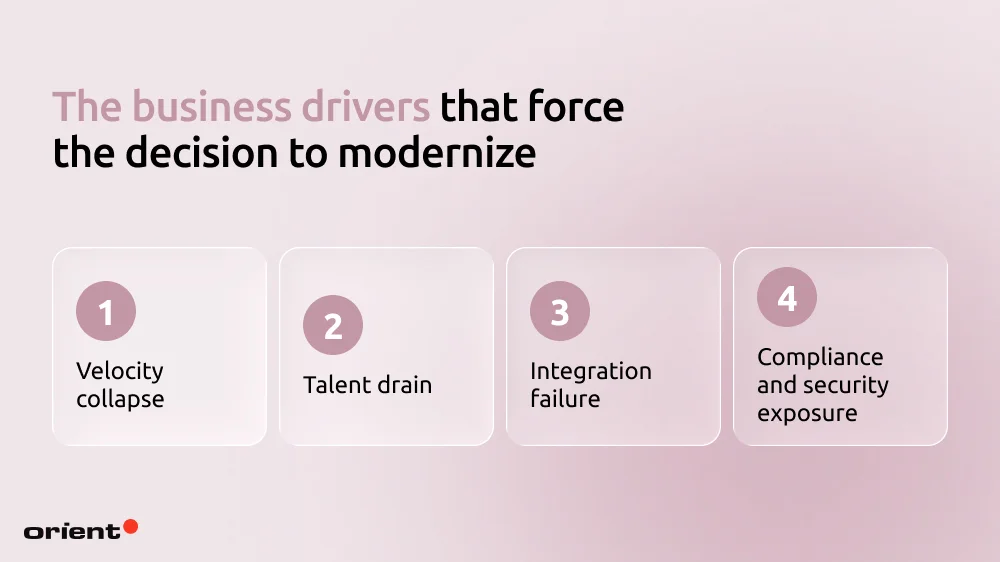
Velocity collapse
If newer developers take far too long to understand your codebase, or if minor updates trigger unexpected issues in seemingly unrelated parts of the application, they are strong indications that the company’s legacy system is in dire need of modernization. A complicated codebase brings with it a systematic drag and many disadvantages:
- Slower development cycles: Not only does it take an excessive amount of time to understand the system, but all changes developers make are risky. Even the smallest changes can trigger unwanted actions in other unrelated parts due to undocumented dependencies. Testing is slower, and release processes are delayed as teams struggle to avoid existing functionality.
- Growing technical debt: When it comes to legacy systems, engineers often avoid problematic areas because the risk of introducing bugs is too high. Years upon years of quick fixes accumulate in unwanted complexity during the development process.
- Rising maintenance overhead: In many cases, teams spend much more time on troubleshooting and fixing bugs, rather than improving and building new capabilities.
In short, the collapse of velocity results in higher costs and missed market opportunities. Not only because the software doesn’t work, but also because it cannot keep up with business growth.
Talent drain
There still exist a number of organizations that rely on decades-old technology. Think of COBOL, early versions of Java, or PowerBuilder. While the system might “still work”, using legacy technology creates a host of problems:
- Legacy platforms have a shrinking talent pool. As experienced developers retire, companies often struggle to replace them. The skills related to this become a specialized skill, which means it will cost more to hire the right talent.
- This also means the core knowledge regarding the system resides with a number of senior developers.
- Younger developers prefer working with modern language frameworks, rather than struggling to understand the old ones, leading to a possible higher rate of turnover.
- In the long run, talent drain can become a serious financial problem. Imagine you need 6 months to hire the right talent - every step of the project is delayed as operational risks rise. At this point, modernization is crucial to ensure the organization can continue to operate effectively and innovate.
Integration failure
APIs are the backbone of modern software. As businesses adopt cloud services, AI tools, and other data-driven applications, older codebases can struggle to connect with modern APIs and third-party platforms.
Outdated architectures make integration difficult due to tightly coupled components and proprietary protocols. These limit businesses from taking full advantage of AI-powered automation, real-time analytics, and other emerging tech. With time, the inability to integrate with modern systems significantly limits a business’s ability to innovate.
Compliance and security exposure
Software needs to be regularly maintained and updated. Legacy systems may rely on unsupported frameworks, libraries, or operating systems that no longer receive security patches, leaving known vulnerabilities unaddressed.
In strictly regulated sectors, limited auditability and incomplete documentation make it challenging for companies to demonstrate compliance with industry regulations or investigate security incidents effectively. This is not to mention the numerous security vulnerabilities that only a handful of senior developers have knowledge of.
The difference between legacy system modernization and codebase modernization
It is easy to assume that the phrases “legacy system modernization” and “codebase modernization” can be used interchangeably. In reality, they address two very different operational layers inside an enterprise.
Understanding the differences between these two concepts and what they entail allows businesses to allocate budget smartly without ignoring application flaws.
| | Legacy system modernization | Codebase modernization |
|---|
| Infrastructure and application layer | Broad macro strategy.
Updates entire organizational ecosystem: migrating servers, restructuring legacy data pipelines, and implementing middleware tools | Focus on micro analysis and application layer.
Refactoring logic, upgrading programming syntax, sanitizing out-out-date dependencies. |
| Business logic | The “black box” approach: Shifts applications to new environments or wraps them in APIs without altering how the underlying software actually functions. | Active optimization: Proactively isolates, cleans, and rewrites core business logic to align with current agile requirements without disrupting operations. |
| Code-level transformation | Focuses on overall hardware efficiency, environment scalability, and macro-integrations across separate company platforms. All in all, the focus lies in ecosystem connectivity. | Delivers code-level transformation through refactoring, CI/CD pipeline optimization, and SDLC automation to give developers a clean foundation. The focus is in behavioral and architectural health. |
Why cloud migration alone is insufficient
Successful cloud migration alone does not translate to technical modernization. It is a milestone, but not quite the destination.

Executing a basic “lift-and-shift” cloud migration means you only change where the software runs, not how it operates. Moving an entire codebase to the cloud does make it more accessible, but it doesn’t fix its inherently monolithic and unoptimized structure. This movement might even make these existing flaws even more expensive due to the cost of running the cloud.
Instead of focusing on cloud migration, companies need to focus on a phased approach, where infrastructure migration is the foundation, and codebase modernization delivers scalability and long-term ROI.
Enterprise codebase modernization approaches
There is hardly a universal framework for enterprise code modernization. Rather, it is a spectrum of strategies, from simple operational updates to full-scale architectural overhauls. This table will provide a quick view of the primary modernization approaches based on operational risks, implementation timelines, and use cases.
| Approach | Best when | Risk level | Time horizon |
|---|
| Retain | The software is stable. Adequately fulfill functional business requirements. The projected ROI of any technical change does not justify the implementation costs. | Low | Ongoing/Indefinite |
| Retire | The application is redundant, provides zero tangible business value, or has its functionality entirely duplicated by a modern internal system. | Low to moderate | 1 to 3 Months (Requires explicit dependency mapping) |
| Rehost (Lift and Shift) | You need to exit physical data centers rapidly due to real estate or cost pressures, keeping code architecture entirely unchanged while migrating to cloud infrastructure. | Low | 1 to 6 Months |
| Re-platform | The application’s core architecture is healthy, but it needs minor optimizations to run efficiently on cloud-native infrastructure, such as adapting code to use managed cloud databases or container layers. | Medium | 3 to 9 Months |
| Refactor | Code maintainability is poor, and technical debt slows down development cycles, requiring targeted internal code optimizations without altering external system behaviors. | Medium to high | 6 to 12 Months |
| Re-architect | The application is a rigid, monolithic system that cannot scale or safely handle modern integration demands, requiring its core code to be split into modular microservices. | High | 1 to 2 Years |
| Rebuild | The existing system completely constrains operational agility, uses dead or unsupportable programming stacks, and must be rewritten from scratch to meet future requirements. | Very High | 2 to 5+ Years (Typically reserved for mission-critical core platforms) |
AI in enterprise codebase modernization
The phases where AI delivers the most value
AI delivers the greatest value in the early stages of codebase modernization, where a lot of labor is required for repetitive tasks. Legacy systems often contain years of undocumented business logic, hidden dependencies, and outdated code patterns that can take engineering teams months to untangle manually. AI dramatically speeds up this discovery process while reducing the amount of specialized expertise required.
AI is particularly effective for:
- Codebase analysis: AI-powered tools can analyze thousands or even millions of lines of code, identify dependencies, uncover hidden relationships between components, and translate technical logic into plain-language documentation. This helps teams build an accurate picture of the system far faster than traditional methods.
- Documentation generation: Creating documentation is no doubt time-consuming. AI tools help the preservation of institutional knowledge by converting code into easy-to-follow explanations, while also working with more technical tasks such as creating a system map.
- Code transformation: AI can significantly reduce the effort involved in updating legacy applications. It assists teams with refactoring outdated code, translating applications to modern languages and frameworks, and handling repetitive modernization tasks that would otherwise consume valuable engineering time. While developers still need to review and refine the results, AI can accelerate the transformation process and allow teams to focus on higher-value architectural decisions.
- Testing and validation: Modernization projects are only successful if the new system behaves as expected. AI helps by generating regression and unit tests, creating a baseline of the application’s current behavior before any changes are made. These automated tests act as a safety net throughout the modernization process, helping teams identify unintended changes and verify that the modernized application continues to deliver the same functionality as the original system.
Rather than replacing engineers, AI serves as a tool that helps teams understand, modernize, and validate complex systems faster than traditional approaches.
Where human judgment is still required

While AI can accelerate execution, it cannot make the strategic decisions that determine whether a modernization initiative succeeds. Modernization is ultimately a business transformation effort, which means critical decisions still require human expertise.
Human judgment remains essential for:
- Target architecture decisions: AI can analyze existing systems and suggest potential modernization paths, but it cannot decide what the future state architecture should look like. Organizations still need experienced architects and engineering leaders to select cloud platforms, define infrastructure strategies, and determine whether individual applications should be refactored, re-architected, or rebuilt. These decisions must align with long-term business objectives, technology investments, and operational requirements that only a human can make sense of.
- Business rule validation: AI can extract business logic from legacy code, but only domain experts can confirm whether that logic is correct. Teams must check that the extracted rules accurately reflect intended business processes, distinguish between legitimate functionality and long-standing defects, and ensure that critical workflows are preserved throughout the modernization process.
- Compliance and security oversight: Compliance and security requirements require human interpretation and oversight. Organizations must ensure that modernization initiatives satisfy regulatory obligations, governance standards, and internal security policies. Human reviewers are also needed to evaluate AI-generated code and recommendations for potential vulnerabilities, compliance gaps, or unintended risks.
- Migration planning and prioritization: Determining what to modernize and when is ultimately a business decision rather than a technical one. Leaders must decide which systems should be prioritized, balance the trade-offs between cost, risk, and expected business value, and sequence modernization efforts around organizational goals and operational constraints.
The organizations that get the most value from AI treat its outputs as a highly capable first draft rather than a finished product. AI can accelerate discovery, documentation, code transformation, and testing, but engineers, architects, and business stakeholders remain responsible for validating the results and making the final decisions.
A phased approach to enterprise codebase modernization
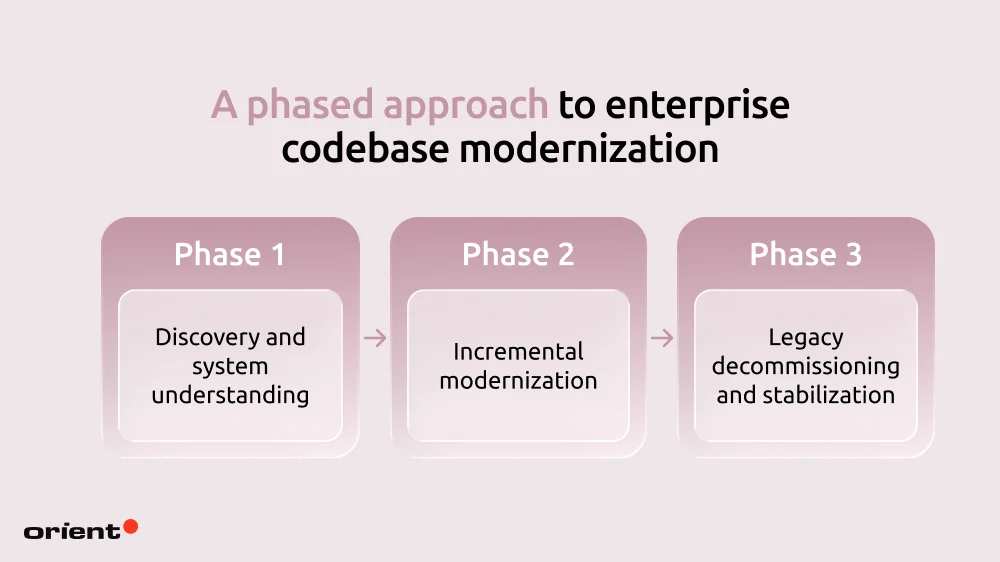
When it comes to modernization, it is never a good idea to do an overhaul without breaking down the daily workflows. Such “big bang” rewrites are highly risky and can result in catastrophic failures. To avoid this, organizations need to implement a framework that is both structured and predictable.
Understanding the phasing principle: never stop the business
One rule of thumb of modern engineering: you never shut down a revenue-generating business to rewrite its code. It is best to rely on incremental modernization strategies, and the Strangler Fig Pattern is one of the most notable ones.

Coined by software theorist Martin Fowler and later expanded upon in AWS’s guidance on the Strangler Fig Pattern, this approach avoids replacing a legacy system all at once. Instead, teams gradually build new functionality around the existing application, moving one component at a time to a modern architecture while the legacy system continues to operate. As more capabilities are transferred to the new environment, the old system plays a smaller and smaller role until it can eventually be retired without disrupting business operations. As mentioned in the guide, this allows both the old and new systems to coexist. Production traffic gradually shifts away from the old code to the modern architecture until the original application is safely moved from the operation, avoiding unwanted business disruptions.
Phase 1: discovery and system understanding
Before making any changes, engineering teams need a clear understanding of the legacy system they are working with. Many enterprise applications have evolved over decades, creating a “black box” where dependencies, business rules, and system interactions are poorly documented or understood. The first step is to map out the application’s components, identify how they interact, and uncover hidden dependencies that could create risks during modernization.
This discovery phase also helps establish performance baselines and document critical business processes, giving teams a clear picture of the current state before they begin transforming it.
Phase 2: incremental modernization
- Timeline: Continuous iteration
Once teams understand the system and have identified clear boundaries between its components, they can begin modernizing it in smaller, manageable pieces. Rather than replacing the entire application at once, organizations gradually move individual features or business functions to a modern architecture while keeping the legacy system running.
Each newly modernized component is tested under real-world conditions and validated against the legacy system to ensure it delivers the same expected outcomes. Teams do this by routing a tiny percentage (5%, for example) of live traffic to the modern service to validate its reliability before deciding to scale up.
Phase 3: legacy decommissioning and stabilization
- Timeline: Post-migration wrap-up
The final phase focuses on fully retiring the legacy system and ensuring the modernized environment is stable and maintainable. Once new components have proven they can handle production workloads reliably, teams can begin decommissioning outdated code, databases, and infrastructure that are no longer needed. This cleanup work is critical, as leaving legacy components in place can create unnecessary complexity and expensive maintenance costs.
At the same time, organizations finalize documentation, establish modern development and deployment practices, and ensure the new system can be supported efficiently over the long term. The result is a more scalable codebase that is easier to maintain while also adapting to future business needs.
Why most enterprise codebase modernization projects fail

Legacy modernization efforts are complicated and often need a systematic approach and long-term game plan. However, the odds are not in most organizations’ favor. Research from Azul Systems found that 79% of application modernization projects either fail or become stuck before they can deliver meaningful results.
It is admittedly challenging to get a modernization project right. It is made obvious by the numerous possible reasons behind a failed modernization project.
- Inadequate discovery phase: Teams frequently make the mistake of skipping the discovery phase. Doing so is detrimental as this phase is the foundation that uncovers hidden or undocumented relationships, laying the foundation for the next steps in the project. Moreover, ignoring this step means you are ignoring the gaps that very possibly blow up the budget mid-execution.
- Underestimated business logic complexity: Decades of operation have resulted in database triggers, emergency patches, and other complex legacy components. Jumping straight into code modernization without properly considering this tangled complexity equals breaking critical operational workflows that no one knew were connected.
- Unrealistic timelines: Modernizing legacy systems is a long-term effort that comes with multiple risks. It isn’t merely swapping out code lines and then calling it a finished project. Setting unrealistic timelines and aggressive target dates might force the team to cut corners, leading to stability issues later down the line.
- Lack of executive alignment: Legacy code modernization is a long-term strategic initiative, not a routine IT maintenance project. When executives view it solely as a technology expense rather than a business strategy, securing sustained funding and organizational support becomes difficult. Different departments may prioritize short-term deliverables over modernization efforts, creating resource conflicts and changing priorities. Without clear executive sponsorship and alignment around business objectives, modernization initiatives often lose momentum and eventually stall before reaching actual results.
- Attempting full rewrites: One of the most common traps is the attempt to completely abandon a multi-million-line system to rewrite it entirely from scratch. Not only is this overly ambitious, but it also introduces massive risks. Incremental modernization through rollback-friendly steps has continuously proven to have a higher success rate when compared to complete overhauls.
- Poor change management: Modernizing a codebase requires every team - developers, QA team, and operation staff, to adapt accordingly. Skipping adequate training might cause the team to revert to familiar old processes, ultimately wasting the modernization efforts.
What determines enterprise codebase modernization costs
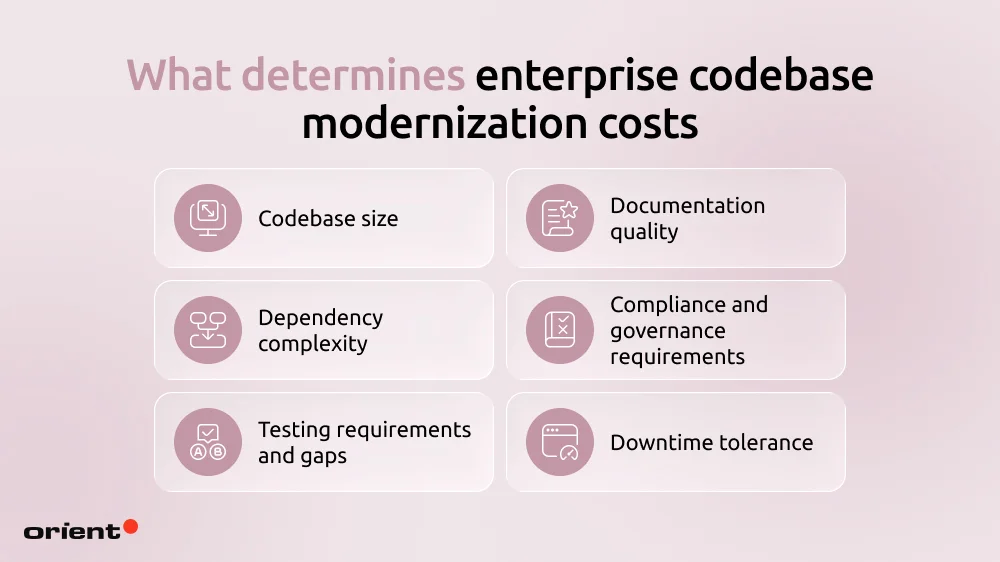
Pinning down an exact number for an enterprise modernization initiative is easier said than done. Legacy systems are complicated; no two are the same. This is why the pricing structure may vary, depending on an array of factors.
- Codebase size: The larger the codebase, the more time and effort it takes to modernize. The total volume of your codebase acts as the baseline. The price will likely go up should the codebase be large, as more resources and infrastructure will be needed for each step of the project.
- Documentation quality: Having clear and up-to-date documentation is a huge advantage. They can directly cut costs since developers won’t need to spend hours figuring out what these specific code lines are supposed to do, cutting significant man-hours.
- Dependency complexity: Enterprise legacy systems are often a web of tightly coupled APIs, libraries, and custom middleware layers. Resolving these complex dependencies and replacing them with modern architectures easily skyrockets the scope of the project.
- Compliance and governance requirements: If you operate in a strictly regulated field, like healthcare or finance, there are rigorous standards and guidelines to follow. This often means integrating strict security guidelines into the tech pipeline, e.g., data encryption or comprehensive audits. Your team should consider this factor in the final pricing.
- Testing requirements and gaps: Many legacy applications were built before automated testing became standard practice. As a result, organizations often have no reliable way to verify that the system will continue to behave correctly after changes are made. Before modernization can begin, teams may need to invest significant time and resources into documenting existing functionality and creating safeguards that catch issues before they reach customers. While this increases upfront costs, it is often necessary to reduce the risk of service disruptions and costly mistakes later in the project.
- Downtime tolerance: The level of downtime a business can tolerate has a major impact on modernization costs and complexity. For systems that support critical business operations, taking the application offline for an extended migration is rarely an option. Instead, organizations must modernize in stages while keeping the existing system running. This gradual approach helps minimize business disruption and reduces risk, but it also requires additional planning, coordination, and investment, making the overall project more complex.
A phased modernization approach spreads investment across multiple stages rather than requiring a large upfront commitment. By modernizing and validating smaller parts of the system incrementally, organizations can identify issues early and make adjustments before they affect the broader project. This reduces both financial risk and operational disruption while allowing the business to continue delivering value throughout the transformation.
Conclusion

If your company is weighed down by a multi-million-line legacy state, the path forward isn’t chaotic or a complete rewrite from scratch. It is a carefully planned, phased evolution.
Don’t let the technical debt and tangled web of dependencies hinder the growth of your company. A project modernization is often long and takes a lot of time and effort, but it is completely achievable. The rates of success go up dramatically if you have a credible partner by your side. With more than two decades of software development experience, Orient Software helps organizations modernize legacy systems with tailored solutions designed to minimize risk and maximize long-term value. Contact Orient Software to discuss your modernization goals.