With the growth of digital ecosystems, the development of enterprise apps is more complicated than ever before, with architectural choices and system integration becoming more vital than ever. In such an environment, the business of selecting the appropriate enterprise software development company is no longer a technical procurement challenge. It is a strategic move that directly affects the ability to do business in a resilient manner and in the long term, in competitive terms.
The difficulty, however, is not a lack of vendors but the multiplicity of options. Freelancers, boutique agencies, or big outsourcing companies are all available today to work with businesses under various delivery models.
Even with huge budgets, most enterprise projects fail because of poor technical underpinnings, disjointed integration services, or partnerships that do not have a proven track record in handling complex enterprise processes. A quality software development vendor should be more than a code-writer. It should integrate architectural knowledge, disciplined project management, awareness of regulatory issues, and a mature development process that can support multi-year transformation initiatives.
The top enterprise application development companies stand out in terms of principled execution. They provide secure and scalable enterprise software that is in line with business strategy, fits in well with current ecosystems, and helps with long-term digital change as opposed to short-term feature delivery. They are trusted by clients of global enterprises and not only behave as vendors, but are organized technology partners who can effectively perform in high-stakes environments.
What Makes an Enterprise Application Development Company “Top‑Tier”?
Breadth and specialization are not the only distinctions between top companies, but also the capacity to develop enterprise applications at scale.
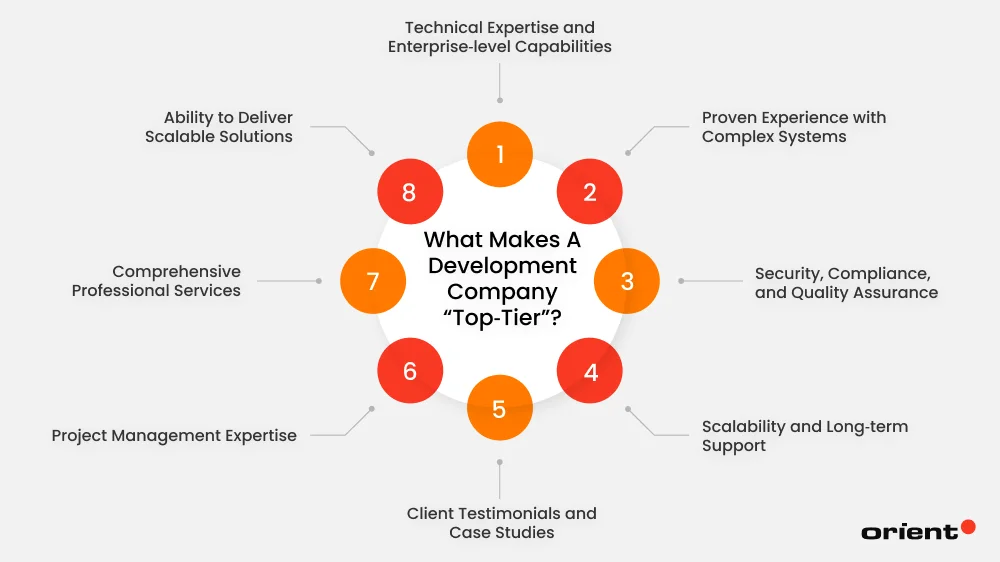
Technical Expertise and Enterprise‑level Capabilities
At the enterprise level, technical expertise does not concern mastering the latest framework. It consists of the design of enterprise software and enterprise applications that can be used in heavy loads and in complex enterprise integration, as well as in long-term evolution.
A powerful enterprise software development firm will show this by utilizing architectural thinking, rather than feature-driven development. It consists of scalable solutions designed to be highly available, extensive backend development, well-practiced cloud services and infrastructure, and advanced system integration services to bridge legacy systems to modern web platforms. Strict performance engineering and security by design are the way to make sure that enterprise apps do not crash when business operations grow and digital transformation increases.
Proven Experience with Complex Systems
An elite company will show its proficiency with practical projects of large user bases, mission-critical services, and multi-layered system designs. The nature of these systems is complex, as indicated by integrations with legacy systems, ERP or core banking systems, large volumes of transactions, stringent regulatory demands, cross-border systems, and coordination across various business units.
Having dealt with such challenges provenly is what can make the difference between theoretical ability and enterprise-grade execution.
Security, Compliance, and Quality Assurance
Such terms as security, compliance, and quality are not marketing labels. They are a product of organized management and ordered implementation used throughout all projects.
Specifically, the existing maturity is demonstrated through the practical aspects of ensuring a secure SDLC, using Zero Trust architecture, ensuring high data encryption standards, and having ongoing vulnerability management. On the operating front, intensive performance and load testing combined with well-laid-out disaster recovery plans will enable systems to withstand the real-life pressure.
Scalability and Long‑term Support
Scalability at the enterprise level is not only determined by the performance of a system on initial launch but also by the ability to adjust to changes in demand. Scalability actually needs to be observed continuously, performance tuned, the infrastructure optimized, and capacity planned to keep pace with the growth.
Enterprise platforms have a history of existing for years and sometimes even decades, constantly changing with the business strategy, regulatory requirements, and technology. Constant success has to be based on the regimented maintenance procedures, active security management, limited release schedule, and well-defined upgrade plans.
Client Testimonials and Case Studies
Client references and recorded case studies are the tangible evidence of the ability of any company to generate significant business value.
The case studies provided by leading firms go beyond the level of high-level summaries. They state the key issues faced by the client, the rationale behind the adopted strategy, the design and technical choices that were made, and the results that can be measured. Effective performance metrics like faster processing time, lower cost of operation, more revenue, system reliability, or user engagement are a convincing confirmation of success in complex enterprise environments.
Project Management Expertise
Enterprise software initiatives demand more than good technical capacity. They require rigorous implementation models to fit the technology delivery with the business priorities, budgetary limitations, schedules, and stakeholder congruence.
Mature organizations practice this discipline by having a form of governance, a clear channel of communication, and well-distributed accountability. Proper planning methodologies, well-organized risk mitigation practices, controlled change management processes, and regular monitoring of performance during the entire course of the project are encouraged.
Comprehensive Professional Services
The major companies offer end-to-end solutions that cut across technology advisory, enterprise architecture design, product and experience strategy, intricate system integration, cloud transformation, quality engineering, and DevOps implementation.
Full-service delivery also goes into organizational enablement. It involves the implementation of structured change management programs, user onboarding and training, comprehensive documentation standards, and extended post-deployment support programs to facilitate long-term adoption, stability, and performance optimization.
Ability to Deliver Scalable Solutions
Scalable solutions are also an indication of the company’s capability to think beyond the short-term needs and future growth.
Systems in the enterprise setting will be required to handle growing workloads, user populations, and changing business models without undergoing reengineering anew. This needs a modular architecture that can easily support thousands of users online at a time and absorb large bandwidth bursts without affecting performance or stability.
Why Asia Is a Strong Region for Enterprise Application Development
Asia has been gradually forming itself as a strategic center in enterprise application development. The region is characterized by a combination of scale, capability, cost-effectiveness, and innovation potential that aligns well with the long-term needs of the digital transformation of enterprises.

First, the technology talent pool continues to expand in both scale and quality.
Asia countries jointly produce a considerable number of engineering graduates every year, which makes it one of the largest contributors of technical manpower to the development of software worldwide. In addition to scale, most teams have practical experience with enterprise application development projects, which include complex system architecture, enterprise integration, cloud services, DevOps pipelines, and performance optimization.
Second, development costs remain competitive without sacrificing delivery standards.
Most of the Asian markets provide a better cost structure than North America and Western Europe. The benefit is greater than labor arbitrage. The presence of well-developed outsourcing ecosystems, long-developed development processes, and well-managed project management structures allows the software development companies to produce enterprise-level quality at an optimized cost.
Third, governments across the region actively support the growth of the IT sector.
Asia has been empowered in the global technology ecosystem by national plans of digital transformation, investment policies, technology hubs, and massive development of infrastructure. Such programs provide software development firms, cloud services firms, and innovation-based enterprises with the environment to grow sustainably.
Fourth, the region serves an increasing number of global enterprise clients.
Asia is a delivery destination and also a fast-expanding enterprise market. There are multinational companies, fintech companies, e-commerce, and big manufacturing organizations that are involved in operating throughout the region. The work with such organizations has enhanced the ability of local vendors to support large-volume transactions, regulatory rigor, data security, and critical mission systems in the finance, health care, logistics, retail, and manufacturing sectors.
Fifth, Asia is home to globally experienced software development firms.
There are numerous firms in the area that have been providing complicated enterprise undertakings to international purchasers over the decades. Their portfolios comprise multi-region rollouts, large-scale integrations with legacy systems, and long-term maintenance agreements. This experience has matured into architecture design processes, security compliance processes, quality assurance processes, and scalability planning processes.
Finally, strong expertise in cross-platform development and emerging technologies strengthens the region’s strategic value.
Asian engineering teams have a good knowledge of how to develop applications that run well on web, mobile app development, and cloud platforms. Meanwhile, most companies proactively implement AI, machine learning, data analytics, and cloud-native solutions into their business. This is a combination of the underlying engineering practice and innovation preparedness that makes Asian an uncompromising and progressive technology partner.
In this larger regional context, Vietnam is becoming one of the most strategically located technology markets in the Asian region.
In contrast to India, which gambles on the enormous scale of competition, or Singapore, which leads in the area of financial and regional headquarters functions, Vietnam distinguishes itself by the means of a modern engineering basis and stability of delivery. Most of the Vietnamese technology companies had been constructed directly in the cloud age, which enabled them to embrace the agile, cloud-native, and DevOps practices without incurring heavy legacy migration.
Top Enterprise App Development Companies in Asia
Vietnam
Orient Software
Orient Software is a Vietnam-based software development firm that was founded in 2005 and has gradually increased its presence in the enterprise application development and digital transformation services. In the last 20 years, the company has transformed from a conventional outsourcing firm into a wider technology partner to facilitate AI integration, cloud adoption, and system modernization initiatives.
The company boasts of over 400 engineers and serves clients in finance, healthcare, logistics, manufacturing, and education. Besides the headquarters in Vietnam, Orient Software has representative offices in Singapore, Japan, Australia, and North America, which allow us to work within many time zones. We are also certified to ISO 9001:2015 and ISO/IEC 27001:2013, which means that we follow the international professional standards of quality management and information security.
In terms of technical focus, Orient Software has worked on projects of enterprise modernization, especially the migration of legacy systems to microservices and cloud-native architecture. The company is also engaged in AI-related advanced technologies such as natural language processing, computer vision, and large language model applications, which are generally integrated into business process automation or data-driven platforms.
A number of international projects are pointed out in published case studies. Indicatively, we contributed to modernizing an education platform by NTUC in Singapore by switching from a monolithic to a microservices architecture. We have also used AI on document processing in another project with Excosoft in Sweden, which sought to minimize the number of people doing manual work, as well as enhance the accuracy of the data extracted. Other projects involve cloud-based platforms that are constructed on Microsoft Azure and include intelligent matching or analytics features.
Industry recognition has been given to Orient Software, with it being listed by VINASA as one of the top ICT companies in Vietnam and listed by Financial Times as part of the Asia Pacific High Growth Companies. At Clutch, the company has a rating of 5.0 regarding the verified client reviews as of the time of writing.
FPT Software
Regarding the scale, FPT Software has tens of thousands of IT specialists, and it has delivery centers and offices in over 30 countries in the Asia Pacific, Europe, and the Americas. It has a presence in most established technology service providers in Southeast Asia due to its global workforce and huge delivery capacity.
The industries that FPT Software clients are in are banking and financial services, automotive, manufacturing, healthcare, retailing, energy, and telecommunications. Its magnitude and diversification in the industry can enable it to cater to huge, complicated, and multi-region enterprise courses.
Having pioneered in the market, having a large number of employees, and having a vast delivery network on a global basis, FPT Software is generally considered one of the most prominent enterprise IT service providers based in Vietnam.
KMS Technology
KMS has development centers in Vietnam and offices in the United States, which allows it to work in close cooperation with North American clients and utilize engineering talent in Southeast Asia. The firm has over 1,000 employees, such as software engineers, product experts, and QA automation experts.
KMS Technology has customers in the health, financial services, ISV, retail, and enterprise SaaS sectors. The company also has an incubation and product development arm to its services, offering a hybrid model that has merged its outsourcing experience with product development know-how.
The company concentrates on engineering background, automation quality, and product-oriented thinking, making KMS Technology a commonly known mid- to large-scale technology partner to enterprises and software firms seeking long-term development services.
India
Tata Consultancy Services (TCS)
TCS offers a broad spectrum of capabilities across the enterprise technology landscape, including:
- Custom enterprise application engineering
- Legacy system renewal and platform modernization
- End-to-end digital transformation and cloud enablement
- Data platforms, analytics, and business intelligence solutions
- Web and mobile solution development
- Ongoing application management and infrastructure services
It has a client base in banking, insurance, retail, healthcare, telecommunication, manufacturing, and energy. The company often works in highly dependent environments, those that require regulatory compliance and managing large volumes of transactions.
As a result of decades of experience, industry focus, and an established international network of delivery, TCS has proven itself as a leading choice when organizations seek scalable, secure, and long-horizon delivery technology programs.
Wipro
Its service offerings cover the entire technology lifecycle of the enterprise, such as:
- End-to-end enterprise application development
- Legacy modernization and platform transformation
- Cloud migration and hybrid infrastructure services
- Data, analytics, and AI-driven solutions
- Cybersecurity and risk management
- Managed services and ongoing application support
Wipro operates in banking and financial services, health, energy, manufacturing, retail, and telecommunication industries. The environment that the company is normally involved in is on a large scale that involves system integration of old and new platforms, regulatory compliance, and long-term service governance.
With decades of presence in the industry and extensive coverage of the domain, Wipro continues to be a well-known enterprise technology partner in organizations, inclined to structured modernization and managed services support of complex systems.
Singapore
NCS Group
NCS is based in Singapore, and its activities are spread throughout the Asia Pacific, where thousands of technology professionals assist government agencies and also enterprise clients. This has made the company a trusted partner in complex, high-security environments, as it has a great presence in regulated and national-level projects.
NCS provides a broad range of services, including:
- Development and management of government-grade enterprise systems
- Large-scale digital transformation programs
- Cloud platform design, migration, and operations
- Cross-platform mobile application development
- Comprehensive enterprise web development
- Data, analytics, and cybersecurity solutions
The company caters to the sectors of the government, health, banking, telecom, and transport. NCS has a special reputation for managing nationwide platforms, citizen-facing online services, and integrated infrastructure programs, which are highly available and meet stringent requirements.
ST Engineering Digital Systems
ST Engineering Digital Systems is a division of ST Engineering, a Singapore-based international group of engineering and technology. The division focuses on making enterprise software and digital platforms to serve operationally intensive markets, including the aviation sector, the defense sector, logistics, and the public services sector.
Key capabilities include:
- Enterprise application development for aviation and defense operations
- Digital platforms supporting logistics and public sector services
- Cross-platform mobile application development
- Enterprise web system architecture and implementation
- Systems integration for mission-critical environments
ST Engineering Digital Systems mainly focuses on government agencies, transportation companies, and big businesses that need dependable and secure online infrastructure. Its specialization in regulated and high-reliability industries makes it stand out in the enterprise technology market in Asia.
Japan
Fujitsu
Fujitsu provides a diverse range of enterprise technology solutions, such as application development, system integration, digital transformation programs, and high-technology cloud solutions. It is also widely recognized to assist the organization in modernizing the complex legacy environments, as well as industries, where the core systems are many years old.
One of the major areas of strength of Fujitsu is legacy integration and modernization. The company helps enterprises move out of mainframe or tightly coupled legacy-based architectures to more adaptable, cloud-enabled, and scalable platforms. These efforts usually entail incremental migration plans meant to reduce the interference to operations, coupled with enhancing performance and long-term maintainability.
Fujitsu operates in areas like financial services, manufacturing, government, telecommunications, health, and retail. Its interactions are often mission-critical systems, regulatory compliance mandates, and high-availability systems.
NTT Data
NTT DATA is a multinational IT services and consulting firm based in Japan, founded in 1967, and is a member of the NTT Group. Over the decades, it has grown to be amongst the most successful enterprise technological suppliers in the world, and it is operating in North America, Europe, Asia Pacific, and Latin America.
Its core capabilities include:
- Enterprise application development for mission-critical systems
- Large-scale systems integration across heterogeneous environments
- Legacy platform integration and modernization
- Cloud transformation and hybrid infrastructure enablement
- Ongoing application management and managed services
NTT DATA has a strong legacy system integration. Most of its interactions include assisting businesses in updating core platforms without interrupting the business. This usually involves gradual strategies of migration, integration levels, and redesign of the architecture to enhance scalability and maintainability.
South Korea
Samsung SDS
Samsung SDS concentrates on providing solutions of enterprise caliber that improve operational efficiency and facilitate business complexities. It has abilities that cut across cloud service, artificial intelligence, data analytics, cybersecurity, and enterprise platform development. The company is especially engaged in creating a combined digitalized space to interconnect supply chains, logistics networks, manufacturing systems, and corporate processes.
Key service areas include:
- Enterprise IT solutions and system integration
- Cloud infrastructure and platform services
- AI-driven analytics and intelligent automation
- Digital transformation consulting and implementation
- Managed services and operational support
Samsung SDS targets manufacturing, logistics, retail, financial services, and technology industries. Most of its initiatives focus on the optimization of workflows, enhancing real-time visibility of operations, and data-informed decision-making on a large scale.
LG CNS
LG CNS is an IT services subsidiary of the LG Group that was founded in 1987 and has its base in South Korea. The company specializes in enterprise technology solutions that help large organizations to modernize and adopt digital transformation strategies for operations in every industry.
Its core capabilities include:
- Enterprise software development and system integration
- Smart factory and Industry 4.0 solutions
- Cloud platform design and migration
- Data analytics and AI-enabled applications
- Digital transformation consulting and managed services
The company has served the manufacturing, logistics, financial services, retail, and public institutions. Most of its interactions are geared towards streamlining its workflow, improving supply chain alignment, and creating scaled digital platforms that can enhance the expansion of its operations in the long term.
How to Choose the Right Enterprise Development Partner for Your Business Needs
Match Company Strengths to Your Project Requirements
When picking the appropriate enterprise software development partner, brand recognition is not the issue. It is about alignment. The biggest or most visible vendor is not always the most competent, but the one that, with its strengths, demonstrated the best fit for the technical and strategic requirements of your particular initiative.
In case cloud migration is your top priority, you should determine whether the partner has insights into architectural change and not just relocating the infrastructure. A plausible supplier must be in a position to describe their strategy of phase migration, how they refactor applications to be used in cloud-native systems rather than using the lift-and-shift method, and how they manage the costs, performance, and risk in moving.
Alignment is even more important when making legacy systems modernized. Modernization is rarely concerned with rewriting everything from scratch. It demands an exposure to the slow breakup of monolithic architectures, the maintenance of vital business logic, the reorganization of databases without disrupting normal business, and the introduction of modular services.
In the case of organizations that develop custom enterprise systems, architectural thinking will have to be the focus. The appropriate partner must be able to design modular platforms that have the capability to support high transaction levels, simultaneous users, and cross-department work. It involves designing with scalability in mind, implementing DevOps and monitoring in the initial design, and building backend systems that are scalable without reengineering them over and over again.
When you are considering incorporating AI as part of your roadmap, understand that the vendor may only be a model experimenter. Enterprise AI requires consistent data pipelines, production-viable deployment, monitoring systems, controls, and measures of business alignment. An efficient ally must be able to describe how models are retrained, placed, and tracked in production, and how AI results can be associated with operational KPIs as opposed to existing in technical silos.
Questions to Ask Before Hiring
Start with technical stack expertise.
Inquire about the technologies they specialize in and why they are the best fit for your application. Are they capable of making architectural choices other than trends? Are they certified experts in the cloud platforms, frameworks, and databases within your ecosystem? Above all, are they able to illustrate actual deployments of those technologies on the scale of an enterprise?
Next, examine security and compliance readiness.
Get to know their security models, data security practices, and compliance experience. Have they operated within standards like GDPR, HIPAA, SOC 2, or ISO standards? What is their approach to secure coding, vulnerability testing, and incident response? Enterprise systems do deal with sensitive data; thus, security maturity should be incorporated in each development phase and not at the end.
Discuss the delivery model and communication style.
Clarify how teams are structured, how frequently progress is reported, and how issues are escalated. Are communication channels transparent and predictable? Are they providing specialized teams, hybrid teams, or wholly integrated teams? Lack of alignment in communication is usually a bigger threat than technical issues.
Scalability should also be addressed directly.
Inquire about how they plan for scalability and post-launch support. What is their architecture so that systems can be expanded without significant maintenance? What do they do when it comes to infrastructure evolution, performance optimization, and technical debt over time? Proactive monitoring, constant improvement practices, and model support will be articulated by a credible partner.
The answers to these questions can be very revealing and, in many cases, better than any marketing material ever did. Partnership strength in the context of enterprise development is not determined by what a company constructs but by the manner in which they construct their work in a responsible and sustainable manner.
Why Vietnam - and Orient Software - Stand Out for Complex Enterprise Solutions

As the technology environment of Vietnam is evolving, an emerging generation of firms has outgrown the labor arbitrage to architecture-driven delivery. Such companies integrate cloud-native engineering behaviors with structured governance frameworks, which helps them to serve enterprise settings where uptime, adherence, and capability are critical.
Orient Software reflects this evolution. Our strategy is based on modular system design, lifecycle planning, and continuity in operation, as opposed to the delivery of isolated features. This is important in the enterprise context, where systems need to be able to scale across geographies, integrate with existing legacy platforms, and be flexible to meet changing regulatory or business demands.
The other strength that has defined itself is the long-term collaboration model. Enterprise transformation can hardly be achieved by using short-term engagements. They need stable teams, built-up domain knowledge, and post-launch optimization. Through the design of delivery, which centers around a long-term partnership based on sustained partnership as opposed to transactional outsourcing, Orient places itself in a position to support the multi-year strategic initiatives.
For organizations practicing high-impact enterprise projects, the decision is less about choosing a cheap provider but rather reducing the execution risk. Integration of engineering capacity, architectural vision, and delivery governance is critical in determining whether transformation initiatives create long-lasting value. In this case scenario, Vietnam provides a competent environment, and companies like Orient Software reflect the way such competence can be converted into enterprise-level results.