Top PHP Alternatives for Modern Web Development Projects
The modern expectations in web development have evolved far beyond what PHP was originally created for. Let's take a closer look at some of the most popular and capable alternatives to PHP.
Content Map
More chaptersIn the programming world, PHP is well known as one of the foundational technologies of the web. PHP, or Hypertext Preprocessor, is an open-source, server-side scripting language released in 1995 and designed for building dynamic web pages. It is the backend language that powers over two-thirds (73%) of all websites in some ways. Over more than two decades, PHP has matured into a powerful dynamic language that is trusted and widely used across different layers of web infrastructure and business software ecosystems.

The modern software development landscape has shifted dramatically, along with the expectations placed on web technologies. While PHP still commands a massive market share and is listed as one of the most popular programming languages, web developers are increasingly searching for alternative languages and frameworks that excel at scalability, concurrency, security, and cloud-native performance, especially when digital experiences become richer and more real-time. If you are among them, this article is made for you.
In this listicle, we not only show you more viable options beyond PHP but also help you understand what makes a better PHP alternative.
Why Consider an Alternative Programming Language?
Strengths of PHP
Before answering this question, let’s briefly review the key advantages of PHP. It is a popular language for a balance of power, simplicity, and reliability.
PHP is generally considered straightforward, familiar, and beginner-friendly, which means it is easier for developers to write code. Its massive ecosystem, driven by platforms like WordPress, Drupal, and Magento, is another plus. Hence, PHP projects can benefit from external libraries of ready-made plugins, themes, and tools that dramatically reduce development time and cost. Also, most shared hosting providers include PHP and MySQL as standard backend environments. So, small businesses and large enterprises alike can find web hosting that supports PHP without additional costs, specialized configuration, or deployment complexity.
Modern frameworks such as Laravel and Symfony have further revitalized PHP, introducing elegant syntax, powerful ORM layers, built-in functions, and tooling that align well with contemporary development practices. Combined with a large, active community and steady improvements via updated versions for optimal performance since PHP 7 and 8, all these advantages explain the long-lasting dominance of PHP in the web development scenario. Lastly, PHP is widely favored for its low learning curve.
Limitations of PHP
Nonetheless, PHP cannot fully meet the modern expectations of web development compared to other programming languages. Even though it remains powerful and widely trusted for web projects, there are other choices that offer strengths in areas where PHP is less efficient.
Firstly, today’s applications need to handle real-time features, heavy concurrency, complex distributed systems, and cloud-native architectures. These are areas where PHP often falls short due to its traditional request-response execution model and limited built-in support for asynchronous operations. Secondly, PHP also trails behind in emerging tech ecosystems, such as AI/ML integration, data engineering workflows, edge computing, and serverless-first development. Despite the fact that PHP is still applicable in these contexts, its ecosystem is not as mature or as well-supported as the others, like Python, JavaScript, or Golang. Developers may have to cope with higher development effort and limited tooling.

In addition, hosting environments and development workflows have shifted toward containerization, DevOps automation, microservices, and continuous deployment. Many modern languages now integrate more naturally with Docker, Kubernetes, CI/CD pipelines, and cloud platforms, reducing operational overhead and long-term maintenance costs. PHP applications, especially legacy ones, may require more refactoring or infrastructure adjustments to fit into these paradigms.
Last but not least, developer trends also play a role. Newer generations of developers increasingly gravitate toward programming languages that offer stronger type safety, richer standard libraries, and modern, streamlined syntax. The shift influences hiring, long-term maintainability, and availability of specialized talent. This matters because PHP becomes a less common choice for young engineers entering the workforce, leading to a shrinking talent pipeline for PHP. Beyond that, languages that are trending upward tend to have more community innovation, more open-source contributions, and seamless integration with modern tooling (E.g., CI/CD automation, containerization, observability systems, and cloud-native workflows).
Key Factors to Choose the Right Alternatives to PHP
Here are some of the most important reasons why development teams may consider alternatives (both languages and frameworks) to PHP, depending on their project goals, ecosystem needs, and long-term strategy:

Security
PHP itself is not inherently insecure, but its long history and widespread use have made poorly written PHP applications a common target. Many vulnerabilities stem from outdated code, legacy PHP versions, or inexperienced developers. So, you should consider alternatives that enforce stricter defaults, opinionated security patterns, and automatic protections in order to reduce the risk of developer mistakes.
Performance
Modern PHP (particularly PHP 7 and 8) is faster than older versions. But still, PHP’s traditional request-response lifecycle may not be ideal for every workload. Programming languages and frameworks (such as Node.js, Go, or Elixir) can deliver higher concurrency performance, persistent server processes, or real-time capabilities with fewer resources.
Memory Efficiency
PHP resets its memory after each request, and this increases predictability but creates overhead in high-throughput applications at the same time. Instead, use other languages that can handle memory more efficiently for long-running processes, microservices, or streaming tasks.
Control & Architecture Flexibility
Indeed, PHP shines in web development, but alternatives may offer more control over low-level functionality, concurrency, event loops, or system-level features. For example, Node.js is better for event-driven applications, while Go excels at network services and highly concurrent backend systems. Such languages or frameworks give teams architectural patterns that PHP does not natively support.
Maintainability
Another factor influencing the move toward PHP alternatives is how quickly a language’s ecosystem evolves. While programming languages like JavaScript, Python, Go, and TypeScript are rapidly evolving and supported by fast-growing ecosystems, PHP’s innovation pace is comparatively slower and more tied to traditional web-heavy use cases. Choosing these languages over PHP, developers can benefit from vibrant contributor communities, frequent library updates, and tooling designed specifically for today’s development workflows.
Cost
At first glance, this may not be one of the primary considerations, as PHP is often cheap to host and deploy. However, the problem only escalates in long-term scalability, talent availability, infrastructure efficiency, and modernization needs.
Maintaining large legacy PHP applications, especially those built on older versions or monolithic structures, can be expensive. Finding developers experienced with older PHP stacks is increasingly challenging, and refactoring outdated codebases can require significant effort. In contrast, alternatives with stronger typing, modern frameworks, and greater alignment with current engineering practices often lead to cleaner code, faster development cycles, and ultimately lower total cost of ownership (TCO).
Community & Ecosystem
PHP has a massive, mature community. However, some other languages’ communities - such as Python’s scientific/AI ecosystem or JavaScript’s full-stack ecosystem - offer richer libraries for specific domains. Choosing an alternative programming language can unlock domain-specific tools or access to communities that specialize in the type of product you’re building.
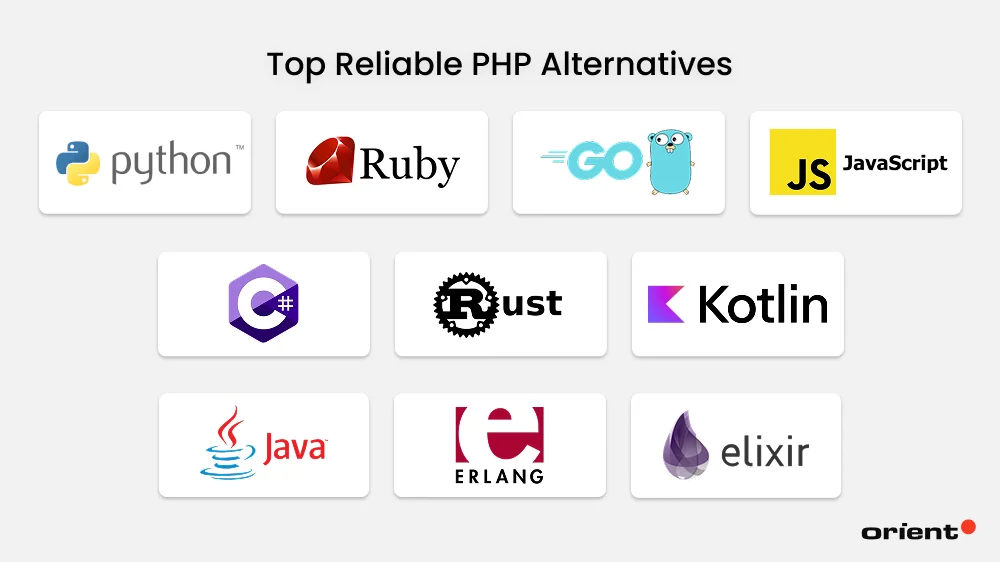
The Best PHP Alternatives to Consider: Top Programming Languages
In the web development scenario, there are many programming languages available today that can serve as strong alternatives to PHP. These picks are based on use cases, performance needs, and developer preferences.
Python
One of the most popular and robust PHP alternatives must be Python. First released in 1991, Python is a versatile, general-purpose, interpreted language, widely used for scientific computing, machine learning, automation, and web development.
Python advantages lie in its clean, readable syntax (similar to English) and ease of learning. The language also becomes a dominant force in web development thanks to Django, Flask, and FastAPI. These frameworks offer clean, readable syntax and strong conventions that help developers write maintainable code with minimal boilerplate.
But beyond web applications, this versatile language is the “leading language of modern development” across data science, machine learning, artificial intelligence, automation, analytics, DevOps scripting, and scientific computing.
Compared to PHP:
Python excels in data science, AI, and automation. These are areas where PHP is rarely used. While PHP is stronger for traditional server-side web development, Python offers a broader application range and more robust ecosystems for analytics and scientific computing. Organizations that expect their digital ecosystem to integrate machine learning or data-driven features often choose Python because it allows them to build everything, from backend APIs to AI services, within the same language ecosystem.
Ruby
The creator of Ruby, Yukihiro Matsumoto, wanted a language that was fun to use and easy to learn. He succeeded in creating Ruby, an object-oriented programming language that is both enjoyable and practical. Created in the mid-1990s, Ruby, particularly when paired with Ruby on Rails, has become a strong alternative to PHP, trusted for rapid prototyping and start-up velocity.
One of Ruby’s advantages is its clean syntax that emphasizes convention over configuration. Together with Rails, Ruby helps teams build fully functional web applications extremely quickly, with clean scaffolding, built-in security, and smart defaults. This means teams can launch MVPs quickly, validate ideas faster, and iterate with minimal friction.
Compared to PHP:
Both Ruby and PHP are excellent for rapid web development, but Rails provides more opinionated conventions and built-in tooling than most PHP frameworks. PHP offers more hosting flexibility, while Ruby excels at developer productivity.
Golang
Go, or Golang, is an easy-to-learn, fast, and stable programming language developed by Google. It is an excellent alternative to PHP for teams that need extreme performance, low latency, and high concurrency. Go compiles to fast, lightweight binaries and can handle thousands of concurrent connections with ease through its goroutine model, making it highly effective for modern backend systems.
Go’s architecture, runtime, concurrency model, and binary output make it particularly well-suited for cloud-native, high-performance, and highly scalable backend development. Its simplicity and minimalism promote clean architecture and maintainable code, helping streamline the development process. Because of these strengths, many companies building distributed systems, microservices, and network-intensive applications turn to Go when they need maximum efficiency without sacrificing readability.
While Go may not be as universally popular as JavaScript or Python, it has firmly established itself as a top choice among backend and infrastructure engineers, especially in cloud-based environments. Its speed, resource efficiency, and ability to scale with minimal overhead make Go a powerful option for performance-critical services and technically demanding backend projects.
Compared to PHP:
Go outperforms PHP in concurrency, speed, and long-running processes. While PHP is easier for web-focused tasks, Go is superior for microservices, APIs, and systems that demand high-speed parallelism.
JavaScript
In the programming world, JavaScript is well known as a classic language that has empowered generations of coders. JavaScript, or JS, is a versatile and widely used scripting language that Brendan Eich created in 1995. Originally built for browser interactivity - such as animations, form handling, dynamic page updates - JavaScript has since expanded to server-side development through Node.js, powering full web applications end to end. This enables a unified full-stack development experience.

What makes JavaScript particularly compelling as a PHP alternative is its event-driven architecture, which enables it to handle a large number of simultaneous connections with minimal resource consumption. This makes it exceptionally strong for real-time applications such as chat systems, live dashboards, streaming platforms, and collaboration tools. PHP’s traditional request–response lifecycle is not naturally optimized for these areas.
Compared to PHP:
JavaScript provides a unified language for both frontend and backend development, while PHP is primarily a backend technology. Node.js also handles asynchronous tasks and real-time communication more efficiently than PHP’s traditional request-response model.
Java
Created by James Gosling in the 1990s, Java is a mature, strongly typed language commonly used in mobile apps, desktop applications, enterprise systems, and scientific computing. Java’s “write once, run anywhere” philosophy and strong ecosystem have made it a global standard, supported by massive open-source communities and powerful tools.
Frameworks like Spring Boot have modernized the Java ecosystem; this enables developers to build microservices, REST APIs, and cloud-native applications with ease. Java is a top choice for large organizations that prioritize long-term maintainability, strict security, and scalable architectures. Its vast ecosystem, tooling support, and enterprise integration capabilities make it a powerful alternative for complex or mission-critical systems.
Compared to PHP:
Java is better suited for enterprise-scale applications requiring strict type systems, multi-threading, and decades of tooling support. PHP is easier to deploy for smaller web applications, but Java excels in large, mission-critical systems where performance and type safety are priorities.
Other Options
- Erlang: Erlang is far superior for real-time, fault-tolerant applications, while PHP is better suited for request-based web applications. Erlang’s concurrency model is unmatched, but its syntax and paradigm require a steeper learning curve.
- Elixir: Built on the Erlang virtual machine (VM), Elixir delivers far better concurrency and uptime than PHP. While PHP focuses on synchronous web requests, Elixir is ideal for real-time systems, chat apps, notification servers, and event-driven architectures.
- C#: C# and .NET offer stronger performance, advanced libraries, and native support for desktop, cloud, and enterprise development. PHP is more accessible for beginners and easier to host on shared servers, but C# provides a more structured environment for large-scale software systems.
- Rust: This programming language is vastly safer and faster than PHP for systems-level development. While PHP simplifies web development, Rust targets reliability-intensive software such as servers, compilers, security tools, and real-time systems.
- Kotlin: Kotlin is both an object-oriented and a functional programming language. Kotlin’s static typing, null safety, and multi-platform capabilities give it a major advantage for mobile and enterprise systems. PHP remains easier for classic web development, but Kotlin offers stronger safety and versatility across platforms.
Choose the Right Technology with Confidence
PHP still powers a significant portion of the web and remains an excellent choice for many traditional applications. However, the expectations have evolved far beyond what PHP was originally created for. And PHP may not always be an ideal option for your project.
With so many powerful alternatives to PHP - each with its own strengths, ecosystems, and ideal use cases - selecting the right programming language can quickly become overwhelming. The decision affects not only your development timeline but also scalability, long-term maintenance, security, and overall cost of ownership.

At Orient Software, we help businesses cut through the confusion and choose the technology that best supports their product goals. Our development teams are experienced across a broad range of modern languages and frameworks. Rather than pushing a one-size-fits-all solution, we assess your requirements and recommend the stack that delivers the best performance, flexibility, and long-term value.
Whether you’re modernizing an existing product, exploring alternatives to PHP, or building a new application from scratch, our experts can guide you from planning to deployment with a clear, strategic roadmap. Reach out to us today to discuss your project, and let’s build the right solution together.

Trung Tran
Technical/Content Writer
Trung Tran
Technical/Content Writer
Topic: