Editor's Picks: Fintech Software Development Companies of Choice in Vietnam
For fintech businesses seeking a reliable development partner, this curated list features four trusted service providers to consider.
Content Map
More chaptersThe fintech services industry in Vietnam today is staggeringly different, especially in the context of digital transformation. The scene has shifted from the early experimentation phase to a scale-up and formalization stage.
Notably, mass-market digital payments are becoming mainstream. In the first 9 months of 2025, there were 17.8 billion non-cash payment transactions processed by Vietnam’s banking system, and around 87% of adults have a payment account. The stats signal that Vietnamese consumers and merchants are more comfortable with digital money movement. And the infrastructure, like QR acceptance, bank connectivity, settlement, and reconciliation processes, becomes mature enough to support nationwide rollouts. This is a crucial foundation for fintech products to reach mass adoption in Vietnam. The rise of two digital payment unicorns made in Vietnam, namely MoMo and VNPay, further underscores the momentum behind the country’s digital finance evolution.

Vietnam is not only ready for financial technology in terms of customer adoption and payment infrastructure, but it is also emerging as a delivery hub. The country offers both fintech-grade engineering capacity and a pool of talent experienced in building and operating transaction-heavy products.
For foreign fintech firms, outsourcing to Vietnam has become a practical move to gain both resources and real-world delivery insights without losing control of product direction. Vietnam boasts a broad vendor landscape, so which partner to pick? By shortlisting top choices of financial software developers in Vietnam, this article aims to support informed decision-making or, at the very least, provide useful points of reference.
How We Assess a Custom Fintech Software Development Company
Vietnam’s tech industry is indeed experiencing exponential growth and entering a booming phase. In the financial services industry alone, Vietnam is home to more than 260 fintech startups that offer a wide range of solutions, spanning digital payment systems and e-wallets, wealth management, alternative finance, and blockchain/crypto-related solutions.
What about fintech software developers? As aforementioned, Vietnam also has a vivid delivery ecosystem with a large and soaring volume of service providers. According to official figures reported by Vietnam’s Ministry of Science and Technology, the country had 73,788 digital technology enterprises as of the end of 2024. With so many providers claiming strong technical and engineering capabilities, making the right choice can feel overwhelming without clear evaluation criteria.
Here are the key criteria we use to shortlist top fintech software development vendors. Let’s check them out.
What They Excel at
First and foremost, a reliable partner must provide both industry expertise and fintech readiness.
During the evaluation process, cutting-edge technology or technical proficiency is not a differentiator to consider, but the entry ticket. Therefore, a strong engineering company needs to first demonstrate capability across the full stack, including backend, frontend/mobile, data, QA, cloud computing, and DevOps. The focus is on strong practices for transaction integrity, security, and production readiness.

What else? The most dependable vendor specializes in translating financial complexity into financial software that can be deployed, monitored, maintained, and evolved without breaking trust.
Beyond technical prowess, the fintech developers of choice should adhere to a mature, well-defined software development life cycle. Clear requirements and acceptance criteria, secure coding and peer reviews, automated testing for critical flows, controlled releases, and production monitoring are baked into every phase of the development process.
What They’ve Delivered
Secondly, a fintech-ready team you can truly rely on must be able to demonstrate its specialization and experience through real-world delivery across core fintech domains such as online payments, digital banking, lending, and wealth management, or insurtech. This makes verifying a vendor’s proven track record not just helpful but essential.

The strongest credibility does not come from promises or polished marketing materials, but from what a financial software developer has actually shipped, maintained, and supported in production. It is important not to move too quickly or rely solely on portfolio pages filled with glossy screenshots, as they often reveal very little about real delivery capability.
A proper due diligence process requires a careful review of past projects, client feedback, and in-depth case studies. These references offer a clear window into a company’s true strengths, including the depth of its fintech domain exposure, its ability to manage integration-heavy systems, the maturity of its security and compliance practices, and the consistency of its delivery execution. By examining past performance, you can more accurately assess the caliber of a fintech software developer’s output and determine whether it has successfully built solutions comparable to your product vision.
What They Provide
The next criterion to check is the services offered. It is not because “more services” automatically mean “better”, but because your success depends on having the right capabilities available at the right time.

In reality, you don’t necessarily need a comprehensive, end-to-end provider. Many fintech teams work effectively with a specialist partner. For example, if your priority is financial app development, it makes sense to focus on vendors with proven mobile expertise, secure authentication flows, and experience delivering production-ready apps in regulated environments. Likewise, if you’re building a backend-heavy platform, you may prioritize architecture, integration, and reliability engineering over UI capability.
The ultimate goal is not to reward the biggest menu of services but to shortlist partners that can reliably deliver what fintech companies require as they build and scale their products. That said, this article targets a wide base of buyers whose needs often evolve quickly. For that reason, we give higher priority to companies with versatility. They are teams that can cover multiple stages of the product lifecycle and expand scope without forcing you to switch vendors in midstream.
Popular Services to Entrust with a Fintech Software Developer
Fintech products are rarely “build one application and ship it.” They are often a blend of product design, transaction-heavy engineering, third-party integrations, security controls, and long-term operations. That’s why companies typically outsource fintech software development in clusters - services that either call for specialized expertise or continuous demand execution.
In this section, we’ll highlight the key offerings so you can quickly map your requirements to the type of partner you should shortlist. The following categories match how a fintech company (service buyer) approaches outsourcing decisions, starting from building to connecting, operating, protecting, and scaling.
Product Engineering
The first group focuses on the core engineering capability you look for in a vendor. Services under this category cater to the ability to translate business needs, ideas, and requirements into viable financial solutions. The ultimate goal is to ship faster while maintaining product ownership and decision-making in house.

Custom Software Development
Within fintech outsourcing, custom development refers to engineering customized software solutions (mobile and web applications) that match specific financial workflows, security requirements, and integration environments. This group is an umbrella that can span the full software development lifecycle, from discovery and solution design to development, testing, deployment, and long-term maintenance.
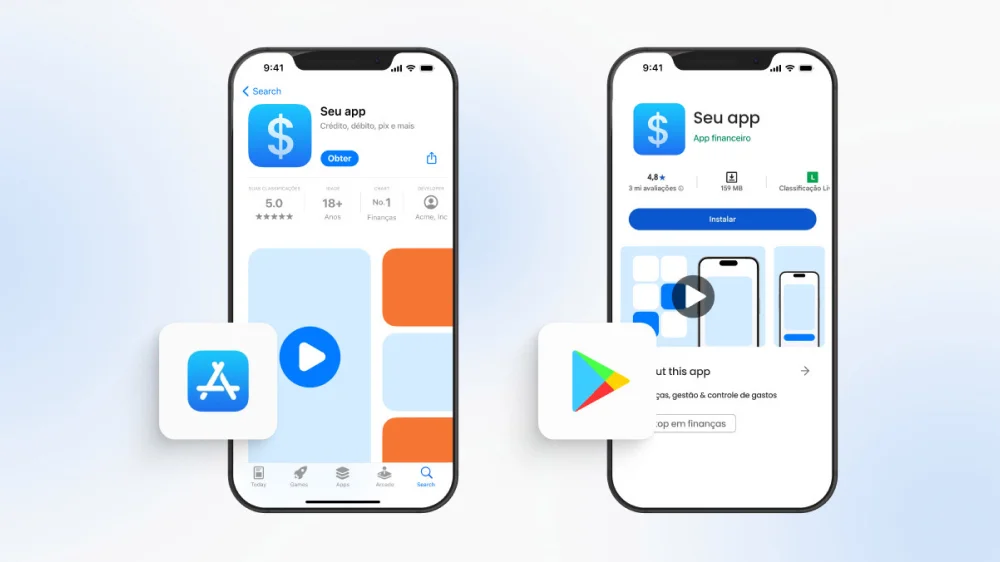
- Mobile Application Development: Mobile apps, such as e-wallets, mobile banking, and investment/trading platforms, have become the primary interface of today’s fintech services. These mobile applications are purposefully designed to enable easy and secure financial transactions on the go, creating seamless and enjoyable user experiences on mobile devices while still demanding a high bar for security, usability, and reliability. In this regard, mobile development services make it easy and accessible for tech startups and financial institutions to build intuitive, user-friendly applications tailored to specific workflows and compliance expectations.

- Website Design & Development: Fintech web development services are about crafting secure, responsive, and user-centric websites that function like a brand’s digital front door. These web-based platforms display products and services, enable customer support, and support secure online interactions. For many financial institutions and companies, well-built websites also serve as an important conversion channel where they guide users toward digital registration or app adoption, significantly broadening their customer reach and boosting revenue generation. In practice, various financial institutions and merchants outsource web development to empower e-commerce experiences where websites must handle checkout flows, payment processing, and integrations with third-party services. In these cases, the priority shifts from “just design and content” to performance, security controls, and reliable payment experiences that protect both the business and end users.

- Web App Development: Web applications are browser-based products that run across devices without requiring download or installation. In fintech, web apps are commonly used for customer portals, merchant dashboards, internal operations tools, or lightweight consumer experiences where cross-platform reach matters. Usually, fintech firms resort to web app development services when they need richer functionality than a standard website while optimizing time and resources.
UI/UX Design & Development
User interface (UI) and user experience (UX) are both important to create a successful digital product that not only looks modern but also functions smoothly. In fintech, UI/UX design remains critical when it comes to shaping trust, clarity, and conversion in every journey where users share sensitive data and transfer money.

Therefore, UI/UX services are tasked to craft intuitive interfaces and frictionless flows for key moments such as onboarding, identity verification (KYC), authentication, transfers, bill payments, and investment actions. Meanwhile, the focus is also on clearly communicating transaction status (pending, completed, failed) to reduce confusion and support burden.
Platform & Integration
This group of services engages in building the core digital infrastructure that underpins financial products. The purpose is to transform a fintech business idea into one connected, scalable ecosystem where systems, applications, and data work seamlessly together and securely at scale.
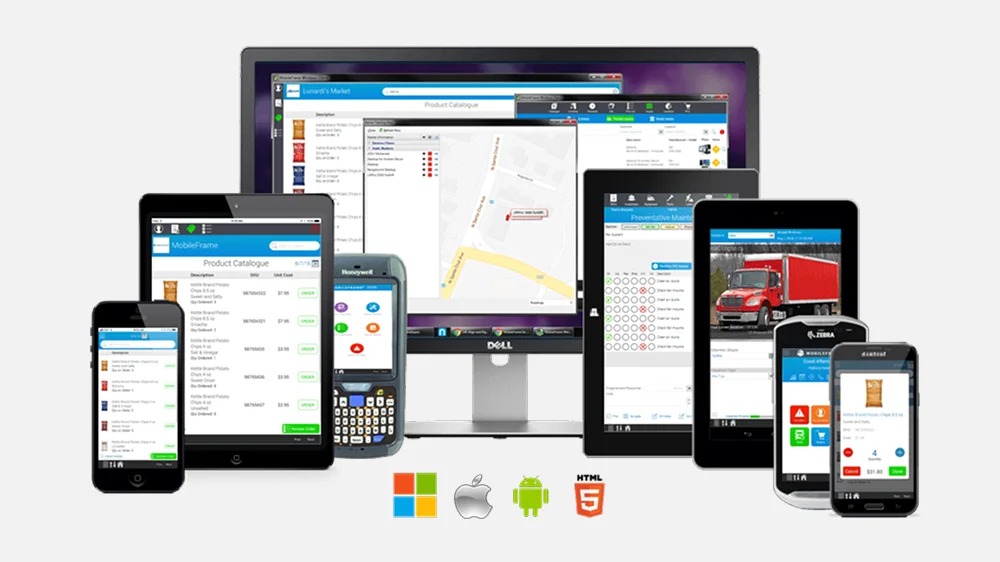
Software Integration
In fintech, software integration services aim to connect disparate financial systems like banks, payment gateways/PSPs, card processors, KYC/identity providers, fraud tools, CRMs, and accounting systems, using APIs. This ensures data and transactions can flow reliably end-to-end while minimizing manual effort. Also, it allows for the incorporation of AI and other cutting-edge technologies to improve business analysis, decision-making processes, and overall customer experience.
API Development & Middleware
APIs serve as digital connectors that standardize how software interacts, while middleware acts as the orchestration layer, managing communication, security, and data consistency between front-end applications and back-end systems. This type of service focuses on building enablers for communicating, sharing data, and performing transactions across various systems, such as core banking systems, payment gateways, and analytics tools.
Cloud Infrastructure & DevOps
Strong cloud and DevOps capability is what enables frequent releases without risking stability and keeps the fintech product resilient while it evolves. And this area of services covers how a fintech system is deployed, monitored, and operated at scale.

- Cloud Development: This includes designing cloud architecture, selecting managed services (databases, queues, caching, identity services), containerizing workloads, and setting up secure networking and access control.
- CI/CD, Infrastructure-as-Code, Monitoring & Observability: This service sub-category is about repeatable, low-risk delivery and production visibility. CI/CD pipelines automate building, testing, and deploying software so releases are faster and less error-prone, while infrastructure-as-code makes environments consistent, auditable, and easy to reproduce across dev/staging/production. Monitoring and observability (logs, metrics, traces, alerts, dashboards) ensure teams can detect anomalies, trace transaction flows end-to-end, and respond quickly to incidents.
Data & Automation
Services under this group involve data analytics, reporting, and automation initiatives (Such as robotic process automation). They aim to help fintech companies reduce manual work and improve decision-making while strengthening risk control and scaling operations.
Blockchain & Digital Assets
This category reflects specialization for fintech businesses that treat digital assets as central parts of their products. Still, it is not a default requirement for most fintech products, but when needed, it often demands niche skills in smart contracts, wallet infrastructure, security hardening, and transaction monitoring.
Spotlight on Top Providers for Financial Software Development Services in Vietnam
Without further ado, let’s come to our top Vietnamese service providers. Note that not all of these fintech software development companies are headquartered in Vietnam.
Orient Software
Services Offered: Mobile app development, web development, web app development, UI/UX design, quality assurance and testing, legacy system modernization, and cloud and infrastructure.
Fintech Domains: Payment gateways, digital wallets, mobile banking apps, investment platforms, wealth management systems, and blockchain development.
First on the list is a 100% made-in-Vietnam candidate - Orient Software. Founded in 2005 in Ho Chi Minh City, Orient Software has positioned itself as a one-stop service provider for end-to-end software engineering services. Beyond coding, Orient provides comprehensive solutions, including UI/UX design, QA testing, and staff augmentation.
In 2026, the company celebrates its 20-year milestone, which marks a successful journey with a proven track record of 200 projects delivered and 100+ global clients, and a talent pool of 400+ professionals spanning specialized areas.
Successful Stories:
In fintech software development, Orient Software is a dedicated team with sufficient resources, solid expertise, and hands-on experience. As a reliable partner, the company has helped lots of businesses transform and optimize financial operations with digital solutions and technical support. The following are a few of their successful cases:

- Netwealth - an Australian fintech company specializing in superannuation funds, wealth management, and financial administration services. Netwealth was under pressure to modernize its infrastructure quickly and cost-effectively without compromising quality. Orient Software tailored a modernization plan that replaced the legacy monolithic system with a scalable microservices-based architecture, improved deployment and security efficiency, and provided ongoing maintenance and optimization with agile collaboration.

- Plenti - an Australian technology-powered lender. In this case, Plenti encountered legacy infrastructure limitations that slowed development, and they needed to scale rapidly in consumer finance. However, they struggled to expand their internal IT team quickly enough to meet their high security and performance demands. Orient Software assembled a dedicated team of 15 skilled engineers and helped Plenti migrate to .NET Core, adopt microservices, and move infrastructure to Kubernetes for scalable operations.

- DigiPay Espos - A Norwegian cashless payment solution provider. DigiPay Espos was in the middle of developing a comprehensive payment (ePayments) system to support expansion into the Southeast Asian market. They faced high local development costs, lacked a well-thought-out technical roadmap, and required a scalable solution to support expansion into Southeast Asia. Orient formed a team to build a secure online payment system with ESPOS card integration and an e-wallet supporting Visa/MasterCard and local gateways (Netsaxept & Vipps), plus integration with vending machines and merchant systems.
- And more case studies.
Furthermore, Orient Software is one of the pioneers in AI offering in Vietnam. As an AI-driven organization, Orient Software does not chase artificial intelligence hype; the company applies AI where it delivers measurable value. Instead of over-expecting and over-promising AI transformation, Orient concentrates on pragmatic adoption. This outsourcing vendor embeds AI into day-to-day workflows to boost performance, quality, and speed, guided by well-defined strategies and realistic roadmaps. As a service provider, Orient supports AI initiatives with its consulting and development services as well as skilled professionals.
So, whether you need a dedicated squad to deliver AI-powered features and specialized talent (Machine learning/AI engineers, data engineers, etc.) or an AI strategy and enablement partner, Orient Software can support you end-to-end.
Axon Active
Services Offered: Dedicated software development team, project management and consulting services, ICT and DevOps services for cloud computing, and coaching and training services.
Fintech Domains: Mobile payment systems, digital banking onboarding, and trading platforms.
Founded in 2008, Axon Active is a Swiss-headquartered company specializing in agile software development. The company maintains operations in both Switzerland and Vietnam. In the “S-shaped” country, Axon establishes multiple branch offices in Ho Chi Minh City, Da Nang, Can Tho, and Thu Duc City.
Axon positions itself around its dedicated development teams and delivery governance. For more than 17 years of success in ICT outsourcing services, Axon has built a strong pool of talent, including 80+ teams and 650+ professionals, and empowered 40+ long-term clients. This fintech solution company boasts a portfolio spanning various industries, including business intelligence, ERP, energy, healthcare, insurtech, smart mobility, and more. And fintech software development is also one of its strengths.
Successful Stories:
- MetaTrader Platform (Australia): Axon Active worked on the improvement of the MetaTrader (MT4/MT5) trading platform and its surrounding ecosystem. In this project, the core challenge was to enhance user experience while ensuring fast load times, strong data security, bug-free performance, and efficient customer support readiness. As a technical partner, Axon addressed this by simplifying and decluttering the interface, iterating via user testing, optimizing code for speed, and strengthening security practices.
- And more.
KMS Technology
Services Offered: Advisory & technical consulting, application modernization, artificial intelligence, cloud & DevOps, data & analytics, product engineering, quality engineering & test automation, systems & integration.
Fintech Domains: Digital banking and payments, client onboarding and compliance workflows, trading/brokerage ecosystems, and more.
Founded in 2009 in the U.S., KMS Technology positions itself as a strategic software engineering and technology consulting company. The company has expanded its cross-border presence with the headquarters in Atlanta and delivery hubs in Vietnam and Mexico, becoming a global organization with over 1,100 professionals across locations.
KMS Technology pursues the vision of bringing deep industry expertise, AI-native engineering, and delivery excellence to each and every engagement. This company specializes in end-to-end product engineering and excels in various domains, especially fintech software development services. For over 16 years in business, KMS has gained trust from more than 130 global clients, primarily in the U.S. and Canada.
Successful Stories:
- Asia Commercial Bank (ACB) - Business Banking App: This was a digital banking build focused on architecting and launching a dedicated “Business App” to serve business customers. The key challenge at first was speed-to-market, as ACB wanted to move quickly enough to meet modern user expectations while still meeting security requirements for a typical banking product. KMS helped by providing product engineering support to the architect, build, and deploy the app as required.
- Agreement Express - Fintech-supporting onboarding platform: This project centers on a fintech-supporting platform utilized by financial services firms to streamline onboarding and compliance-heavy workflows. Agreement Express needed to accelerate a critical roadmap and modernize delivery while maintaining momentum through major releases. KMS supported them by supplying dedicated Scrum teams, helping deliver multiple large-scale releases while also supporting a key modernization phase.
- And more.
NashTech
Services Offered: Custom software development, artificial intelligence, cloud app development, quality assurance & testing, tech consulting, and data science solutions.
Fintech Domains: Digital banking, core banking modernization, payment/transaction platforms, AI in financial services, etc.
Headquartered in London, United Kingdom, NashTech is a global technology services and software development firm. It is also known as a part of Nash Squared, a UK-based global professional services group focused on technology, outsourcing, and talent solutions.
With over 25 years in the outsourcing industry, NashTech has established a global presence across multiple popular hubs, namely Canada, the USA, Germany, India, Singapore, Costa Rica, and Australia. NashTech has deep roots in the Vietnamese market with offices in Ho Chi Minh City, Hanoi, and Da Nang, setting a strategic development base for clients across the globe.
NashTech specializes in secure mobile development, custom backend systems, data platforms, AI integration, and cloud migration. While NashTech is not exclusively fintech-focused, it still remains a strong contender for fintech solutions thanks to its breadth of services, deep engineering talent (with 2000+ skilled professionals), and hands-on tech delivery experience.
Successful Stories:
- VietinBank - a major Vietnamese commercial bank: VietinBank, one of the “Big Four” prestigious banks in Vietnam, chose NashTech to help optimize internal operational efficiency and drive digital transformation. They chose NashTech as a technical partner to build an advanced custom AI chatbot called Genie. This model was powered by NashTech’s BonBon AI platform and tailored to the unique needs of VietinBank. After two months, Genie was rolled out successfully, enabling VietinBank to process more than 350,000 queries and reduce 95% of Q&A time for the staff.
- A Finance Giant - a large international bank: The client is a global bank that operates PayMe, a social payment app exclusively built for the Hong Kong market with 1.8+ million users. The system previously dealt with fragmented data systems that made analytics, personalization, and fraud detection slow and inefficient. The client then reached out to NashTech to help them build a unified data and machine-learning architecture. As required, NashTech designed a scalable data platform that consolidated multiple databases into a single source of truth and enabled real-time analytics and ML workflows. As a result, data processing times were reduced from hours to seconds, user engagement increased significantly, and the bank gained the ability to apply predictive models for personalization and transaction monitoring.

Trung Tran
Technical/Content Writer
Trung Tran
Technical/Content Writer
Topic: