

How to Reduce Technical Debt Before It Starts
At the time, the decision made perfect sense. Months later, that same decision became one of the hardest parts of the system to change. What once looked like progress quietly turned into technical debt. If this is your reality, read on to find the solutions.

Content Map
More chaptersReducing technical debt is one of the top priorities for most software development teams. However, it is often addressed too late.
By the time technical debt becomes visible, systems are already hard to modify, reuse, or scale. At this point, developers have no choice but to respond with refactoring, stricter rules, and more tooling; and of course, these methods are merely stopgap measures and don’t truly address the core problem. In other words, technical debt reduction efforts implemented early in the software development life cycle - when architectural decisions are still flexible, usage assumptions are being formed, and the cost of change is lowest - are the most effective way to avoid falling into a fait accompli.
What do you need to know to reduce technical debt from the start? This article will provide you with many interesting insights from real-world project developers.
The Myth: Technical Debt Comes from Bad Implementations
Technical debt refers to the long-term financial debt of choosing quick code solutions or simpler solutions today instead of a more sustainable one that would better support future changes to shorten the time to launch software products.
Many people still believe that technical debt is the result of bad implementation, such as messy functions, lack of tests, rushed work, or engineers cutting corners. This belief makes sense in several ways. Because code quality issues are easy to spot and often painful to work with, as they cause systems to slow down or become fragile, it is natural to blame implementation details as the cause of technical debt.
Reading this far, you may realize a paradox that there are well-maintained systems that still experience slowdown over time, no matter how well they are deployed. Even with clean code and strong testing, systems can become increasingly risky to modify as they are reused and extended beyond their original assumptions. Teams can follow best practices, write clean code, and maintain test coverage, but still accumulate technical debt.
All evidence shows that the myth that technical debt comes from bad implementation is not entirely true and is not a valid answer in all cases. By focusing only on how code is written, this myth creates a false sense of control and causes teams to miss where technical debt actually accumulates.
The Reality: Technical Debt Appears Where Code Is Used
The reality contradicts what many people believe. Under normal circumstances (a rather healthy organization with code reviews, for example), architecture debt, build debt, code debt, defect debt, design debt, or whatever debt belongs to technical debt, never occurs at the point of implementation. Instead, technical debt is often created at the point where code is used, not where it is implemented.
Typically, components and functions are designed to serve only a specific context. However, as the system grows, those same pieces of code are used to extend, reuse, or integrate into new parts of the product. A function that once served a single purpose may now support several features. Doing this without revisiting the original assumptions, even small changes can trigger a “butterfly effect,” breaking behavior across the system in unexpected ways. This is a natural outcome of software evolving beyond its initial design boundaries, which results in later technical debt.
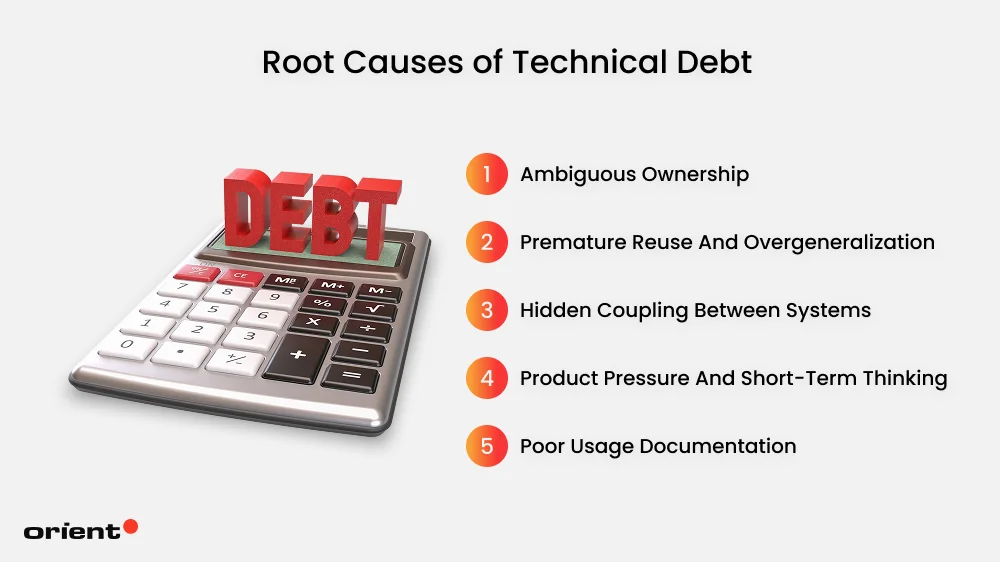
Although technical debt often feels like a single problem, it usually emerges from a combination of systemic issues. The most common root causes tend to appear not in isolated implementation decisions, but in the way responsibility, usage, and change are managed as systems grow.
Root causes of technical debt include:
- Ambiguous Ownership: When it is unclear who owns a piece of code at the usage level, changes become risky. Without documented assumptions and decision context, teams lack understanding of the downstream impact of source code. Although the change process can still take place, the risk of duplicated logic or unintentional side effects is very high due to this lack of clear ownership.
- Premature Reuse and Overgeneralization: Reusing code is often seen as a way to save time. However, when code is reused before real usage patterns are fully understood, and changes are driven by hypothetical future needs, the code may appear adaptable on the surface but actually become burdened with too many changes for too many unclear reasons.
- Hidden Coupling Between Systems: Even when modules appear to operate independently for their own purposes, shared assumptions and implicit dependencies can tightly couple them together. However, these relationships are rarely explicitly documented, and developers often only discover them during the implementation of changes. As coupling increases, small updates can require system-wide awareness and coordination.
- Product Pressure and Short-term Thinking: As delivery timelines mean a lot to every project and development team, decisions made to “just get it working” rise as one of the seemingly reasonable measures at the moment. In reality, this is a very dangerous short-term thinking. As the system develops and expectations rise accordingly, cleaning up the mess beforehand becomes an obstacle to necessary structural improvements.
- Poor Usage Documentation: Many source code programs are very well documented, but lack clarity on how they should be used. Without explicit guidance on intended use cases, boundaries, and limitations, developers rely on assumptions. Over time, inconsistent usage increases the likelihood of misuse and unintended dependencies.
Early Warning Signs That Technical Debt Is Forming
Technical debt doesn’t develop overnight; it’s a process of formation - a silent one at that. In most cases, tech debt is embedded in everyday development decisions - decisions that seem “logical” at the time but aren’t. These early warning signs are often quite obvious but frequently overlooked in everyday decisions and conversations, specifically:
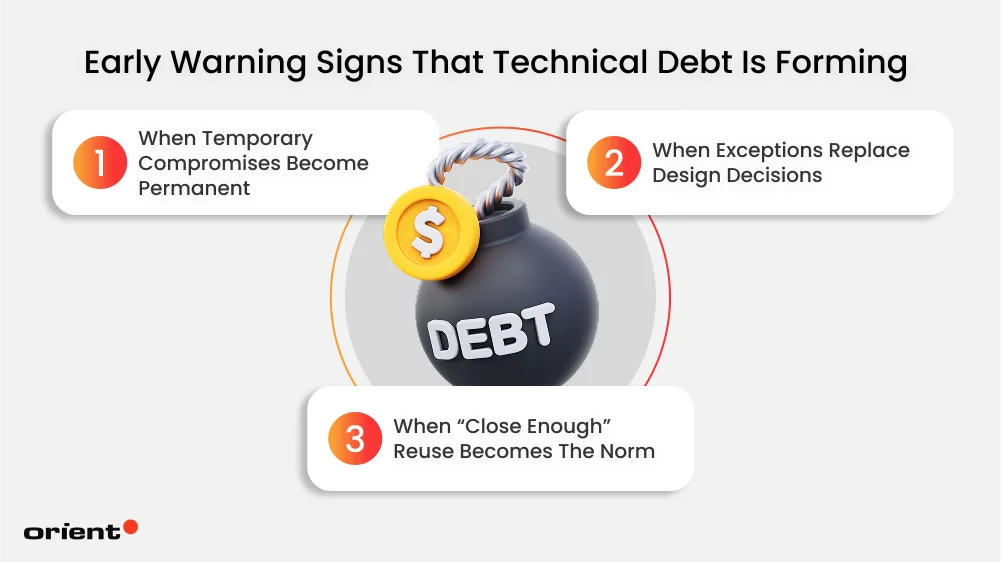
When Temporary Compromises Become Permanent
Sometimes teams know perfectly well what the best solution is for a given situation. However, time pressure causes them to unthinkingly overlook future consequences and choose time-saving methods in the present with the intention of revisiting them later. Typical thoughts include “This is just for now,” “We will clean this up later,” or “We don’t have time to design it properly.” These common thoughts are among the top early signs that technical debt is approaching.
Once the feature works, the deadline passes, and the new priority arrives, the truth is nobody comes back to improve those temporary solutions. The compromise quietly becomes permanent, even though it was never meant to be. Implementing future changes with the same shortcut that wasn’t designed to last at the beginning quickly leads development teams into technical debt in later stages of the project, whether they like it or not.
When Exceptions Replace Design Decisions
Adding rules instead of rethinking design is one of the quick solutions many development teams use when faced with new features/requirements. This is understandable, as it is often easier to add conditional logic or special cases than to reconsider the original design. However, besides making things move quicker, adding an “if” for the situation can cause the system to increasingly deviate from its original structure, making the original purpose of the code unclear. Each added exception makes the code harder to understand and increases the risk of unintended behavior when changes are introduced.
To give a more practical example, this is similar to patching holes in a wall instead of fixing the foundation. Each patch helps temporarily, but the structure gets weaker overall.
When “Close Enough” Reuse Becomes The Norm
Reusing existing work is a good thing to save time and help teams move faster. That’s why when a piece of code already exists, engineers often look at it and think, “This almost does what we need.” And this is where everything starts - the origin of a high technical debt ratio.
The problem starts when “almost” becomes good enough. Instead of starting from scratch and building something that truly fits the new requirement, existing team members choose to adjust the original code and extend its logic without considering any other references to it in other areas. What they usually do is add small tweaks to make the systems work temporarily, regardless of the former design that was never meant to support this new use.
At first, this feels efficient. But underneath, each new adjustment slightly changes how the code behaves. Future developers may not know why certain behaviors exist or which part of the system relies on them. Even though nothing seems to be wrong and the system obviously won’t collapse immediately, it becomes harder and riskier to update, making what starts as a time-saving decision turn into long-term and increased maintenance costs.
Although the three signals may seem similar at first glance, they represent different stages of the same underlying problem, which is further explained in the table below:
| Sign | What it reveals |
|---|---|
| When temporary compromises become permanent | Short-term decision-making becoming long-term constraints |
| When exceptions replace design decisions | Growing structural complexity |
| When “close enough” reuse becomes the norm | Loss of clarity and confidence about how the system should be used |
Can Technical Debt Be Eliminated Once It Already Exists?
When technical debt has already formed, teams often ask whether it can be completely eliminated. Unfortunately, the short answer is no. Technical debt can be reduced after it appears, but completely eliminating it once it already exists is very difficult.
The reason for this? It’s not because development teams lack skill or discipline. Rather, it’s because software systems are living components that are constantly evolving over time. They need to respond to new requirements and operate closely under changing real-world constraints as a matter of course to survive in a competitive market. This growth will accumulate some level of technical debt again in the future.
We have many measures to prevent the emergence of technical debt, but these are, after all, only stopgap measures, providing only temporary relief instead of putting a permanent end to the debt’s existence.
Often, teams simplify overly complex areas, refactor code that causes frequent issues, and remove components that no longer serve a clear purpose to improve system stability. Even with these clean-up efforts, some level of technical debt will still reappear as the system continues to grow. The result is that, besides wasting effort, addressing technical debt after it’s too late costs business teams more money and slows down the development of existing systems. So, the goal here shifts from elimination to intentional management: preventing tech debt from the very start.
Best Practices to Reduce Technical Debt from the Start
Once technical debt is embedded in a system, teams are no longer choosing freely. Instead, they are working within the constraints of past decisions. This is why the most effective way to manage technical debt is to reduce the conditions that allow it to form in the first place. Automated tests, in particular, provide confidence when changes are necessary, reducing the fear that often accompanies technical debt. However, it is not the only solution.
Most best practices to mitigate technical debt come from changing mindsets, which begins with understanding technical debt not as a single issue, but as a set of patterns that emerge throughout the software development lifecycle.
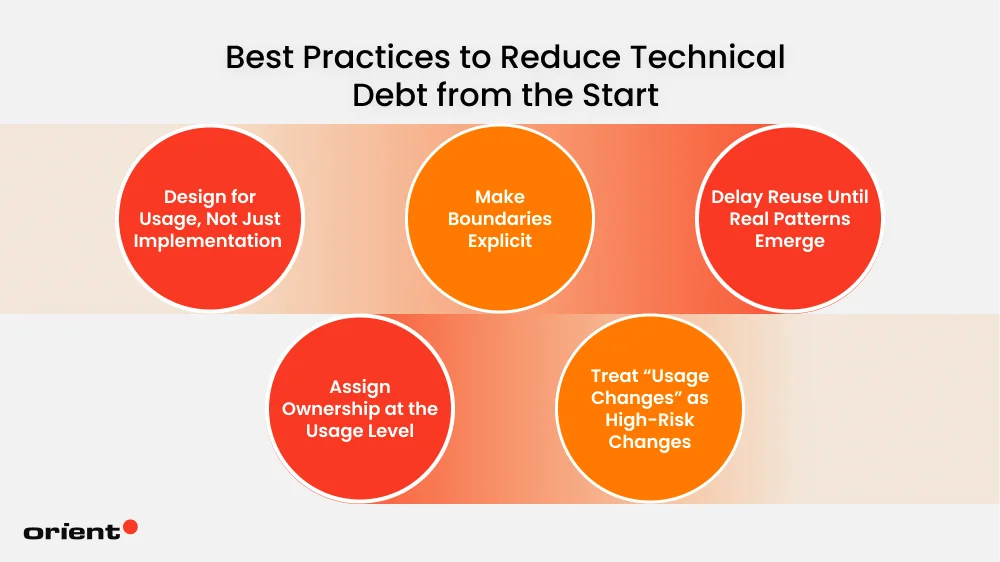
Design for Usage, Not Just Implementation
We cannot deny that how well a piece of code is written plays a crucial role in the success of software projects. However, it is not everything. Many teams focus solely on implementation details to ensure the code best meets current needs, forgetting that code should also be designed with a clear understanding of how it will be used in the future. This often leads to process debt, where the system technically works but becomes difficult to adapt as usage expands.
Not all technical debt comes from poor execution. Development teams need to write code not only to satisfy current requirements, but to design things with long-term usage and evolution in mind. The solution here is to keep one principle in mind: design for usage from day one by making assumptions explicitly and considering realistic future scenarios. Following this practice helps teams identify technical debt early instead of struggling with a system that wasn’t designed for evolution.
Make Boundaries Explicit
In real software systems, there are often multiple libraries and components that appear to solve similar problems. When utilized by different teams, overlapping functionality can be created over time. Because of this, an engineer cannot rely solely on the code to know which one is safe to use. This is where clear boundaries come into play, acting as guidelines that make usage expectations explicit.
Technically, boundaries define:
- Responsibility: what a component is meant to do
- Scope: where it should be used
- Constraints: situations it was not designed for
By using documentation, design, and architectural decisions, teams can clearly define boundaries, helping everyone understand where lines are drawn. With well-defined boundaries, it is easier to distinguish between different types of technical debt, such as architectural debt or process debt, allowing teams to collaborate smoothly, guide engineers toward the correct choice, and reduce accidental misuse. Conversely, working under boundaries makes it harder to mitigate technical debt as the system grows.
Delay Reuse Until Real Patterns Emerge
The principles of thorough analysis and stakeholder understanding apply not only in product planning but also in software development. You cannot develop a feature effectively without first understanding the requirements and the nature of the problem they are trying to solve. Even when reuse is the goal, it doesn’t mean you can skip such a stage.
Your project evolves over time, inevitably leading to changes in feature requirements and usage patterns. For this reason, internal code, including business rules, shared services, domain-specific components, and internal helper functions, must adapt to these shifting contexts. While reuse is often encouraged, delaying it until clear, repeated usage patterns emerge helps avoid premature generalization. Instead of building shared solutions based on assumptions, teams can design reusable components based on real evidence, reducing complexity and preventing unnecessary technical debt. This mindset helps teams avoid building “shared” components too early, before they understand what should actually be shared.
However, besides that, there are some types of reuse that you can freely use if appropriate, such as frameworks (React, Spring, .NET), libraries (authentication packages, logging tools), standard infrastructure tools, etc. These tools are built specifically for reuse, reducing effort without introducing much uncertainty.
Assign Ownership at the Usage Level
A feature is typically designed to solve a specific problem. Modifying it, even slightly, for a different purpose without proper review eventually creates conflicts, making the system risky and difficult to modify. Instead of “Anyone can reuse this.” It should become “This component has an owner. Let’s check before we extend it.” This level of clarity prevents hidden complexity and reduces technical debt.
Many people still think that ownership only extends to writing code. In reality, ownership should exist at every level of the system. It is not just about writing code, but about taking responsibility for how that code is used, maintained, and evolved over time.
If there is a clear owner of the code, it is essential to ask them to review your intended usage to determine if your new use case fits within its boundaries. This isn’t about permission; it’s about impact awareness. Even if the original developer leaves the company, the source code should still be granted to another individual to leave room for future reuse and development of the software. This is how clear ownership helps teams manage technical debt more consistently, especially as team members change.
Treat “Usage Changes” as High-Risk Changes
Even the smallest changes should be flagged as dangerous changes. This may sound exaggerated and unnecessary, but it’s one of the best ways to reduce technical debt. Saying this doesn’t mean you should panic every time someone reuses something. Treating “usage changes” as high-risk changes means usage changes deserve deliberate review, not automatic approval. This encourages teams to review code carefully, test thoroughly, and communicate impacts clearly, regardless of whether the change is big or small.
Practices such as continuous integration and well-chosen project management tools can support this approach by surfacing risks early and maintaining visibility across teams. Over time, this makes it easier to measure technical debt, track its growth, and decide when targeted improvements are necessary.
Conclusion
Technical debt doesn’t build up overnight, nor does it stem solely from careless implementation. It’s the small, seemingly reasonable decisions you make under time pressure and expanding your usage that are the root cause. When these decisions are repeated without clear ownership, boundaries, or review, they gradually generate technical debt that slows teams down and increases long-term risk.
Some forms of debt are highly visible (e.g., duplicated logic, complex conditionals). Others are less obvious but equally costly (e.g., infrastructure debt, outdated deployment pipelines, environments that no longer support fast iteration). Without deliberate attention, these hidden issues compound over time and reduce a team’s ability to deliver reliably.
Hopefully, with everything Orient Software has gathered from the perspective and practical experience of our project team, we have helped you somewhat on the path to managing technical debt before it limits your system’s ability to evolve.