

This might start to sound like a cliche, and you have probably heard this a dozen times, but technology has truly transformed every nook and cranny of our lives. Be it in entertainment, work, paperwork, or how we pay for our groceries. As technology is becoming more integrated into our daily lives, the financial sector is at the forefront of this profound evolution.
Fintech is booming. Back in 2025, the global market was sitting at a cool $253.4 billion, but it’s nowhere near hitting a ceiling. According to the IMARC Group, the numbers are looking at a massive climb to $938.7 billion by 2034. That’s a CAGR of 15.19% between 2026 and 2034. For now, North America is still the leading region, claiming over 35.8% of the market share as of 2025. Such impressive numbers have attracted various businesses into the market, building and releasing fintech-related apps.
The challenge with building fintech apps, however, in many cases, isn’t in the tech itself, but in the process of finding the right developers. To hire the right fintech developers, you need a strategy that balances technical skill with industry expertise. This guide helps you clear that first hurdle and build a long-term, sustainable team.
Key Takeaways:
- Fintech is seeing explosive growth. To compete with other players in this field, hiring a fintech developer is one of the best ways to go about it.
- A fintech developer brings to the table a unique mix of technical and financial knowledge, where they can translate regulatory requirements into technical steps.
- Key technical skills a fintech developer should have are data analytics, AI and ML, blockchain, and cloud computing.
- Companies can choose to build an in-house team, partner with an outsourcing company, or hire freelancers. Each hiring method has its pros and cons.
- Cost shouldn’t be the only focus when it comes to hiring fintech developers.
Why hire a fintech developer in 2026
The fintech industry is growing at a rapid pace, and not just in North America. While this region still holds the largest share, other regions are scaling much faster. Asia-Pacific (APAC) is the fastest-growing market, with a CAGR of 27%. In China alone, digital financial adoption has already surpassed 90%.
Despite these impressive numbers, your team needs to find answers to the “why” question. Why would you need to hire a team of fintech developers in the first place? What do they do, and how do they bring value to the company? Having a team of professional fintech developers brings a wealth of merits, beyond simply putting together a financial app.
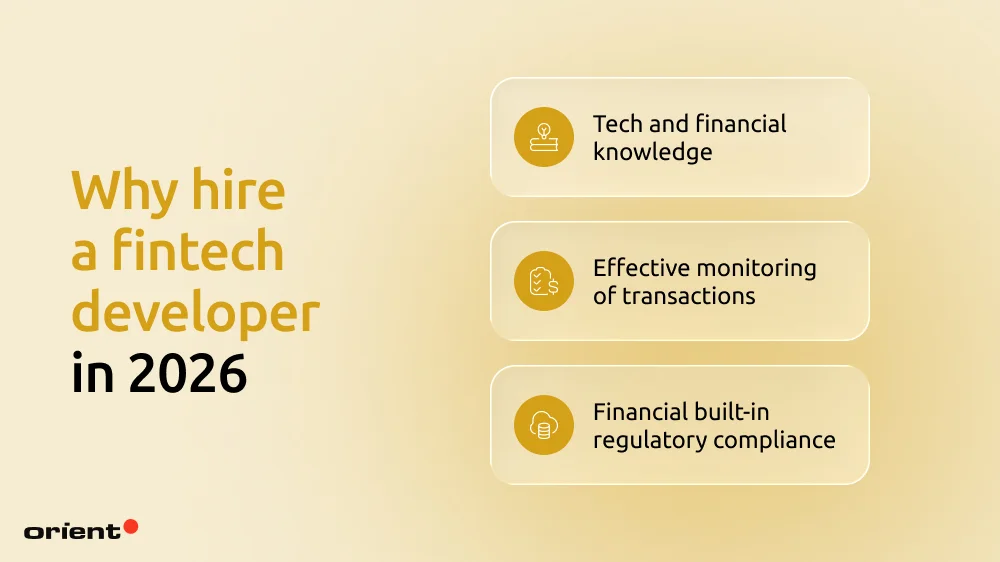
- Fintech developers bring a unique combination of tech and financial knowledge. Beyond identifying a tech stack that works best for the project’s specific requirements, they can offer valuable insights into the market’s data, regulations, banking workflows, or payment gateways.
- A fintech developer will also design and monitor the logic behind withdrawals and transactions, ensuring a reliable and consistent financial system.
- In order to future-proof the app, compliance and cybersecurity need to be built in from the very first steps. Not only will the team help you build a system that adheres to the latest compliance standards (like KYC, AML, PCI-DSS, etc.), but it will also prepare the app for future inspections and scrutiny from auditors and stakeholders. They do this by translating regulatory requirements into technical features like data monitoring and database screening.
- Fintech institutions need to make multiple decisions a day, and this calls for a centralized system to track risk, compliance, customer support, and operations with trustworthy data. A professional developer can build a dashboard to monitor issues and incidents quickly, all while operating in a strictly regulated environment.
Skills to look for in a fintech developer
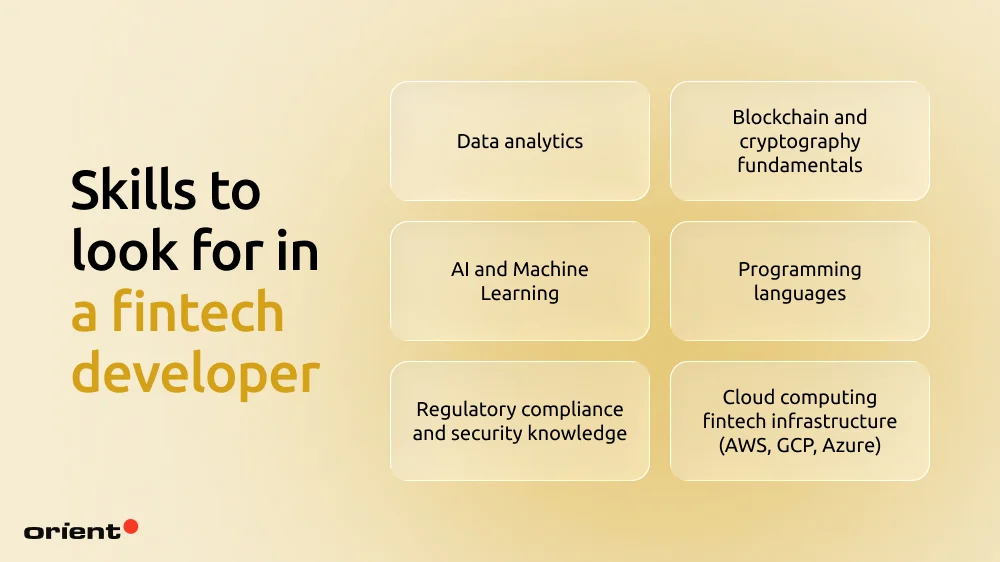
Fintech software developers deliver a wealth of benefits to a business in the long run. Here, they must have skills that every high-skilled fintech professional should have.
Data analytics
Fintech is a data-driven industry. Every decision, big or small, is made based on data regarding customer behavior, market trends, risk assessments, and so on. Strong fintech app developers will be able to gauge patterns, make forecasts, and detect anomalies. They will also be able to implement the data analytics models themselves.
Blockchain and cryptography fundamentals
The hype around blockchain and cryptography has lasted for quite some time, but it is slowly cooling down. This doesn’t mean, however, that blockchain or cryptography has become completely irrelevant. As a matter of fact, blockchain is no longer considered a niche hobby or foreign tech, but an infrastructure layer in financial systems. It becomes even more pronounced in projects relating to decentralized finance and scalable payments or lending apps.
A developer doesn’t need to be a “crypto bro”, but they do need to have at least the basic knowledge regarding:
- The backend and architects of blockchain. If your company ever decides to use stablecoins for cross-border payments to avoid 3-day bank delays, your team should be able to trigger and verify on-chain transactions.
- Front-end and UX of “Web3” wallets and how they might interact with other apps.
- How the security and regulations work.
It can be admittedly hard to secure a developer with a strong blockchain and crypto background, but with an attractive benefit package and payment, along with strong tech leadership, you will be able to find the right candidate.
AI and Machine Learning
The fintech industry is investing heavily in AI-first apps. According to KPMG, AI-focused fintech companies raised $16.8 billion across 1,334 deals in 2025, up $4.7 billion and 151 deals compared to 2024. Wezom reported that AI adoption among top fintech startups has reached 88%, contributing to over $120 billion in savings in 2025 and projected to exceed $500 billion annually by 2030.
Needless to say, AI is no longer a simple buzzword. Having a developer who knows how to integrate a large language model (LLM) or predictive machine learning system is how you keep your company’s competitive edge. Taking a closer look at AI and ML skills, your developer will bring to the table:
- Real-time fraud detection is not based on general numbers but on each user’s unique behaviors.
- ML allows teams to predict the user’s future financial situation and suggest suitable financial products.
- Automated credit and risk scoring.
Programming languages
Fintech app development involves a number of programming languages depending on the specific requirements of the project and context, but these are the most in-demand ones:
- Python: Python can be considered the most popular language for fintech, as it is a great choice for AI-driven apps.
- Java: This language powers software with heavy backends, like legacy bank systems and payment processors.
- C++: C++ is a great language for apps that focus on speed (e.g., high-frequency trading, execution engines, low-exchange systems).
- TypeScript and JavaScript: These two languages are the go-to choice for responsive UIs, which are typically found in mobile banking apps or real-time dashboards.
- Golang: Great for modern cloud-native startups, blockchain, and web3 apps.
- SQL: This is the language behind the non-negotiables: data integrity, auditing, and regulatory reporting.
Regulatory compliance and security knowledge
Regulatory compliance is vital in the fintech world. Your ideal candidate doesn’t need to be a legal professional, but they do need to understand what key rules might look like in day-to-day operations. Let’s take a look at some examples:
- Understanding KYC and AML translates to identity checks, guided onboarding, and monitored transactions. When blockchain and crypto are involved, they might be even more complicated.
- GDPR is a well-known standard regarding how personal data is collected and handled at various steps. This directly translates to how the team controls access, supports the user’s request, and builds data flows.
- PCI DSS, a payment standard, adds constraints to ensure the careful handling of customers’ card data.
In addition to having a certain understanding of the core regulations, development teams also need to keep a traceable log with consistent identifiers to always be audit-ready.
Cloud computing fintech infrastructure (AWS, GCP, Azure)
By 2026, 82% of financial firms will have adopted a multi-cloud strategy, using platforms like AWS and Azure for different workloads while keeping sensitive data in private clouds.
In other words, the cloud has become an operating model for fintech. It is no longer optional. A strong fintech candidate should be able to build cloud-native systems for the business. These architectures use microservices and serverless components, allowing them to scale instantly under heavy load.
Last but not least, the cloud is basically the backbone for everything AI and big data. Instead of wasting time managing their own hardware, developers are plugging directly into cloud-based AI services and handling the orchestration at a massive scale.
Where to hire fintech developers: the best hiring models
When a company decides to hire fintech developers, there are often three main ways to go about it: to build an in-house team, work with an outsourcing company, or hire freelancers. Each model has its pros and cons, so one needs to consider their project requirements, budget, and existing skills in the company to make the final decision.

Hire in-house staff
An in-house team is a great choice if you value direct control and instant feedback. Beyond having total control over the team’s workflow and priorities, your in-house team also lives and breathes the product and has a deep understanding of the product that might be hard to achieve when working with external teams. If what we mentioned is at the top of your priority list for the next fintech developer team, then definitely consider building an in-house team.
Do keep in mind, however, the challenges that come with it: recruiting top talent can be a nightmare, and maintaining an in-house team is often more expensive than working with an external one or hiring freelancers.
Partner with an outsourcing company
Recruiting an in-house team of dedicated fintech developers can be both costly and extremely time-consuming, and this is where outsourcing comes in. Outsourcing partners are an on-demand team that provides you with the exact set of talents right when you need them. In addition to having immediate access to talents, both specialized and general, you can also quickly scale up or down the outsourced team per the project’s demand. Even more important than a team’s size, having seasoned experts on board cuts time-to-market up to 4 weeks.
The downsides of working with an outsourced partner are the lack of control, IP risks, and gaps in security and compliance, so you do need to be more careful when double-checking your partner’s work.
Hire freelancers
Instead of hiring an entire company to work on your project, you can always opt for freelancers. It is often easier to access niche skills with freelancers, and also more cost-effective. Onboarding freelancers is usually much faster, too.
Even then, freelancers are much less reliable. They might suddenly stop responding, for example, because there are too many projects to handle. Another problem is the security gap – remote freelancers often work from their individual laptops and on their home Wifis, which could easily lead to data leaks. Companies might suffer from heavy fines as a result.
If you still decide to hire freelance fintech developers, knowing some of their risks, here are some platforms to hire high-quality freelancers:
- Toptal
- Upwork
- Lemon.io
- Linkedin Talent Solutions (LTS)
How much does it cost to hire fintech software developers?
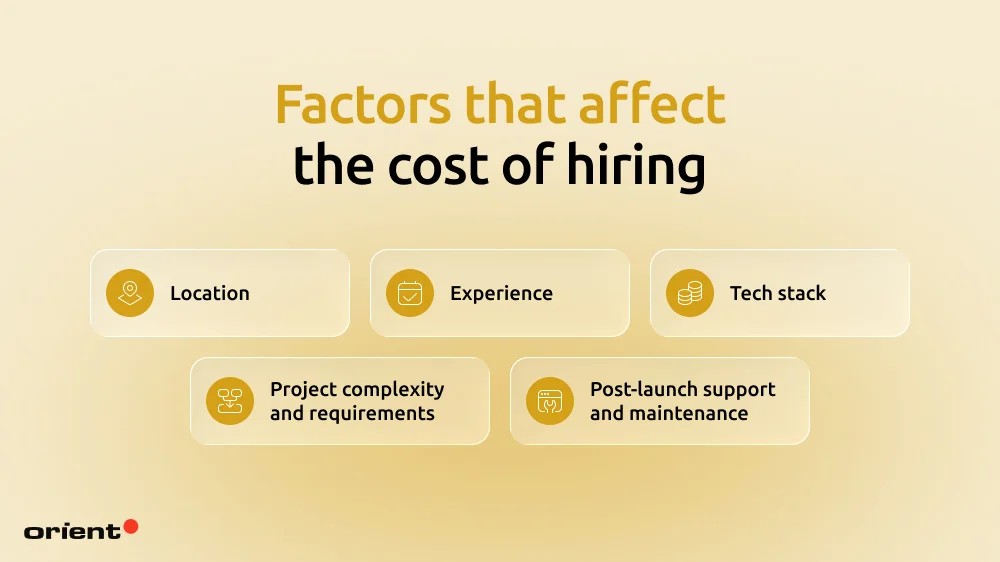
There is no universal, fixed number when it comes to hiring fintech developers. Multiple factors can affect the final price, so the numbers often vary. Here are the main factors that affect the final costs of hiring a fintech developer.
Location
Location has a significant impact on the overall hiring costs of developers. Those who live in developed countries, like in the U.S, the U.K., and Germany, with a higher living cost often charge higher. Hiring software developers from countries with a lower cost of living, like Ukraine, Brazil, Vietnam, and the Philippines, is often much more cost-effective.
| Country | Average Annual Rate (USD) |
|---|---|
| United States | $129,350 |
| United Kingdom | $62,500 – $75,000 |
| Ukraine | $122,500 |
| Brazil | $71,000 – $105,000 |
| China | $43,750 – $78,750 |
| India | $27,800 |
| Vietnam | $18,000 – $54,000 |
| Philippines | $12,500 – $24,000 |
Experience
The next cost factor is experience. The more skilled a developer is, the higher they will charge. This cost can go up if the candidate possesses a rare, specialized skill.
For example, a junior developer in the U.S. might charge $75k a year, while a senior developer might charge around $200k. The large gap demonstrates how senior developers not only bring expertise to the table, but they are also paid for efficiency, security, and compliance.
Project complexity and requirements
The aforementioned factors so far have been external. It is important to remind ourselves that internal project factors also affect the expense spent on hiring fintech developers. If your project involves complex API integrations with legacy systems, hiring a fintech developer will cost a lot more than building something like a simple expense tracker.
Tech stack
Tech stack is the next factor that determines the costs of hiring a dedicated fintech developer. The chosen tech stack will determine the set of skills needed for the project. The more niche a skill is, the more you’ll have to pay for the talent.
Post-launch support and maintenance
Launching a product is only 50 percent of the battle. The financial landscape is constantly evolving, so why should your app stand still?
Post-launch support often brings to mind bug fixes or simple updates. However, in fintech, updates involve regulations, which means the company needs to find a developer who is compliance-aware. Furthermore, fintech apps are a favorite target of cyberattacks, so security needs to be constantly monitored and patched. With all this being said, you need to budget 20 percent for annual maintenance, or your app will soon become a “legacy app”.
Common mistakes to avoid when hiring fintech developers
Building or finding a dedicated development team, no matter what sector, is a lot of hard work. Still, the recruitment process is when you create a strong foundation for a project. To do so, here are some pitfalls you need to avoid:

- Selecting a developer based solely on technical skills: knowing how to code is important, but a skilled professional also understands business logic, financial processes, security regulations, and the importance of communication and collaboration.
- Ignoring compliance requirements early in development: Regulatory compliance is crucial, as we have mentioned multiple times in this article. This is why it shapes the app’s architecture from day one. Compliance isn’t a feature that you can add on to the app later. Ignoring compliance will cause you a lot of trouble in the long run. For example, if your database isn’t designed to be immutable (unchangeable), you won’t pass a bank audit.
- Underestimating security requirements in financial systems: In a fintech app, security should be treated as a core design principle. Again, this isn’t another “step” in the development process that you simply adjust later, as it will lead to gaps in monitoring, weak encryption practice, and weak access controls.
- Prioritizing cost over expertise: Hiring cheap talent can probably be the most expensive thing you can do. This sounds counterintuitive, but reality has proven this time and time again: less experienced developers take longer to complete a task, need constant oversight, and there’s a high risk that rework is needed. Investing in high-quality from the beginning saves you from all this trouble, and eventually saves money in the long run.
Conclusion

Fintech is no longer a temporary hype. To build a robust app and survive in this increasingly competitive market, your development team needs to have the right technical skills, have a deep understanding of compliance and security, and say no to taking shortcuts.
Hiring for the long haul can be a bit challenging, but it is often worth it in the end. You can always start by having a core team and partner with professionals, like Orient Software, to gain further insights! It is always a great idea to have a fresh (and professional) eye on the project, especially when it comes to navigating the complex regulations. Contact Orient Software today to find out more!