

How Much Does a Development Team Cost? Real Numbers & Examples
The basis of any business decision is cost. When constructing an application or going on a software development project, the important question is not only “How much does it cost?” but also how the cost of software development is computed. This article is a practical and detailed overview of the development team’s cost formation and will help you better understand the cost of software development in relation to your own custom software solutions.

Content Map
More chaptersSoftware development budgeting is hardly an easy task. Unlike more familiar investments, the cost of software development does not come with a fixed price list, a standardized unit of measurement, or a one-size-fits-all formula that applies to every software development project.
Most companies may have a budget figure in mind when they are at the budgeting stage, but they fail to explain the reason why that figure makes sense. The quotes between various providers can differ radically even with exactly the same requirements, whereas such terms as “features,” “man-months,” or “team size” are often used without a precise explanation of the principles. Lots of software projects are 30-45% higher than they are estimated because of the factors that are ignored during planning, and this supports the notion that early figures are seldom supported in reality.
Consequently, it makes the software development cost estimation process appear to be a black box: you look at the input, you look at the final price tag, but what happens between them remains a puzzle.
This lack of transparency is what renders budgeting risky in nature. The following of this article will not attempt to provide a single “standard” figure, because no such universal number exists. Rather, we aim to unpack the black box of software development pricing: we seek to decompose the main variables, which comprise the development team costs, the design of development teams, and the reasons why they result in very different price quotations in practice.
Main Factors That Influence Development Team Costs
As a matter of fact, software development costs are a result of a set of mutually dependent decisions that have direct budget implications.
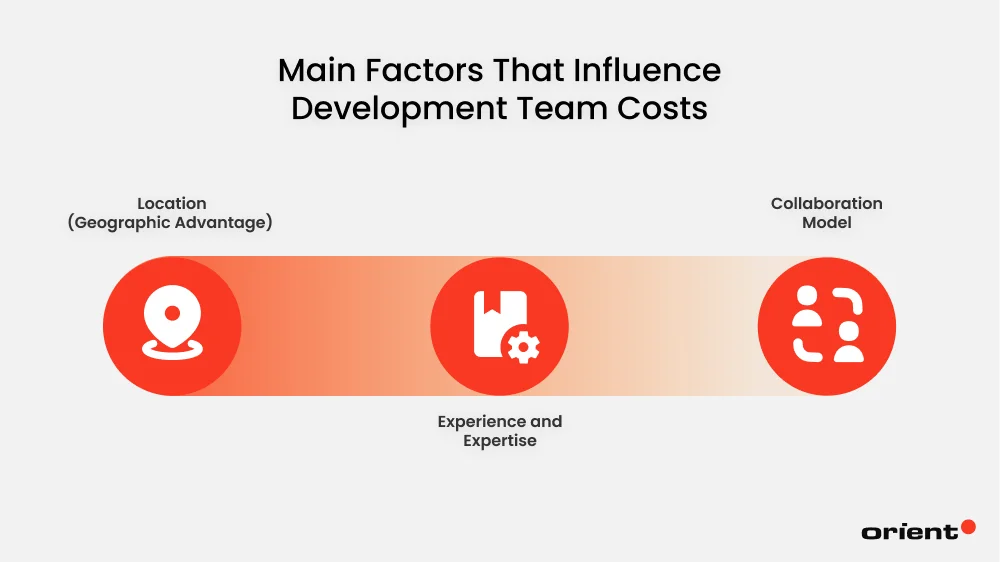
Location (Geographic Advantage)
The difference in living standards, labor markets, and overhead of operation has continued to make geography one of the greatest contributors to software development costs.
- Onshore Development: The team is located within the same country as the business. The advantages involve ease in communication, solid knowledge of the local business requirements, and less friction in legal or regulatory terms. The trade-off is a higher cost. In high-priced areas such as North America and Western Europe, developers are able to charge higher prices, and average hourly rates can be over $100 to over $200, depending on experience and specialization.
- Nearshore Development: Teams are hired in neighboring countries or time zones. This method allows balancing expenditure reduction with high cooperation, which is appropriate to implement projects that involve frequent interaction, but at the same time have a high development budget. Rates at nearshore software development normally vary between $44 - $82 per hour.
- Offshore Development: Teams located in far-off countries, usually in the less expensive areas such as Asia. It has the greatest benefit of affordability, as offshore software developers can cost between $27–$55 per hour. Difficulties are time zone differences, cultural differences, and the necessity to have strict management that would guarantee quality.
In all cases, costs are more than salaries, and so is the cost of friction due to communication, coordination, and supervision.
Experience and Expertise
Once it has been determined where to work, the second important question is who will do it. Experience level is one of the most influential drivers of pricing.
The freelance software developers can be divided into novices and experienced professionals. The junior or less experienced developers are normally oriented towards more specific, narrow-scope work and are less expensive. Newbie software development freelancers normally receive an average $50 to $75 an hour.
Senior developers, in turn, charge more but provide a bigger picture of the system design and architecture, as well as early technical decisions. Experienced software development freelancers typically cost between $100 and $300 an hour, as they can eliminate risk, avoid expensive rework, and lead projects through challenging technical trade-offs.
This is further intensified by the premium charged under specialized positions. Experienced developers who work on artificial intelligence, machine learning, big data, or large systems are usually priced higher due to the limited talent available and the complexity of the project. Technical expertise in those situations can prevail over the geographic cost benefits.
Collaboration Model
Your engagement with the software development team and how you structure the team directly impacts both total development costs and project control.
- Freelance Software Developers: Freelancers are very flexible and demand relatively low initial investment. Freelancers can be perfect for small-scale work or one-time assignments, as they are cheap and adaptable. Nevertheless, the risks of this model may emerge in the area of continuity, scalability, and long-term responsibility, particularly as project complexity grows.
- Outsourcing Software Development: Outsourcing is delegating the development to a third party, which handles the staffing and processes as well as delivery. Software development, when outsourced, can tap into talent around the world at a competitive price, assisting in controlling the expenses, particularly in situations where there is a lack of technical capability internally. With that said, they are usually priced in such a way that the overhead incurred by the management and the profit margin of the vendor should also be added to the overall cost.
- In-House Team: The in-house development is commonly the most costly in the long run. The in-house development teams may become more costly than freelancers or offshore teams because of salaries, benefits, infrastructure, and recruiting. In-house recruiting will add more recruitment fees of at least $20,000 to $30,000 per hire, but this model will provide control, deep product alignment, and long-term retention of knowledge.
There is no single model that is universally the cheapest. Software costs vary greatly depending on several factors, such as the composition of the team, and each approach is a trade-off concerning cost efficiency, control, and long-term strategic value.
Average Hourly Rates by Region
“Where to find the cheapest place to hire” is one of the most frequently asked questions. In reality, hourly rates alone are not enough to answer that question. They just expose the cost of a single hour of labor, and not the total cost of software development required to bring the project to motion. The key is not simply comparing raw numbers but understanding why those rates exist and how they impact your total development budget.
North America (USA / Canada)
Average rates: $100–$200+ per hour (seniors often $150–$250+).
In North America, high costs are not only related to the salaries but also to the profound skill specialization. Such common positions as frontend, backend, DevOps, data, and AI are frequently singled out, with small, rapidly growing teams. The overheads consist of coordination, communication, and operational costs.
Senior developers are valuable in this case in terms of strategic thinking, code reviews, quality control, meetings, and mentoring, and not merely in terms of raw coding speed.
This method is superior in complex projects where stability is very important and long technical decisions are involved. With MVPs or market-testing stages, though, it may seem like it is overkill, providing high prices with low speed and flexibility.
Western Europe (UK / Germany)
Average rates: $60–$110 per hour (UK ~$75–$95, Germany ~$70–$85).
In Western Europe, rates are low compared to North America and are associated with a stress towards technical quality and process discipline. In the UK and Germany, developers operate in very standardized environments where the importance of documentation, testing, and compliance is equal to the importance of coding. Expenses increase gradually with quality management as opposed to surging on an hourly basis.
It’s the stability and the reduction of the long-term risks that businesses pay for. The model is appropriate for products that require a high degree of reliability, legality, or longevity with few pivots.
Momentum processes, though, decrease agility. Procedural overhead may decrease time-to-market in projects where changes or rapid iterative cycles are necessary.
Eastern Europe (Poland / Ukraine / Romania)
Average rates: $40–$70 per hour (seniors up to $80–$90).
Eastern Europe is usually referred to as the “sweet spot” of the software development price, but in actual fact, it’s efficiency per developer that is advantageous. Polish, Ukrainian, and Romanian engineers have a robust technical background and tend to have entire systems coverage as opposed to a limited scope of work. The teams remain lean and do not have many layers.
The lessened coordination and communication friction provide optimization. Reductions in the number of individuals that have expanded responsibilities result in fewer handoff failures, reduced handoff failures, and reduced unexpected hidden expenses.
This model is the best fit for speed, quality, and budget consideration for most software development projects. Additional managerial levels can compensate for a portion of the initial savings; however, to ensure strict legal compliance or inflexible internal procedures.
Latin America (Brazil / Mexico / Argentina)
Average rates: $35–$65 per hour (Argentina often ~$35–$55).
Latin America is not the cheapest, but it is at phase time. Brazil, Mexico, and Argentina collide or coincide with North America, which allows feedback and reviews to be made and decisions to be taken on the same day.
Rates represent the price of the speed of coordination and not only labor. In the ever-changing agile projects, saving a few dollars per hour is not worth much in comparison to saving time through reduced communication.
This nearshore model suits US companies that require close working with no domestic prices. The benefits may not be worth the premium in low-interaction and high-stability projects.
Asia (India / Vietnam / Philippines)
Average rates: $20–$50 per hour (Vietnam ~$20–$45, India/Philippines often $20–$40).
Asia has the lowest rates because of a high supply of technical talent demand, which has made the market competitive and offers a choice at different levels of experience.
Management and requirement standardization have a real cost. There are major time zone, language, and work-style disparities that move the budget towards coding, compared to making sure that the appropriate understanding and action are taken. Fewer autonomous teams can silently eat up the savings at the start due to rework.
The model is ideal in cases where requirements are definite and stable, and internal technical management is robust. Low hourly rates do not necessarily equate to low overall cost of software development, where there is uncertainty about the instructions or where one will need rapid feedback.
Quick Summary: Software Development Hourly Rates by Region (2026)
| Region | Hourly Rate (USD) | Core Insight |
|---|---|---|
| North America | $100 – $250+ | Cost of deep specialization & strategic expertise |
| Western Europe | $70 – $150 | Value of stability, compliance & disciplined processes |
| Eastern Europe | $40 – $80 | High efficiency and output per developer |
| Latin America | $45 – $90 | Saves time (time-zone alignment) more than money |
| Asia | $25 – $50 | Lowest rates but heavily dependent on strong management |
Cost Breakdown by Team Structure

The development team in a software development project is a lot more than just a group of people who know how to code. It is a strategically planned team-based model in which individual roles exist to handle particular risks during the software development cycle, beginning with the vague ideas and ending with a fixed product that can be deployed to production.
Typically, a fully organized software development team has the following roles: Project Manager or Scrum Master, Business Analyst or Product Owner, UI/UX Designer, Software Developers/Engineers (Frontend, Backend, Full-stack), Senior Developers, Tech Lead or Solution Architect, QA Engineer/Tester, and DevOps or Infrastructure Engineer, along with additional specialized roles when necessary. Each position helps reduce risks at particular phases of the development process.
Nonetheless, this complete structure does not need to be applied to all software projects at the very beginning. When a product is still in its initial phases of growth, perfection and scale of operation are not the most important considerations, but rather justifying core assumptions at the lowest possible cost: do the users actually need this solution, and does the value being proposed entice them to invest more resources?
The MVP Squad (Lean)
The MVP development team is created under one goal, which is to launch fast at the minimum cost to confirm the idea under real value. The MVP model implements a small, senior-oriented team of people instead of fielding a full-sized software development team, with all having more expansive roles so that technical threats and product risk can be kept in check without extravagant overheads.
In practice, a viable MVP team usually needs to have only three fundamental functions: technical direction, implementation, and coordination. This is usually managed by a senior developer who is also the technical lead, a junior developer to help in its implementation, and a part-time project manager to keep the project on track and aligned with the stakeholders. Creating a minimum viable product (MVP) can be beneficial in order to test ideas early and ensure that development costs do not run out of control before the feature is established.
Depending on the location, the personnel expenses of such a lean team differ widely. In established expensive markets such as the United States or Western Europe, monthly salaries are frequently in the range of $20,000 to $30,000 based on the compensation of the senior developers, which is about $10,000-$16,000 monthly. In Eastern Europe, similar MVP teams are usually between $7,500 and $14,000 USD a month, whereas in Asia, especially in such a market as Vietnam or India, the monthly cost of MVP teams is often between $4,300 and $9,500.
The Growth Team (Scale)
The Growth Team is established when a business decides to build and scale a long-term product rather than focus on idea validation. This software development group has always valued stability, scalability, and the quality of operation, so that the emphasis is placed on durable architecture, consistent user experience, and sustained delivery velocity. The formation and the size of the development team may influence the overall cost of the software project, particularly with an increase in the division of roles to address increasing technical and organizational risks.
Examples of a standard Growth Team include a tech head/CTO tasked with long-term architecture, two senior developers working on core systems, a QA engineer who would help to maintain quality at scale, a UI/UX designer to keep consistency, and a full-time project manager to coordinate delivery and stakeholders.
There is a huge difference in the personnel costs per region. Premium senior and leadership positions are the main factors that drive total monthly team expenses of between $42,000 - $67,000 in high-cost markets like the United States and Western Europe. In Eastern Europe, comparable Growth Teams tend to be priced at between $22,000 and $36,000 per month and enjoy good expertise and lower competitive rates. In Asia, and especially in markets such as Vietnam and India, the total monthly costs of the personnel can range between $15,000 and $28,000 USD; hence, this model is more affordable if handled well.
The Enterprise Team (Complex)
The Enterprise Team is established when an organization develops software in a very complex environment with many constraints. In this regard, the requirement is not only based on the product but also on organizational requirements, legal requirements, security requirements, and large-scale operational requirements. This is not only a goal of fast delivery or scalability to users but also of having the system designed and constructed in a correct, secure, and sustainable manner using an existing infrastructure.
In the case of an Enterprise Team, management of complexity is the main challenge. These involve the management of legacy systems, multi-platform integration, multi-layered approval processes, regulatory compliance, and operational risks caused by system failures. This means that the team structure will not be optimized to be fast in development, but instead is designed based on the tenets of control, separation of duties, and cross-functional coordination.
A typical Enterprise Team would be built around Solution Architects to deal with the system-wide integrity, several specialized development teams held together by domain, system-level testers and automation specialists, security and compliance experts, and DevOps specialists to manage the complex environments. Program Managers also liaise among teams as well as internal stakeholders. Each role is not only created to add features but also to scale risk.
In terms of expenses related to personnel, a complete Enterprise Team in the US and Western Europe is estimated to cost between 80,000 and 150,000 USD/month, according to the complexity of the tasks and the regulatory demands. In Eastern Europe, it is about 45,000 to 80,000 USD a month on average. In Asia, the human resource cost per team to run a medium-sized enterprise system is normally within the range of 30,000 to 60,000 USD per month.
Hidden Costs You Might Forget to Budget For
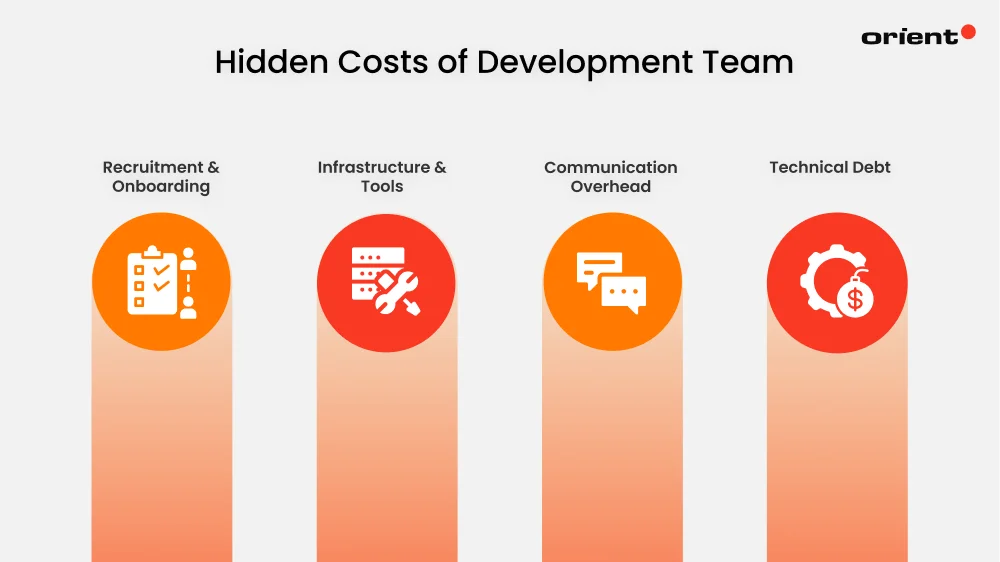
Recruitment & Onboarding
The initial hidden costs can be revealed even prior to the onset of the software development project: recruitment and onboarding. In either case of in-house building or outsourcing to a software development company, locating the appropriate software developers and software engineers takes up a lot of time, money, and opportunity. New employees are hardly likely to achieve optimal productivity within the first day.
The first few months are normally characterized by familiarizing oneself with the system and the product and settling into team dynamics. The cost of making a wrong hiring decision increases these costs more than what has been paid in salaries; it also extends schedules and causes wastage of knowledge at the expense of replacement.
Infrastructure & Tools
The cost of infrastructure and the cost of tools are realized once the development team is in operation. A software project that is professionally developed would not be able to operate without cloud services, testing environments, CI/CD pipelines, error monitoring, and collaboration platforms.
Such providers as AWS, Azure, Jira, and GitHub can be paid per use or number of users, and the cost increases with team size and product growth. What begins as a small expenditure may, when not streamlined early on, turn out to be a huge fixed cost.
Communication Overhead
Project management and overheads in terms of communication rarely feature in the quotes, but are significant hidden expenses of any software development. Whether you are dealing with in-house or outsourced software development, you will need some time to align, quality control, and make decisions.
These difficulties are enhanced in remote or cross-time-zone teams: there are delays in responding, mismatched expectations, and frequent clarification sessions. Meetings, code reviews, and smooth sailings are taking up some of the best management resources, which can be the most costly in an organization.
Technical Debt
Low-cost decisions are usually prioritized when budgets are too tight. Teams focus on quick code, low testing, and simplified architecture only to meet the deadlines. Even though these decisions do not lead to instant problems, they build up over time and make all future changes more gradual, costly, and dangerous. Most projects will ultimately run over budget, not due to the need to add features, but rather because they must cover the cost of the technical shortcuts made in the early phases, which were made at relatively low costs.
Red Flags: When “Cheap” Becomes Expensive
- The “Black Box” Billing: When a partner gives a fixed total but does not provide a breakdown of sprints, team roles, or hourly rate, it is probable that the partner is covering up some process deficiency. The only way to determine whether your money is making it into code is through transparency in billing.
- The Rewrite Trap (Code Quality): The cheap suppliers can afford to do without automated testing and documentation. This produces spaghetti code, which works one week and collapses under pressure. Today you can save 30%, but tomorrow you will spend 200% to get another group that will never write the foundation again.
- The Communication Tax: When the price is low due to the lack of experienced product managers in the team or due to bad English/your native language, you will be paying the premium later. All the hours you use to explain a misconstrued requirement are hours of what I would call a hidden cost to your personal or executive compensation.
- Lack of Senior Oversight: A “lean team” can only work effectively when the leadership is experienced. The team usually becomes inundated with junior members who learn on your nickel.
How to Calculate Your Budget
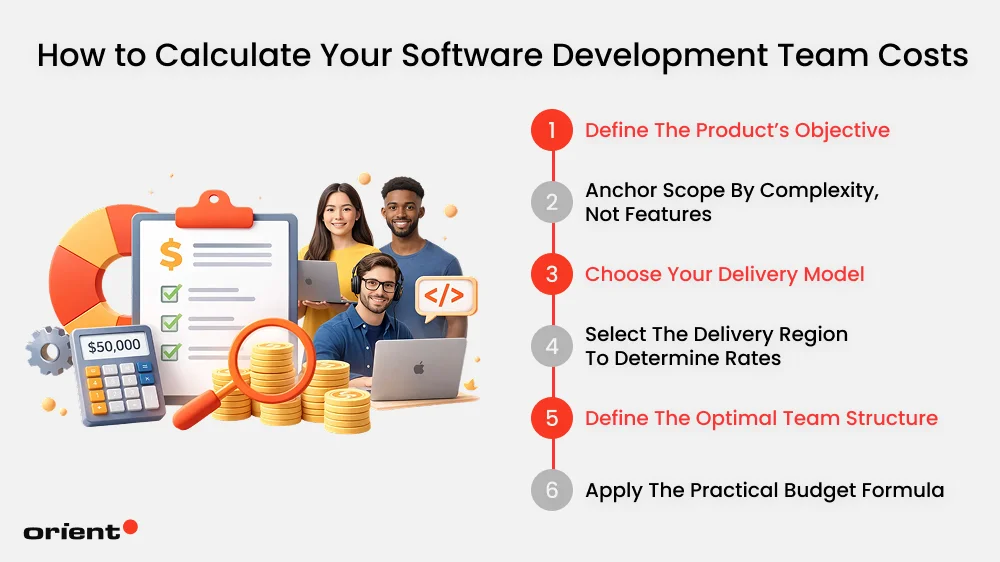
Step 1: Define The Product’s Objective
You need to explain the purpose of the product’s existence before you can ask what it costs. Do you have an MVP to test a market hypothesis, a revenue-generative product that can be scaled, or a long-term intra-organizational system to be efficient? Each goal stipulates an alternative plan of action with respect to the size and priority of the team.
Step 2: Anchor Scope by Complexity, Not Features
Rather than getting lost in an unstable list of features, sort your idea into a particular product category, e.g., a simple content utility, a real-time marketplace, or a complex data-on-demand platform. This method assists in establishing the overall amount of effort needed to achieve a first usable version. At this point, measurement of workload must be on the basis of sprints (usually a 1-2 week cycle of development) instead of dollars.
It is important since the intricacy of the software project is a major factor in determining the cost of the software development, much more than the actual number of features written down on paper. System interactions, real-time behavior, integrations, and scalability requirements are the reasons that cause the pulling of the effort, irrespective of how the feature list is phrased.
Geographical factors influence the cost of software development; however, they do not alter the technical workload that is needed to create a certain type of software. The complexity remains the same and requires the same number of sprints, testing cycles, and architectural choices.
Typical effort ranges by product class include:
- Simple Utility / Content App: 4–6 sprints
- (e.g., basic blog, internal dashboard, task manager)
- Marketplace / E-commerce MVP: 8–12 sprints
- (e.g., basic Etsy- or Shopify-style platform)
- On-Demand / Uber-like App: 12–16 sprints
- (real-time tracking, matching logic, operational workflows)
- Streaming / Spotify-like App: 16+ sprints
- (media processing, offline sync, performance optimization)
Step 3: Choose Your Delivery Model
It is a crossroads where you make it or break it, depending on how you use your capital. In-house development is a payroll method in which you pay for availability, knowledge of the institution, and long-term ownership. On the other hand, outsourced products or projects enable delivery that adheres to the delivery model in which you pay for a particular scope of defined output. The two methods are legitimate, and they will fulfill varying strategic requirements. The combination of these two different mentalities in the same calculation is normally where the budgets fail.
Step 4: Select The Delivery Region to Determine Rates
After determining the amount of work, geography comes in. The area does not alter the challenge of the code, but it determines the hourly rate straight away. Breaking down “effort” (hours) and the “rate” (location) gives you an objective perception of the actual market worth of the project.
Step 5: Define The Optimal Team Structure
As things become complex and the model and region are locked in, the team composition must be developed logically. Not only will the active limitation of the team size at initial stages save the budget, but the restriction will also speed up decision-making and reduce the overhead of communication.
Step 6: Apply The Practical Budget Formula
The final calculation follows two distinct paths based on your choice in Step 3, reflecting whether you are paying for “product output” or “team capacity.”
For Outsourced Delivery: The budget is based on defined work cycles.
- Total Budget = (Hours per Sprint × Hourly Rate × Number of Sprints) + 20% buffer
- An average full-time engineer will bring in an average of 80 hours every two weeks of a sprint. That 20% buffer is not an additional padding but an essential part to consider requirement changes and technical integrations that may have been found in the course of development.
For In-house Teams: The budget must account for the Total Cost of Ownership (TCO) for each employee.
- Total Budget = (Monthly Salary + Benefits + Overhead) × Development Timeline
- This involves insurance, bonuses, equipment, and software licenses, as well as office space. In this case, you are investing in stability and retention of intellectual property; this is because the budget should not be considered as a project cost but rather as an operational cost.
Conclusion
An excellent budget will not be a prediction of the future with 100% accuracy. Rather, it is an upfront, clear, and explicit decision. Knowing the interaction of product complexity, delivery models, and regional rates, the teams will be able to stop baseless guesses on cost, as teams will make conscious decisions on investment. When applied properly, such a framework can be used to make sure that the development team, either an outsourced company or an in-house department, is balanced within financial and long-term strategic objectives.
Need a custom quote for your specific project? Contact Orient Software to have an additional consultation and a professional estimation.