
Let’s say you have an inspiring idea for a mobile app. What’s the next step you take to make it come true? Learn the necessary skills and build the app yourself? Perhaps that’s a bit unrealistic. Hire a team of professionals to do the job for you? This is clearly much more practical.
There is one problem, however: The time and effort it takes to recruit the right talent. There is a global developer shortage, and while the population of developers is growing, it has a hard time keeping up with the demand for high-skilled workers. According to Korn Ferry, by 2030, the global talent shortage across all highly skilled sectors (including tech) will reach 85.2 million people, resulting in $8.5 trillion in unrealized annual revenue.
This begs the question: Why navigate these challenges alone? Why not leave this to the professionals and have them provide you with an experienced, dedicated team? Today’s article will discuss how having a dedicated mobile app team can elevate your entire software development game, and how to find one tailored to your business’s needs. Let’s dive in!
Key Takeaways:
- A dedicated mobile app team is a full-cycle, cross-functional squad that operates as an extension of your business.
- A dedicated developer is a great solution when you have complex or long-term projects, need to customize your application, have a tight timeline, or have a defined budget.
- The benefit from this model is the access to expertise, niche skills, valuable insights, and a stronger competitive edge due to faster time-to-market.
- To find a long-term partner, you’ll need to spend time and effort to understand your own company’s needs and goals before researching for the partner, evaluating their technical, cultural, and budget fit.
What is a dedicated mobile app team?
Definition
A dedicated mobile app development team is a cross-functional group of specialists, typically provided by an outsourcing partner, who work full-time on your product and align with your roadmap, KPIs, and release schedule.
Rather than executing isolated tasks, a dedicated team typically:
- Takes ownership across the lifecycle, from discovery and architecture to development
- Implements QA, DevOps, security measures, and testing standards to ensure maintainability,
- Optimizes workflow and app store readiness, and
- Scale up or down quickly based on practical project requirements.
Dedicated team structure
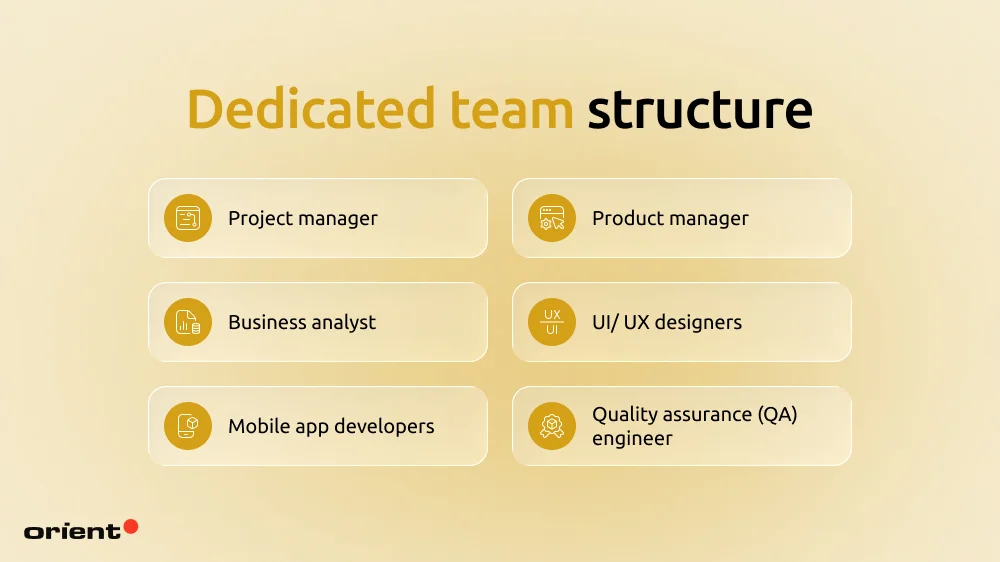
A dedicated team’s structure varies – there is no universal model. It depends on the project’s size, complexity, and, as always, requirements. There are, however, key roles needed in every project:
- Project manager: A project manager is someone who oversees the entire development process, allocates resources, and makes sure important milestones are met.
- Product manager: A product manager is more focused on an app’s market fit and goal. They are the ones who shape the product roadmap.
- Business analyst: Acting as a bridge between technical teams and business stakeholders, they take requirements and business processes and translate them into actionable development tasks.
- UI/ UX designers: The designers are responsible for everything that the users see and interact with. Their goal is to make the mobile experience intuitive and visually appealing.
- Mobile app developers: This team works mostly in the background, transforming abstract business requirements into scalable, functional code. There are three main types of mobile developers: iOS developers, Android developers, and cross-platform developers.
- Quality assurance (QA) engineer: Those who work in this position ensure the app functions smoothly without any bugs or crashes before the actual release.
Do you need a dedicated mobile app team?
The answer to this question may sound familiar: It depends. While having a dedicated team brings a wealth of benefits (which this article will discuss later), it isn’t the answer to every mobile development problem.
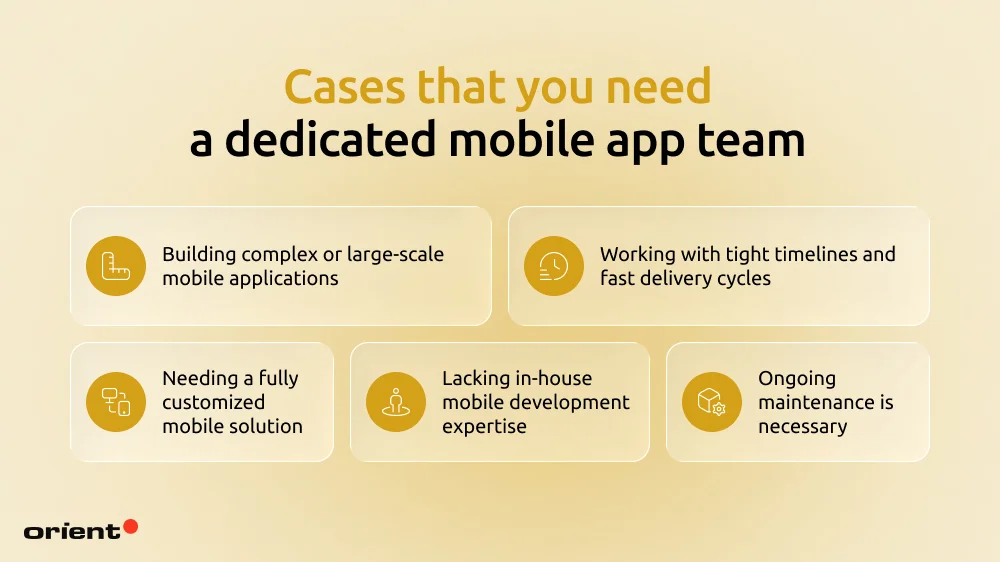
In which cases, then, should you consider finding a dedicated mobile app team? There are a few telltale signs to help you make the decision.
Building complex or large-scale mobile applications
Managing a complex project is, well, complicated. It can quickly become overwhelming, and sometimes it can be difficult for the core in-house team to keep up.
Instead of going through an entire recruitment process to increase manpower or find a specific talent, which is often both costly and time-consuming, it is recommended that you hire a dedicated mobile app development team. Not only can you skip the entire hiring and training process, but you can also tap into a massive talent pool and specialized expertise fast and conveniently.
Needing a fully customized mobile solution
If you plan to build an app from the ground up, or if your business has very specific and unique requirements, a dedicated team is one of the best things you can do.
The development team has extensive knowledge regarding your vision and goals and might even suggest improvements to the app. Without the time and money spent on hiring a team (which often takes around 40+ days), you still have full control over a team of experts with the sole focus of bringing your vision to life.
Working with tight timelines and fast delivery cycles
In time-sensitive projects, it is vital to have enough resources and allocate them as efficiently as possible. You can quickly achieve this with a dedicated team, by keeping the project running with no sleeping time, using the “Follow-the-sun” model. Let’s say your company is in the U.S., and your dedicated team is in a completely different longitude – Vietnam. When the local team wraps up for the day, the work is handed off to the dedicated team, keeping the project moving 24 hours a day. A study reported that a perfectly executed three-site follow-the-sun model can reduce total calendar time for a project by up to 67% compared to a single-site team.
Lacking in-house mobile development expertise
You have a strong core team, but they are not specialized in building mobile apps. This is a sign for you to make the next smart move – hiring a dedicated team! Both teams can work together to finalize the product map, key features, and other important decisions.
Optimizing for cost without compromising quality
In many cases, working with a dedicated team is more cost-efficient than maintaining an in-house team. You can skip the recruiting, training, onboarding, salary, and infrastructure costs, all while still enjoying the same high-quality deliveries as if you have a team in-house.
Ongoing maintenance is necessary
Launching an app is only 50% of the process. Every mobile app needs to be regularly maintained, updated, and fixed. You might have an in-house team, but it is likely that they are swamped with other tasks, and maintenance can easily fall into the backlog. Having a dedicated team take care of this aspect is how you keep your customers happy and your core team focused.
What are the benefits of having a dedicated team?

Expertise and specialization
Beyond pure knowledge or proficiency in certain programming languages and frameworks, a dedicated external team also brings to the table the latest technology trends. This insight, along with years of experience, elevates the mobile app and gives your business a unique competitive edge.
“All-in” mentality
Unlike hiring freelancers, dedicated teams give your project full and undivided attention. Being locked in without distractions from other projects means the team can spot flaws faster. As the project moves forward, they also start thinking like stakeholders, being fully invested in finding ways to improve the features and project to ensure customer satisfaction and the app’s success.
Cost-effective solution
A dedicated mobile time removes hours upon hours of searching for the right candidate. Using a dedicated team model cuts costs along almost every step of the way: The recruitment process, the training, onboarding, salary, facility, etc. Even if there are unexpected shifts in the product roadmap, scalability wouldn’t be expensive or a financial disaster.
Flexibility and scalability
A dedicated tea functions like Lego pieces. Your partner can quickly add an engineer to the team, especially if you have a clear idea of the type of talent that you need. More than adjusting headcount, this fluidity allows the project to move on smoothly without unwanted disruptions.
If your app is in the maintenance phase, scaling down wouldn’t be much of a problem (often, it only takes a 30-day notice for the outsourcing company). The best thing about this is that you can skip all the negative emotions involving layoffs.
Faster time to market
In a competitive tech world, introducing a product first can often be more important than introducing a perfect product. In addition to bypassing the entire recruitment process, a dedicated development team can cut development time by:
- Using CI/ CD, where your core developers might be building feature C, and the dedicated team is focused on testing feature B.
- Establishing a 24-hour development cycle with the follow-the-sun model.
- Reducing idle time, as development teams have daily stand-ups and make decisions in real time.
Quality assurance and testing
A QA team plays a key role in every dedicated application development team. Testing is integrated in every stage of the development process rather than an “add-on” task at the very end. This reduces any risk of bugs and crashes and ensures that the final product comes with the highest quality.
Ongoing support and maintenance
After launching the app, the workload has reduced significantly, but it is far from over. While the partnership with the external team can end here, you can also scale down the team and have them focused on the maintenance tasks while your in-house professionals focus on value-driven work. As a result, your app is always functioning smoothly, while the core team is working on innovating.
Step-by-step guide to building a dedicated mobile app team
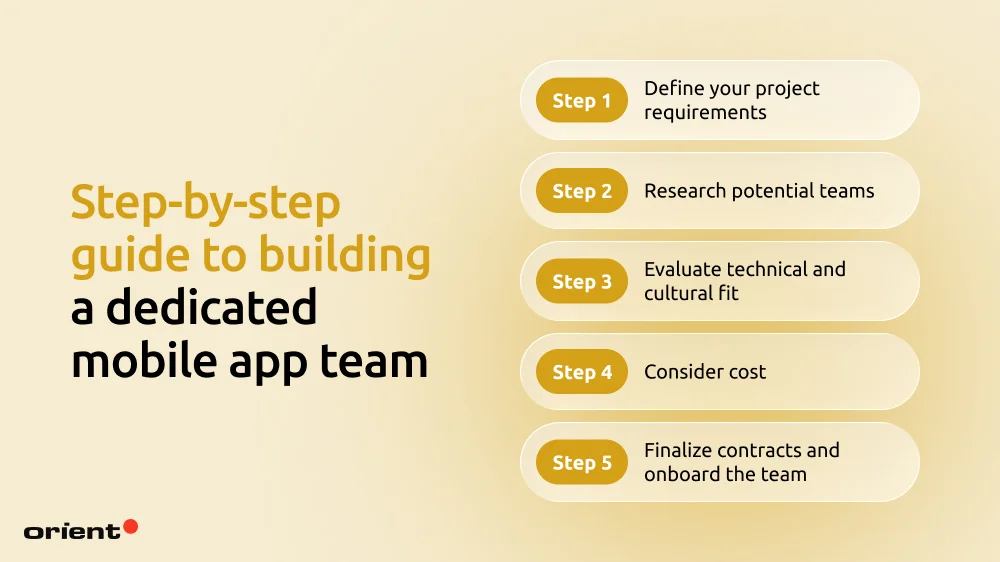
Step 1: Define your project requirements
Start by defining your expectations for the mobile app. Having a good idea of what you want in an app will set the expectations of the future dedicated team. Here are a few key requirements to go through:
- Business requirements (target audience, main ideas, monetization models, etc.)
- Functional requirements: Describing what the app will do (push notifications, user authentication, etc.)
- Non-functional requirements: Describing how the app will perform (performance expectations, load time, etc.)
- Technical requirements (tech stack, mobile app platform – iOS or Android, etc.).
Take your time, do careful market research, and make sure to document these requirements in as much detail as possible.
Step 2: Research potential teams
With clear expectations and requirements in mind, it is time to put together a list of potential partners. There are several ways to go about this:
- Visit B2B rating platforms like Clutch and LinkedIn to read up about the companies and make comparisons.
- You can also leverage referrals from professional network platforms or attend tech-focused meetups.
- Research the candidate’s portfolio and case studies to gauge a better idea of their experience and technical expertise. A quick note: Also look for the company’s innovations and user-centric designs.
Step 3: Evaluate technical and cultural fit
After having compiled a list based on pre-defined requirements, it’s time to take a deeper look at each candidate. Beyond profiles and case studies, this is the time you actually sit down with the teams and get to know them better.
- Ask for the apps the company has actually published. Look up their reviews on App Store or CH Play and see if they mentioned crashes or if they complimented the UI.
- Have a technical lead check the company’s sanitized code sample or GitHub repo.
- When it comes to cultural fit, pay attention right from the sales process. How long does it take them to respond? If they take 48 hours to respond to an email now, how long will it take if there is an actual critical bug that needs fixing?
- Ask them hypothetical questions about a mid-project crisis and see how they will respond.
- Have a paid pilot. This is where you assign a non-critical 2-week sprint and evaluate the handoff: The documentation, deadlines, and overall process.
Step 4: Consider cost
Wrapping up the technical and cultural evaluation, it is time for financial discussions. Most companies providing dedicated developers have clear and consistent pricing.
It is also important to understand the factors that affect the prices.
- Region: Location is the number 1 factor that affects the final price. The cost of hiring a dedicated developer differs significantly if they are located in the U.S. or Vietnam. The hourly rate of a U.S. developer typically ranges from $60 to $250, while the rate in Vietnam would be around $25 to $85.
- Project’s complexity: A large, complicated project will require larger teams, which often pushes the costs up. Also, if the project consists of tech like AI or LLM, or high-level fintech security, you will need to add a 20–50% premium to the hourly rate due to the need for specialized senior talent.
Lastly, make sure you demand transparency from your partner (don’t accept a blended rate, like “$56 an hour for everyone”). Clarify overhead costs and how payment is handled during idle time.
Step 5: Finalize contracts and onboard the team
Before finalizing any contract, ensure you’ve gone through the contract several times. The most important clauses involve cost, IP rights, detailed deliverables, and confidentiality. Don’t rush through this process.
Once the contract has been finalized, prepare the onboarding process. The first two weeks of working with a dedicated team will set the pace of how quickly they reach full productivity.
- Prepare the essential documents regarding architecture so they can quickly get up to speed.
- Prepare all the tools and essential access.
- Have a buddy or tech leader to help guide the team and review their work.
- Schedule daily check-ins with the team.
- Spell out coding standards clearly – never assume the external team knows how to match your company’s style.
Conclusion

While it is easy to think of the dedicated mobile app team as an “external” department, proper integration allows you to enjoy unexpected benefits: The team is “all-in” in the development process, suggests valuable insights, speeds up the overall process without compromising quality, and more. The process of searching for the right partner and preparing for onboarding might seem like a long one, but the effort is almost always worth it.
If you are unsure where to begin, let Orient Software help you. Bring us the vision, and we will guide you through the process of ideation, all the way through maintenance. Our mobile development team is proficient in both well-known and niche technologies. Don’t let your idea wait; get in touch today!