Java has a long history of powering all kinds of systems. Even then, one shouldn’t choose the language as a default. While Java still dominates enterprise development, 2026 has seen a growing number of teams shifting to more streamlined, developer-friendly environments.
The rise of AI development, serverless architecture, and microservices has prompted developers to look elsewhere. It is true that Java has powered countless projects; in some cases, it can actually bring more harm than good.
This is not to say that Java is going extinct, but to highlight the fact that there are different languages for different kinds of jobs, which is the beauty of technological evolution. Let’s dive right in!
Key Takeaways:
- Java is one of the most popular programming languages in the world. However, due to its several limits: performance overhead due to the JVM, high memory consumption, verbosity, and technical debts, Java might not always be the best choice for certain types of projects.
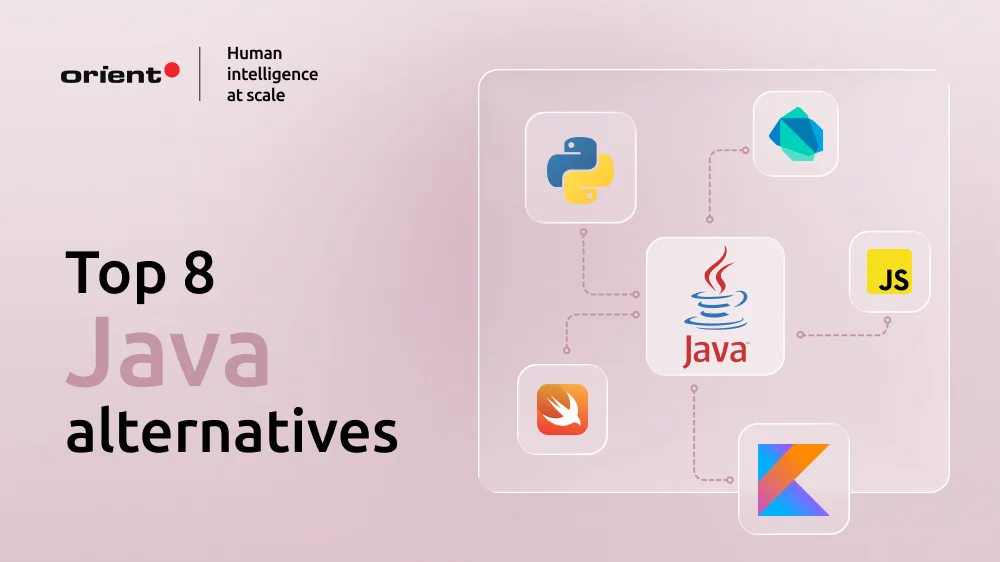
- There are several alternatives to Java that you can look at, such as the interoperability of Kotlin, the sheer concurrency power of Golang, and so on. Other great alternatives include Python, JavaScript, Swift, Dart, C++, and Rust.
- Each alternative tackles Java’s limitations, but every option comes with its own set of trade-offs.
Why Developers and Businesses Look for Java Alternatives
Java is a high-level, class-based, object-oriented language built to minimize platform dependencies. It is best known for its “write once, run anywhere (WORA)” philosophy through the Java Virtual Machine (JVM).
The language is extremely reliable and can be used to create enterprise-scale applications, big data apps, scientific apps, etc. To fully understand what the programming language entails and why developers might be shifting away from it, we need to learn Java’s pros and cons.
Java’s Key Advantages
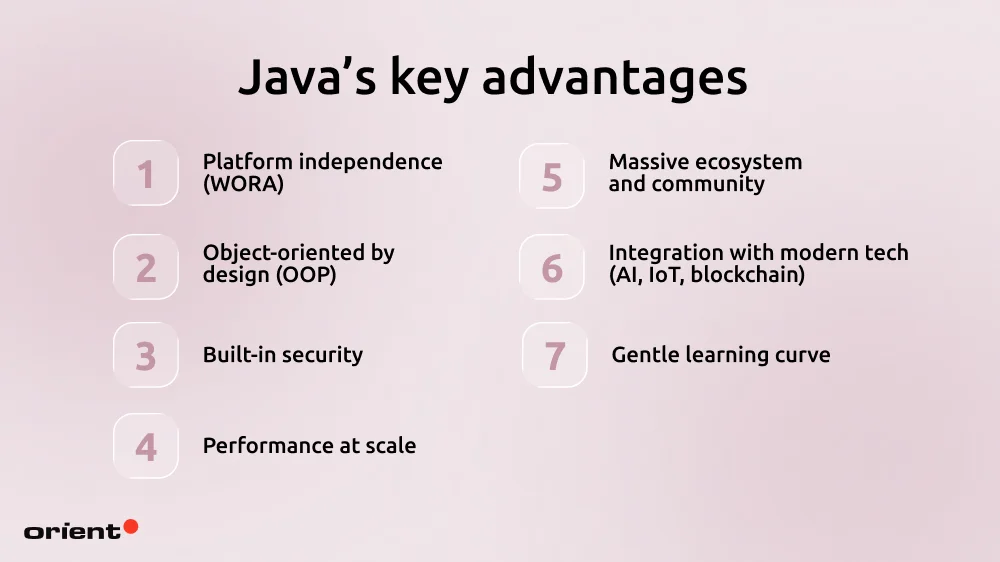
Java is present in a massive number of projects due to its following strong points.
- Platform independence (WORA): Java’s WORA model lets the same bytecode run on any system with a JVM, whether it’s Windows, Linux, or macOS.
- Object-oriented by design (OOP): Java’s OOP model keeps large codebases structured and maintainable by organizing logic around classes and objects.
- Built-in security: Java provides its users with strong security controls such as bytecode verification, secure class loading, and sandboxing at the JVM level (the legacy SecurityManager has been deprecated).
- Performance at scale: With mature threading, memory management, and JVM optimizations (e.g., JIT compilation and tuning), Java handles high concurrency and large workloads reliably.
- Massive ecosystem and community: Java boasts one of the largest ecosystems in software development. Java libraries and frameworks are battle-tested for almost every use case.
- Integration with modern tech (AI, IoT, blockchain): Modern tech stacks, be it machine learning, IoT, or blockchain, can be integrated cleanly using Java.
- Gentle learning curve: Java is approachable for beginners thanks to its readable syntax, strong documentation, and broad learning resources.
Java’s Limits
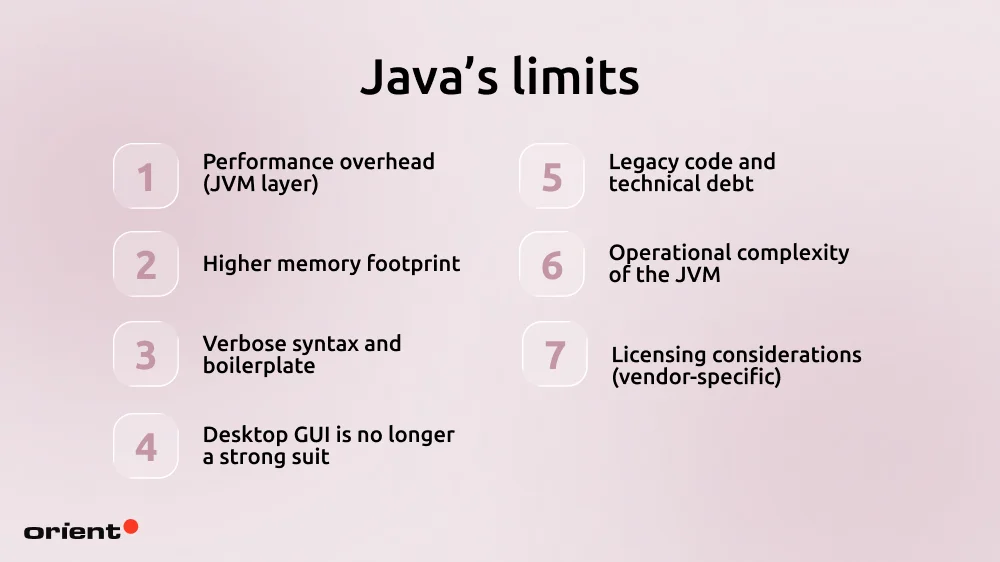
Similar to every other language out there, Java has its drawbacks. Here are some that you need to keep in mind.
- Performance overhead (JVM layer): While Java isn’t slow, the JVM adds overhead, slowing apps down. JIT compilation helps reduce this overhead, but Java can still fall short in systems where every millisecond counts, such as real-time trading or ultra-high-speed processing.
- Higher memory footprint: The JVM, garbage collector, and runtime metadata consume significant memory before your app logic even runs. This posts an issue for memory-constrained environments.
- Verbose syntax and boilerplate: Compared to its modern companions, Java is more verbose, or in other words, more “wordy”. This feature is meant to create consistency and readability in large teams, but productivity can take a hit when compared to other programming languages.
- Desktop GUI is no longer a strong suit: Java’s desktop UI toolkits work well for internal tools, but they aren’t optimal when it comes to polished, design-heavy consumer apps.
- Legacy code and technical debt: Java’s strong backward compatibility is a double-edged sword. It keeps old systems running, but it also encourages long-lived legacy code, outdated architectures, and brittle dependencies.
- Operational complexity of the JVM: JVM is undoubtedly a powerful tool, but it also adds operational overhead, making it a subpar choice for performance-critical apps.
- Licensing considerations (vendor-specific): Java itself is open-source, but certain vendor distributions and support models come with licensing costs. For enterprises, this can affect the long-term cost and budget of the project, so teams need to carefully evaluate which plant to support.
The Best Java Alternatives
There is more than one option when it comes to choosing Java alternatives. Choosing the right language depends on specific project requirements, the developer’s experience, maintainability, and how extensive the ecosystem and tooling are.
Whichever language one chooses, however, it still needs to meet the basic requirements of a Java alternative: the ability to do whatever Java can do, having an extensive ecosystem, being object-oriented, and being portable. Here are the top programming languages that we recommend.
Kotlin
Kotlin is emerging as a sleek and modern Java alternative. It is a modern, statically typed language created by JetBrains. It runs on the JVM, works seamlessly with Java code, and focuses on reducing boilerplate while improving safety and developer productivity.
Compared to Java, Kotlin offers the following advantages:
- Conciseness: Kotlin cuts down boilerplate by roughly 30-40%. What might take 50 lines in Java can often be expressed in a single line in Kotlin.
- Fewer crashes caused by missing data: Kotlin is designed to prevent common errors that often cause applications to crash when data is missing or unexpected. This means more stable software and fewer production incidents.
- Simpler handling of background tasks: With Kotlin, developers can handle background tasks, such as loading data or calling external services, with much more ease.
- Seamless interoperability with Java: There is no need to rewrite your entire Java codebase if you decide to switch to Kotlin. You can start using Kotlin for new features or services while keeping the existing Java code in place, as both languages work together in the same system.
Kotlin does present some weaker points compared to Java:
- Smaller talent pool: While Kotlin’s talent pool is still growing, it is still smaller compared to Java. Therefore, hiring a Kotlin developer can be more competitive and thus, more expensive.
- Learning curve: Java developers might need more time to master Kotlin’s features and functional style.
- Slower compilation in some cases: Kotlin’s runtime performance is on the same level as Java, but it can be a little slower as its compiler has more features to process.
The language’s common use cases include Android development, backend systems and server-side projects, and multiplatform projects, like the Kotlin Multiplatform.
Python
Python is a versatile, high-level language known for its readable, almost English-like syntax, which lets developers express complex logic in far fewer lines of code. As an interpreted language, it runs code directly, making development faster and well-suited for automation and data-driven applications.
Advantages Python has over Java are:
- Rapid time-to-market: Thanks to Python’s clean syntax, developers can build features and complete projects rapidly. A prototype taking months in Java might only take weeks with Python.
- The AI and data goldmine: Python is arguably the best language for artificial intelligence and machine learning projects. With Python, you have immediate access to libraries like TensorFlow and PyTorch.
- Cost-effective and fast onboarding: Python is currently the most popular introductory language in the world. This creates a massive pool of talent, making it easier (and often more affordable) to hire and onboard new engineers.
- Zero licensing friction: Oracle’s recent per-employee licensing model has left many firms dependent on Java with massive bills. Python, however, remains open-source and free.
Here are two drawbacks of Python:
- Possible slower performance: When it comes to high-frequency tasks, Java might be a little bit faster.
- Too much freedom: Python is a flexible language, which can lead to more runtime bugs if the team fails to uphold strict standards.
Python is best suited for generative AI products, web startups and MVPs, data science and financial modeling, and internal process automation.
JavaScript

JavaScript is no longer just meant for web development; it has become a strong alternative to the traditional Java tech stack. It is a lightweight, versatile language often referred to as the “language of the web,” powering everything from interactive user interfaces to high-performance backend services. Unlike Java, which requires a runtime setup, JavaScript runs natively in every modern web browser.
Advantages of JavaScript include:
- One team only: Unlike traditional Java setups, where you need a frontend and backend team, JavaScript allows developers to work across the entire stack.
- Rapid development: JavaScript is built with speed in mind. It is flexible with a massive library of prebuilt tools (via npm), allowing teams to launch MVPs much faster.
- Large talent pool: JavaScript is one of the most commonly used programming languages. It is generally easier to find and onboard JavaScript developers for your team.
- Smooth user experience: JavaScript excels at asynchronous tasks. In other words, it can update data or handle users’ interactions without the screen freezing.
Its shortcomings, however, are:
- In massive, CPU-intensive calculations (like in complex financial modelling or scientific simulations), Java is still superior.
- JavaScript’s flexibility comes with trade-offs. Teams need to be extremely disciplined to ensure the code doesn’t become hard to maintain simply because it is “easy to write”.
JavaScript is a top choice in web apps, SaaS platforms, real-time apps, cross-platform mobile apps, and e-commerce apps with high traffic.
Swift
Swift is a modern, high-performance language created by Apple for building apps across iOS, macOS, Apple TV, and Apple Watch. It is a modern language that has a cleaner, more readable syntax compared to older languages, all without sacrificing speed or performance.
Swift’s advantages over Java are as follows:
- Fast performance: As Swift compiles directly to machine code via LLVM, apps typically run around 15-20% faster than Java equivalents. In practice, this means faster load times, smoother performance, and better battery efficiency.
- Safety first: Swift was built with the goal of eliminating common coding errors that can cause an app to crash. The bugs are typically caught right when developers are typing.
- Neat syntax: Swift’s syntax is concise, meaning development teams can build, iterate, and ship updates much faster.
- Deep hardware integration: If your product relies on advanced device features like Face ID, augmented reality, or high-end graphics, Swift integrates far more efficiently with Apple hardware than Java ever could.
The limits of Swift are as follows:
- Smaller hiring pool: Compared to Java, Swift has a smaller, specialized talent pool.
- “Apple silo”: Swift’s biggest limitation is that it is built specifically for the Apple ecosystem. It can’t be a true replacement if you plan to run the same code on Windows or Android.
Choose Swift as an alternative when you aim for premium consumer apps meant for the Apple ecosystem, or aim to build MVPs quickly, with server-side efficiency.
Dart

Dart is a modern, developer-friendly language created by Google and optimized for building fast, visually rich apps across platforms. It powers Flutter, letting teams write once and ship high-performance apps to iOS, Android, and the web from a single codebase.
Dart is a strong contender as a Java alternative for the following reasons:
- Single codebase, multiple platforms: Via Flutter, Dart allows developers to share nearly 100% of code across iOS, Android, and web. This significantly reduces maintenance costs as a result.
- Lightning-fast performance: Dart uses “Ahead-of-time” (AOT) compilation, which translates code into machine language before the app even opens. This creates “instant-on” startup and smooth animations.
- Hot reload: One of Dart’s best-known features is “hot reload”. Developers can change code and see the results on a live device in under a second.
- Built-in safety features: Dart was built with “Sound null safety,” a technical safeguard that prevents the most common types of app crashes.
Using Dart means you need to understand the following limits:
- Larger app size: Because apps built with Flutter bundle their own rendering engine to deliver consistent UI across devices, the initial download size is usually larger than a purely native Java or Kotlin app.
- Limited use for heavy backend systems: While Dart can run on the server, Java still dominates large-scale, mission-critical backend systems. In practice, Dart works best when the product is UI-driven and front-end heavy.
In short, Dart is the most suitable for cross-platform mobile app development (both iOS and Android), MVPs, and internal corporate tools.
C++
C++ is a high-performance, object-oriented language that gives developers direct, low-level control over hardware and memory. It’s the go-to choice for building everything from AAA games to ultra-low-latency trading systems, where every microsecond directly impacts revenue.
There are several reasons for it being one of the most popular programming languages:
- Strong performance: C++ compiles directly to machine code, so it runs without the extra runtime layer Java relies on. As a result, the language is much faster in computer-heavy and real-time workloads.
- Full control over system resources: C++ engineers can manage resources (memory and hardware usage) at a highly accurate level.
- AI engines and graphics: While teams may prototype AI in Python, the production-grade inference engines and GPU-heavy workloads are typically implemented in C++. If you’re building advanced AI systems or 3D graphics tools in 2026, C++ remains the standard for performance-critical components.
- Enterprise-grade ecosystem: C++ has decades of production use behind it, with a massive ecosystem of professional libraries across domains like finance, engineering, graphics, and security.
C++ comes with several trade-offs.
- Potential higher costs: C++ programming is unforgiving. Simple, small mistakes can cause crashes or security issues, meaning the QA process needs to be extremely strict. This can drive up development and maintenance costs.
- Lower time to market: With fewer out-of-the-box enterprise frameworks, C++ teams take more time building the core infrastructure.
Rust
Rust has become the go-to option for teams that need C++ level performance but can’t accept C++-level security risk, especially in modern systems programming environments.
Rust is a modern systems programming language created by Mozilla. It enforces memory safety by design, preventing many common crashes and security vulnerabilities.
Rust is growing quickly due to its attractive strengths:
- Removing security vulnerabilities: Major tech companies like Microsoft and Google have consistently found that roughly 70% of their most serious security flaws stem from memory-related issues. Rust’s unique structure eliminates these bugs right from the source.
- Cost-efficient: Rust doesn’t require a significant amount of memory, as its services often use 20 to 50 percent less RAM.
- Effective memory management: While Rust doesn’t have a garbage collector, it manages memory precisely and predictably, ensuring the app stays responsive even when there is heavy traffic.
- Government endorsement: Rust, along with several other languages, is recommended by the White House and CISA for being a memory-safe language.
There are several disadvantages regarding the language as well.
- Steep learning curve: A Java developer might take 2 to 4 months to become proficient in Rust, as the tech is well known for its “Borrow Checker.” It is a strict part of the compiler that forces developers to write safe code.
- Higher hiring costs: Rust expertise is in high demand, but the talent pool is still maturing, which means the average cost of hiring a Rust developer is higher.
- Longer development time: The language’s compiler is so strict that it often takes longer compared to Java to write a feature in Rust, especially if it’s your first time.
Rust makes the most sense when you are building high-performing backends (that handle millions of messages per second), infrastructure (database engines, file systems), cloud tools, and security-critical systems.
Golang (Go)

Go (Golang) is a streamlined, open-source language created by Google, built for speed and simplicity at scale. It blends near C++ efficiency with clean, readable syntax, making it a gold standard for building scalable cloud services and modern distributed systems.
Go is a go-to choice for lightweight infrastructures and a number of other reasons.
- Lower cloud costs: Go can run using far less memory compared to Java. Switching to Go can easily save businesses a massive amount of money.
- Immediate starts: While Java apps might take a few seconds to “warm up” and reach full speed, Go apps start almost instantly. Thus, Golang is an ideal candidate for serverless computing.
- Concurrent programming: Go was designed for the modern era of multicore processors. It can handle thousands of simultaneous tasks in a single server. This is far more efficient than Java’s traditional threads.
- Easy deployment: Instead of a complex JVM, Go compiles everything into a single, small file, allowing teams to deploy the software faster.
There are several limits of Go that businesses need to keep in mind.
- Growing ecosystem: Go doesn’t have the rich enterprise history as Java does, so if you are looking for various pre-built solutions, Go might not be the best option.
- Simplified logic: Go deliberately leaves out some complex features that can be found in Java. This does soften the learning curve but also makes expressing highly complex “business rules” a bit more repetitive for developers.
All in all, Go is the most suitable for building microservices, APIs, high-traffic fintech apps, cloud infrastructure, DevOps, and automation projects. Building web applications, game development, or complex mobile interfaces are not its strong suits.
Cheat Sheet: Comparing Java Alternatives at a Glance
| Language | Primary “alternative” strength | Best business use case | Execution speed | Talent availability |
|---|
| Kotlin | 100% Java interoperability | Android and modern enterprise | High | High |
| Python | Development speed and AI | AI, data science, MVPs | Moderate | Very high |
| JavaScript | Full-stack web unity | Dynamic web and mobile | High | Very high |
| Go | Lightweight cloud scaling | Microservices and DevOps | Very High | Medium |
| Rust | Safety and performance | Security-critical systems | Extreme | Emerging |
| C++ | Maximum hardware control | Games and trading systems | Extreme | High |
| Swift | Apple ecosystem Native | iOS and macOS premium apps | Very high | Medium |
| Dart | Single codebase UI | Cross-platform mobile | High | Medium |
Final Note

The tech landscape is growing at a breakneck speed, with new tech coming out every other month. This is not to say that you should be scared or that you must apply every single piece of new tech to your system, but to embrace changes and more suitable alternatives when the opportunity shows up.
Another effective way to handle constant new tech is to ask for help from seasoned professionals. Orient Software’s teams of developers are proficient not only in Java, its alternatives like Kotlin, Python, or Swift, but also in more niche languages like Scala or Elixir. Let us know which niche you are looking for, and don’t hesitate to reach out to us today!