Change is a natural occurrence in the software development process due to the evolving user demands, security requirements, and advancing technology. Thus, software enhancement and software maintenance became two crucial aspects that are always present in every technical plan and roadmap.
On the surface, they appear to be very much related. They both pertain to altering a current software program or an existing software program. The two also demand engineering work by the IT staff or external experts. Both are time-consuming, resource-consuming systems and budget-consuming systems. This is precisely the surface similarity that causes many organizations to lose the distinction between enhancements and maintenance.
The misunderstanding usually begins at the operational level. When a team updates functionality to enhance performance or improve processing speeds, is that fixing something or providing additional functions? When developers refactor legacy code to make it more scalable and efficient, is that software maintenance or application enhancement? When a product has a minor yet useful addition with the reaction of the user, is it support or innovation?
Understanding the distinction is not about labeling work differently. It concerns the clarification of intent, scope, impact, and long-term direction. The following sections will subdivide what software enhancement actually entails and what software maintenance actually involves, so the distinction becomes clear, actionable, and supports data-driven decision-making in organizations.
What is software enhancement?
Software enhancement refers to intentional improvements that expand, optimize, or modernize existing software or current software beyond its original capabilities. Unlike typical fixes, application enhancement is motivated by the growth goals, including user experience enhancement, performance improvement, competitiveness, or external platform change and market requirements adaptation.
Sometimes the objective is functional expansion. The product can add new features, artificial intelligence-driven suggestions, enhanced search, or additional functions such as new payment options to open up revenue streams or venture into different markets. Such modifications are more than preserving existing functionality. They strategically broaden the value proposition of the product and offer additional functions.
In other situations, performance becomes a strategic priority. When the user base increases, the company may rearchitect certain aspects of the architecture to support much more traffic, or to be more efficient, or provide much more responsiveness almost in real time with a faster processing speed. In case the system is in operation and is performing within acceptable limits, but is upgraded to a new performance benchmark, it is a software enhancement. It is about raising the ceiling, not fixing a failure.
The user experience and user interface (UX/UI) can also be upgraded. A redesigned interface, improved navigation logic, cross-platform compatibility, or enhanced accessibility standards may not be required for the system to function, but they elevate usability and brand perception. The goal is competitive advantage and stronger engagement, not simple correction.
The same case applies to security upgrades. The use of sophisticated authentication, zero-trust architecture, or next-generation encryption is an enhancement when it expands the system beyond the baseline protection.
What is software maintenance?
Software maintenance is the ongoing process of repairing, modifying, improving, and even optimizing software when it has been published. Maintenance is not about expanding capabilities, as is the case with enhancement, but rather primarily about stability, reliability, and usability in the long term.
Upon a product being released in the real world, real-world usage commences, exposing the issues that could not be seen in the process of development. Maintenance is there to maintain the smoothness, security, and functionality of the software in accordance with the purpose it was designed for.
Traditionally, software maintenance is categorized into four classic types.
- Corrective maintenance involves fixing defects that are identified during actual usage. These can be bugs, system crashes, calculation errors, or unforeseen behaviors. The goal is straightforward: fix what is broken and restore proper functionality.
- Adaptive maintenance makes the software compatible with the modifications in its external environment. This may include modifying the system to support a new version of the operating system, new hardware, regulatory changes, or a change in third-party services. The software itself might not be flawed, but the environment surrounding it has changed.
- Perfective maintenance is concerned with the incremental maintenance that is done based on user feedback or performance observations. This may involve the optimization of workflows, database queries, or even making minor feature changes to enhance efficiency. Although it might be similar to enhancement in certain instances, the aim in this case is usually to refine and advance the current functionality, as opposed to increasing the strategic scope of the product.
- Preventive maintenance is aimed at minimizing risk in the future. Developers can refactor old code, enhance documentation, enhance logging, or reorganize modules in order to make the system easier to maintain. There may be no visible wrongs, but such measures reduce the chances of failures in the future.
Essentially, software enhancement is forward-moving. It relates technical development to strategic growth, evolving user demands, user feedback, and the enhancement of technology. While software maintenance preserves stability, enhancements push the product toward its next stage of maturity and support data-driven decision-making for long-term success.
Key differences between enhancement and maintenance
| Criteria | Software enhancement | Software maintenance |
|---|
| Purpose | Drive innovation, growth, and competitive advantage | Ensure stability, reliability, and continuous operation |
| Timing | Typically planned as part of a product roadmap or strategic initiative | Often reactive to issues, environment changes, or user feedback |
| Scope | Expands capabilities or significantly improves performance, security, or experience | Focuses on existing functionality and keeping it working properly |
| Budgeting & Resource Allocation | Usually funded as part of innovation or product development budgets | Allocated under operational or support budgets |
| Impact on Users | Users experience noticeable improvements, new features, or better performance | Users expect minimal disruption and consistent experience |
Where enhancement and maintenance overlap
As a matter of fact, the distinction between enhancement and maintenance is not always sharp. Some forms of maintenance may closely resemble upgrades, particularly from the perspective of a business or user.
An example is performing perfective maintenance. In cases where teams optimize workflows, make them easier to use, or even make them slightly more efficient, the outcome may seem like an upgrade. Nevertheless, the main goal is to enhance the current functionality and not to add new strategic capabilities. It is refinement and not expansion.
On the same note, certain corrective maintenance jobs can seem like compatibility enhancements. When a system does not work after an operating system update, and developers repair it in a manner that makes it operate normally, then that is corrective maintenance. Nevertheless, when the team takes the initiative of expanding support to additional platforms or devices to reach a wider market, then it would be a compatibility upgrade. One is a restorer of behavior that is expected. The other is the ability to extend.
The difference can be easily pictured with the help of a simple analogy. Maintenance is the renovation of the house. You paint the walls anew, put the roof in order, or change out the old windows to make the structure sound and comfortable. Improvement is the same as building an additional floor or expanding the living space. It adds to the total capacity and long-term value of the property.
Although they overlap, both are very important in long-term product quality and user satisfaction. Maintenance is a safeguard of stability, compliance, and reliability. Enhancement drives innovation, competitiveness, and growth. The changes are not classified by the users, but the users experience the result. They demand reliably operating software that is continuously improving.
When organizations know the point at which maintenance and enhancement start, they are able to allocate resources efficiently, prevent strategic confusion, and create products that are reliable as well as progressive with time.
How to decide whether you need enhancement or maintenance
Deciding between enhancement and maintenance becomes significantly simpler when you split the decision into several focused dimensions: user signals, business intent, system condition, and risk posture. Each lens tells you something different about what your organization actually needs.
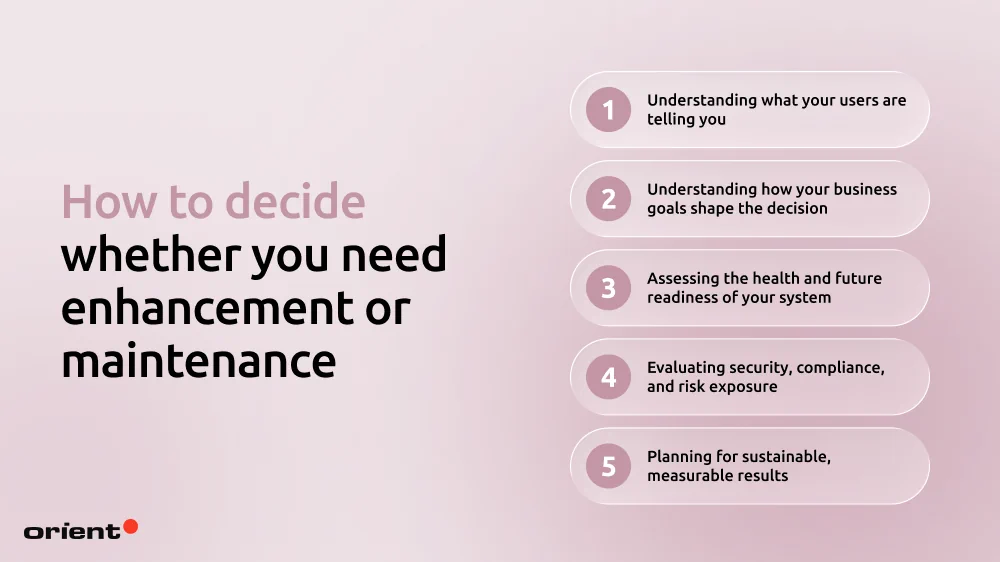
Understanding what your users are telling you
User feedback is usually the most straightforward measure of whether you should enhance or maintain.
- Requests for new capabilities: When the user requests more capabilities, integrations with other applications, and workflows that are not yet available, it is an indication of unmet opportunities. This is a typical enhancement realm since it increases the capability of the system.
- Reports of defects or instability: These are complaints concerning crashes, slowness, broken functionality, or erratic behavior indicative of maintenance requirements. The consequences of these issues damage confidence and effectiveness, and their resolution maintains the reliability of the system.
- Patterns in feedback: When feedback occurs regularly, like theming: “this process is taking too long” or “the system keeps freezing”… now you can recognize the pattern in that feedback, which helps you identify whether the core need is innovation or stabilization.
- User maturity and expectations: The more advanced the user base is, the higher their expectations may be. Even when the system is stable at the moment, this change will naturally lead it to improvement.
Understanding how your business goals shape the decision
The strategic direction you are pursuing is a significant factor when it comes to identifying the value improvement or preservation.
In cases where the organization is oriented within an innovative, competitive differentiation or new market, enhancement is consistent with those goals by increasing the capabilities of what the system can provide. When operational stability is the priority, the reduction of risk is the priority, or it is necessary to meet the compliance requirement, maintenance is the more urgent way since it provides the continuity of daily operations.
The decision is also affected by practical constraints like budget, staffing, or timing. Although a particular enhancement is desirable, stabilization of the base might require precedence. On the other hand, a strategic opportunity may warrant an expedited enhancement even in cases where some maintenance operations are left undone.
Assessing the health and future readiness of your system
The technical state of your system is a good determinant of what is practically feasible.
An application that is designed on older architecture or has outdated technology might not be in a position to accommodate the future plans, and so enhancement alone is not enough. A strategic upgrade or modernization can also be necessary in these situations, before adding new features can be done safely.
When the system structure is sound but ridden with technical debt, bureaucracy, or small glitches, then selective maintenance can be used to recover performance without significant redesign.
Scalability is another significant consideration: when you are in a roadmap that involves more volumes, more users, or more functionality, you need to consider whether your existing system can justify your growth or whether you should upgrade it to prepare for that growth.
Evaluating security, compliance, and risk exposure
The issue of security and compliance tends to ride over other priorities. Active vulnerabilities, regulatory loopholes, or direct risk exposures require maintenance since failure to fix them may provide legal, financial, and reputational repercussions.
Nonetheless, during proactive measures in reinforcing your security posture, such as the adoption of new frameworks, enhancing resilience, or surpassing the existing standards, the effort is more toward enhancement. When there are highly regulated industries, it is easy to shift the balance more towards maintenance due to the high cost of non-compliance.
Planning for sustainable, measurable results
Clear planning helps ensure that whichever path you choose delivers meaningful impact.
- Establish success measures: It could be shorter downtimes, more efficient workflows, or more customers adopting the use, but knowing what to accomplish will assist in making decisions and reaching goals.
- Trace processes and dependencies: It is easy to know how systems interact, and this can help avoid unintentional consequences and prioritize the work.
- Make investments wisely: Experienced teams, achievable timetables, and adequate budgeting will make sure the process of enhancement or reparation does not run out partway through.
- Check and refine: Frequent reviews are there to ensure that what you produce changes to meet the needs of the users and the technology and business requirements.
Common mistakes companies make
Even when organizations are aware of the theoretical distinction between enhancement and maintenance, errors still occur during implementation. Such wrong moves usually result in lost budgets, technical debt, and irritated users.
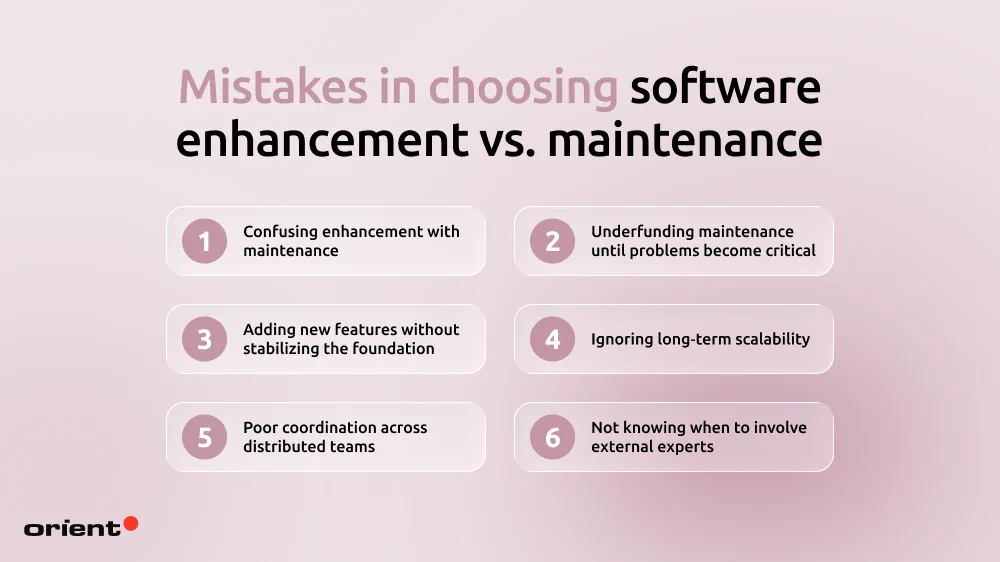
Confusing enhancement with maintenance
A possible trap is the confusion between enhancement and maintenance, which is one of the most frequent traps. Organizations that view strategic upgrades as routine maintenance projects are unwittingly investing inadequately in innovation and being sluggish in long-term development policy. Teams can give less importance to meaningful improvements, as these are seen as optional and not as a critical part of competitiveness.
The converse error, by calling some basic bug fixes “enhancements,” results in an inflated expectation and the falsity of performance reporting. It may occur because the stakeholders will think that the product is under development, whereas the team is merely recovering anticipated functionality.
Such confusion can be avoided by having clear definitions, use of consistent terminologies, and common understanding across teams as a way of ensuring planning, budgeting, and reporting reflect the work that has been done.
Underfunding maintenance until problems become critical
There is a tendency to compromise maintenance since it is viewed as a cost center, instead of a value driver.
Companies can delay regular maintenance and pursue more apparent efforts, thinking that minor problems can be put off or addressed at a later time. These issues remain unresolved, and eventually, there is a sluggish performance coupled with amplified instability that is quite frustrating to users.
This will finally come up to a breaking point where emergency fixes become necessary, or massive remediation will be inevitable and much more costly than steady, active maintenance would have been. Compared to proactive strategies, this is a reactive strategy that creates an additional burden on budgets, destabilizes operations, and damages user trust.
Adding new features without stabilizing the foundation
Fast-paced markets cause businesses to be under pressure to deliver new features as fast as possible to be able to match their competitors or meet their customers’ needs. Nevertheless, it is important to note that the technical debt is multiplied by layering additional functionality onto an unreliable or poor system.
Every new functionality adds new dependencies, complexity, and points of failure. Rather than supporting growth, enhancements upon weak foundations may act to augment risk, reduce development pace, and complicate subsequent improvement. To deliver valuable services with even the most innovative features, a stable core system is fundamental.
Ignoring long‑term scalability
Temporary solutions may be easily alluring, particularly with tight deadlines or limited resources. Nonetheless, decisions taken without regard to scalability in the long run tend to create bottlenecks in future growth.
The architecture, infrastructure, and data management decisions must cater to the present demands as well as the future predicted volumes of users, new markets, and changing business models. A lack of scalability can cause organizations to eventually be constrained to an expensive re-architecture effort in the future, slowing down strategic projects and making them less responsive. Sustainable growth goes beyond the short-term issues and design systems that are capable of evolving over time.
Poor coordination across distributed teams
The more global and distributed teams become, the more difficult it is to coordinate them. Time differences, communication, and work rhythms may cause problems in understanding and repetitive work, leading to delays in releases. Such problems prove to be particularly dangerous in the case of intricate upgrades or cross-functional programs that might demand a strict alignment.
The inability to be consistent and to have momentum may become a concern without the existence of structured communication, clear documentation, and well-defined processes. Successful work of distributed teams requires planned, equipped, and proactive communication patterns that ensure that all members are working as a unit despite the distance.
Not knowing when to involve external experts
Certain projects are too large or complex to resolve with internal teams, including large-scale architectural redesigns, custom software creations, elaborate security implementations, or special-purpose integrations. Costs or the need to have complete control are some of the factors that sometimes make organizations reluctant to attract external experts.
Nonetheless, postponing this choice may cause long-term timelines, unproductive solutions, or risks that will be revealed after the fact. Being able to realize that external competence is required is a strategic advantage rather than a weakness. The speed of progress, minimization of risk, and clarity in the fields of experience of the internal teams may be increased by external experts.
To prevent these errors, it is necessary to invest in a balanced manner, plan realistically, and have a strong cross-functional alignment. With proper management, enhancement, and maintenance, they strengthen one another and make product ecosystems healthier and more adaptable. Considering your own organization, which of these challenges do you feel most familiar with or is the most demanding to solve?
Best practices for managing enhancement and maintenance
Enhancement and maintenance management is more about execution discipline rather than theory. The following are pragmatic principles, each dealing with a typical weakness that organizations encounter in actual projects.
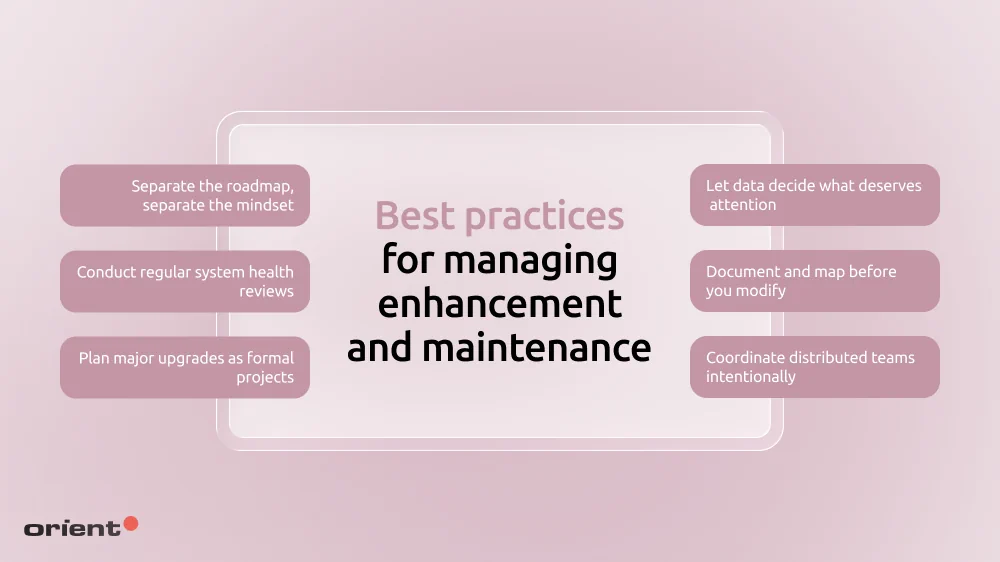
Separate the roadmap, separate the mindset
Among the largest business errors is incorporating maintenance activities and improvement projects into one undifferentiated backlog. Once all the things seem equal on a task board, cleaning up urgent corrections will often predominate, and strategic upgrades creep unnoticed.
A clearer structure is to maintain two visible streams:
- A maintenance track focused on stability, fixes, compliance, and operational health.
- An enhancement roadmap tied to growth objectives and competitive positioning.
The wisdom of this is quite straightforward: what you divide, you tend to control better. Planning can be intentional and transparent when the leadership is able to observe the extent of effort invested to maintain stability and the effort invested towards leading innovation.
Let data decide what deserves attention
The priority of the opinion within the company tends to result in an imbalance. Rather, employ measurable indicators.
For maintenance, consider system uptime, error frequency, performance measures, and security alerts. These reveal areas in which there is an increase in operational risk.
For enhancement, analyze revenue potentials, user activity patterns, customer attrition, and market requirements. These show areas of growth potential.
The insight is that enhancement should be opportunity-driven, while maintenance should be risk-driven. It is important to know which side you are answering to in order to make decisions less emotionally.
Conduct regular system health reviews
It is costly to wait until something breaks. Rather, have frequent checks of architecture, dependencies, scalability thresholds, and security posture. This transforms the maintenance from reactive firefighting to risk management. It can also assist in determining when a minor upgrade can no longer be suitable, and a bigger upgrade is considered to be strategic.
The insight is that invisibility precludes surprises. What is reviewed frequently does not often become a crisis.
Document and map before you modify
Changes that are implemented without visibility of the process normally have unintended consequences. Map current workflows before applying upgrades or structural maintenance. The documentation guarantees that the cooperation becomes easier with the distributed teams across time zones. It also lowers the time of onboarding and eliminates errors.
The insight is that clarity accelerates performance speed. Ambiguity slows it down.
Plan major upgrades as formal projects
Significant enhancement programs must have a scope, schedule, risk evaluation, communication initiatives, and implementation strategies. The careless attitude toward them as “just another sprint” can result in delays or scope creep.
To control testing with targeted user groups, it is possible to use tools like staged deployment and feature flags that can be released only to the identified groups. This is minimizing risk and maintaining the momentum.
The enlightenment is that structured planning saves time and quality. Discipline is not a stifler of innovation. It facilitates innovation that is sustainable.
Coordinate distributed teams intentionally
Time zone working teams can silently postpone maintenance and upgrade projects as they get misaligned. There has to be clear ownership, shared dashboards, well-documented guidelines, and asynchronous norms of communication.
The understanding here is that most delays in projects are not technical delays but are communication breakdowns. The issue of process clarity is even more critical with geographically dispersed teams.
Conclusion
In rapid, digitally dynamic environments, software cannot stand still. It should be guarded, sharpened, and ever advanced so as to remain pertinent. This is the reason why the concept of distinguishing between enhancement and maintenance is not simply a technical practice. It is a strategic move that has direct effects on growth, risk control, and competitiveness in the long run.
External assistance will be a clever and even strategic decision when internal resources are strained or when extensive upgrades require specific knowledge.
Collaboration with Orient Software will provide organizations with access to knowledgeable teams that can provide reliable maintenance services and properly designed software enhancement programs. The dedicated planning and execution with risk management would ensure your systems stay put within the ever-changing demand of the future, but with the right partner, you are guaranteed to be with them throughout.
The objective is not meant to pick one instead of the other. It’s to develop a strategy of technology design in which the elements of stability and innovation are complementary and bring about sustainable business value.