Inside South Korea’s Top Software Development Companies
South Korea is no longer just manufacturing the world’s hardware. In 2025, it’s exporting software, platforms, and AI at a scale most people outside Asia still underestimate.

Content Map
More chaptersKorea went through a period of stunning economic transformation from the early 1960s to the late 1980s, escaping post-war poverty and transforming into an industrialized, wealthy, and tech-advanced country by the late 20th century. This transformation is often referred to as the “Miracle on the Han River”. There are multiple factors that contribute to this miracle, and part of it is thanks to Korea’s major conglomerates (or “chaebol”) - Samsung, Hyundai, and SK. Even though each of these conglomerates has its own core services, they all share one thing in common: tech as a dominant pillar.
Just looking at these major players, it’s easy to conclude that Korea’s tech market is a mature one. While this statement is true, the country is also going through a highly strategic, government-backed boom in advanced, future-facing technologies.
Today’s article will take a look at software development in South Korea and its top tech companies, and provide quick tips to help you find a suitable partner in the country. Let’s dive right in!
Key Takeaways:
- Korea is a top country regarding technology and Internet speed. Despite its many achievements, the government still pushes for innovation, creating a strategic tech boom within the country.
- With its unique tech landscape, our article listed four major conglomerates (LG, Samsung) and four smaller but extremely successful companies (Lunit, Sendbird).
- Despite the colorful tech industry, the intense competition for senior developers pushes partnering and outsourcing rates up. Other considerations are the lack of English proficiency in smaller companies and the time zone.
Why South Korea Is a Growing Software Development Hub
As we’ve mentioned, Korea isn’t simply a growing tech hub. The country has reached levels of maturity, and numerous statistics show proof of this maturity:
- As of 2025, South Korea’s economy ranked 14th in the world by nominal GDP, demonstrating its high level of development and affluence.
- Korea’s digital infrastructure is highly mature and enables one of the fastest Internet speeds in the world, so it’s no wonder that its Internet penetration percentage goes up to 100% in certain age groups.
- The Korea Economic Daily reported that South Korea’s record export performance in 2024 was overwhelmingly driven by high-tech goods, with semiconductor exports surging nearly 44% to a record $141.9 billion, reinforced by strong growth in computing and advanced industrial technology.
Despite the country’s mature tech landscape, it is also going through a strategic tech boom.
- According to the Global Innovation Index (GII) 2025, South Korea is placed fourth in the world, maintaining its remarkable position on the global innovation map this year. This proves that South Korea is constantly researching and evolving and has a strong innovation ecosystem.
- The same report showed that at 5.0% of GDP, the country’s R&D spending is among the highest in the world.
- South Korea’s semiconductor exports climbed 43.9% year-on-year to a record $141.9 billion in 2024, reflecting its continued investment in advanced memory and AI-focused chips as part of a broader innovation-first strategy in global chip manufacturing.
These statistics go to show that despite the multiple achievements, Korea is still focused on innovation with the aim of staying a top leader in the semiconductor industry. Being in such a unique position opens up numerous opportunities for both Korea and its clients.
What to Look for in a South Korean Software Development Company
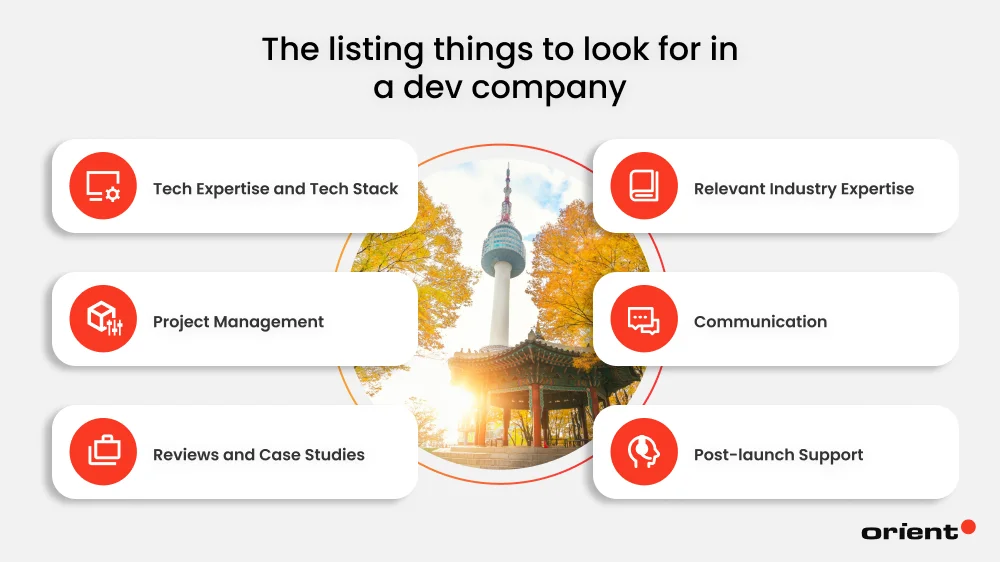
Before we dive into the list of top software development companies in Korea, there are a number of selection criteria for your potential partner to keep in mind.
Tech Expertise and Tech Stack
A tech stack can make or break a project. Talk to your potential partners and let them know your expectations regarding technology. Ask them what experience they have with certain programming languages, frameworks, or platforms, and if this experience fits your expectations. Keep in mind that a professional partner won’t force their tech stack on you but adapt theirs to your project requirements.
Relevant Industry Expertise
Having prior expertise in your industry can make all the difference. Not only can your partner avoid all the common mistakes, but they can also help you navigate the complex regulations and laws. As a result, your project has a competitive edge from the very beginning - making faster decisions and building features that fit in better with the business logic.
Project Management
Managing a project well is as important as high-quality code lines. Make sure you don’t overlook project management or development methods when talking to potential vendors. Ask them how they track progress, handle unexpected delays or problems, and how they plan their sprints. Any credible software development company should be able to answer all those questions and tell you how they prevent unwanted surprises or do-overs.
Communication
Strong communication is foundational. It moves a project forward, aligns stakeholders and objectives, and reduces unnecessary friction. It’s recommended to have a communication policy in place that outlines the frequency of meetings, milestones, how to keep everyone on the same page, and how constructive feedback is implemented. A strong vendor always ensures transparency at every stage of the project.
Reviews and Case Studies
Most companies have a section called “Case studies” on their website, so make sure to check this out first and foremost. Case studies reveal how the company handles challenges or pressure. Look for previous customer testimonials and reviews on the vendor’s website or other platforms to gauge how reliable they are.
Data Security and Intellectual Property Protection
Don’t save data security and IP issues for a project’s later stages. Right from day one, ask how your partner handles:
- Sensitive data,
- Access control and role-based permissions,
- IP ownership terms and transfer upon project completion
- Use of NDAs and confidentiality agreements
- Data encryption practices (at rest and in transit)
Again, a professional should have no problem producing relevant documents and answering your questions clearly.
Post-launch Support
A software development project doesn’t end on the launch day. The product needs regular maintenance, updates, and monitoring. Talk to your partner about these issues and how they’ll adapt to newer, emerging technologies.
Top Software Development Companies in South Korea
Korea’s situation is quite a unique one, where it is considered a country with both a mature tech landscape and a booming tech hub. To reflect the country’s unique circumstances, today’s article will list both enterprise-level software development firms and mid-sized or specialized development companies. The first four will be major conglomerates, and the last four will be mid-sized companies.
Samsung
Samsung is one of the most influential organizations in Korea’s tech ecosystems. It operates in a wide variety of industries and tech sectors, including electronics, IT, semiconductors, display technology, IT services, telecom and networking, automotive components, home appliances, and more.
In recent years, however, it has repositioned itself as a software and AI-driven platform company with a tightly integrated ecosystem rather than standalone devices. To be specific, at a consumer level, Samsung’s One UI and Smart Things connect over 500 million devices globally, creating a consistent and data-driven user experience. The corporation is also investing heavily in on-device intelligence, ranging from image processing to natural language processing and even code generation.
Business-wise, Samsung SDS serves as the group’s software and IT backbone, delivering large-scale products like AI, cloud, and enterprise automation platforms like Birty Copilot.
For anyone evaluating software development companies in Korea, Samsung represents scale, deep R&D, and a long-term commitment to innovation-led software growth.
LG CNS
While Samsung is building a large ecosystem, LG is more focused on consumers’ daily life, both at home and on the road. As of 2025, LG is no longer limiting itself to being a hardware manufacturer but is deliberately transforming into a platform and solutions-driven company, staying with its users through software.
At the heart of this shift is webOS - a Linux-based smart TV operating system that powers LG’s connected screens with a fast, app-driven, web-technology-friendly user experience. The cooperation now treats webOS as a standalone content and services platform, not just a mere TV software. By licensing webOS across devices, LG is turning operating systems into recurring revenue.
LG is also no exception to the booming AI trend. Its AI strategy, branded as “Affectionate Intelligence”, emphasizes on-device processing through its own AI chips, prioritizing privacy and real-time personalization across smart homes.
Kakao Enterprise
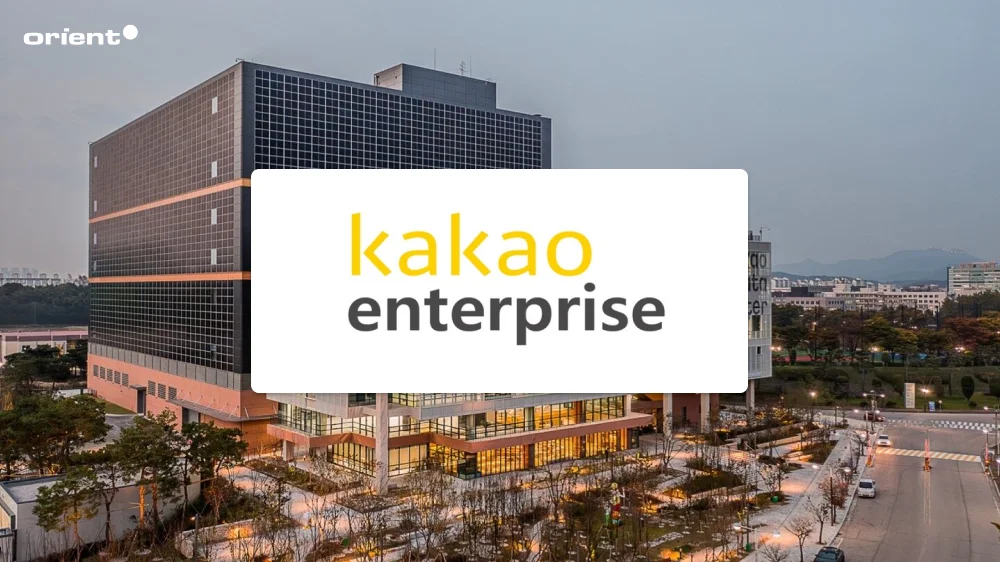
Kakao Enterprise is the platform-native generation, meaning it was built on cloud, software, and AI from day one. In 2025, the company will have restructured as a focused cloud and AI infrastructure provider.
Kakao Cloud is a Korea-based cloud platform by Kakao Enterprise that delivers locally optimized infrastructure and AI-ready services as a domestic alternative to global hyperscalers. The company’s strategy is clear: specialize where it matters. Kakao has delivered meaningful gains in performance and energy efficiency by optimizing for high-performance computing (HPC) and adapting 4th Gen processors, making it attractive to Korean startups and AI-heavy workloads.
The company is also carving out a niche in GPU-as-a-Service, deploying next-generation Nvidia GPUs to support large language models without forcing enterprises to rely on overseas infrastructure.
In short, Kakao is aiming to build the backbone for Korea’s next phase of AI-driven software innovation.
Hyundai
Hyundai Motor Group is famously known as a car company. However, it has been operating less like a traditional car manufacturer and focusing more on software, AI, and robotics. This is why Hyundai is mentioned in today’s list, as it is not just an automaker but also deeply cares about using tech to improve its products.
The corporation has invested over 120 trillion KRW to build a unified electrical and electronic architecture, enabling cars to improve post-purchase through centralized computing. This is all part of its strategy called “Software-defined Vehicle (SDV).
Regarding robotics and AI, Hyundai plans to deploy humanoid and mobile robots across global factories, turning manufacturing itself into a software-optimized system. Its autonomous driving arm, 42dot, continues to push map-less, AI-first driving systems despite leadership changes.
Lunit

Now that we’ve examined Korea’s tech giants, it’s important to take a look at other companies, though smaller in size, that play just as important a role in driving Korea’s innovation.
Lunit is a notable case when it comes to Korea’s deep-tech innovation. The company was founded in 2013 and had quickly become one of the world’s most respected medical AI software companies.
Lunit mostly focuses on oncology - the prevention, diagnosis, and treatment of cancer. The company has made its core mission clear: conquering cancer through AI. It focuses on software that enhances the clinical decision-making process. Lunit’s AI models analyze medical images such as X-rays and mammograms, identifying patterns that can be difficult for even experienced clinicians to detect. Rather than analyzing images in isolation, the system combines imaging with pathology and biomarkers to help predict treatments that are effective for patients.
Sendbird
Sendbird is another notable success story in Korea’s startup ecosystem. The company is the invisible infrastructure behind modern digital communication, powering chats for more than 300 users every month.
The company’s evolution is marked by a significant pivot from its original identity as Paprika Lab and Smile Family, a consumer social app, to a focus on its robust in-house messaging technology. Recognizing the potential for its chat infrastructure, the CEO decided to discontinue app development and instead commercialize this technology through an API-first model, which generated global demand.
Sendbird’s API sits behind real-time messaging platforms like Reddit, DoorDash, and Hinge. The company has also expanded into generative AI, offering chatbots that can be trained on private enterprise data to automate customer support with high accuracy.
Moloco
Moloco was founded by former Google engineers and is consistently viewed as technically elite. The company doesn’t build consumer-facing apps; instead, it builds the machine learning infrastructure that powers modern digital advertising at extreme scale.
Moloco’s platform focuses on performance-based advertising, using deep learning to predict user behavior in real time rather than relying on demographic assumptions or keyword matching. At this scale, optimization is no longer incremental but a mathematical effort.
In 2025, Moloco entered what many call its “Blackwell-era” phase by integrating vector search through Google Cloud Vertex AI. This allows its models to understand user intent and context, not just signals, delivering reported 6x higher click-through rates for retailers.
While you won’t be able to find the Moloco app on your phone, its algorithms are quietly powering ad monetization for giant companies like Lotte.
Toss Lab (JANDI)
.webp)
Toss Lab is a well-known collaboration platform often known as the “Slack of Asia,” called JANDI. There is one important caveat when it comes to JANDI: it is a platform designed specifically for Asian work cultures.
Unlike Western flat organizational norms, JANDI was built for environments where hierarchy, topic-based communication, and cross-department visibility matter. In 2025, the app is used by over 400,000 teams across Korea, Japan, and Taiwan, making it one of the most widely adopted enterprise collaboration tools in the region.
Sprinkler, JANDI’s flagship AI feature, is more than a simple chatbot and more like a corporate memory engine. It can search and find insights buried across years and years of messages, answering questions about feedback history or even decision context in a matter of seconds. JANDI has become a serious alternative to Slack and risky consumer messages for work, thanks to its AWS-backed encryption and organization-level controls.
Challenges When Outsourcing or Partnering in South Korea
Korea undoubtedly offers a strong, innovative tech ecosystem. It houses some of the largest tech companies in the world, and the government encourages innovations in both large and small to medium-sized companies. However, there are some challenges if you plan to partner with software development companies in Korea.

- Higher average pricing: Korea is considered to be on the upper-mid to high-end cost on a global scale. While it is much more affordable compared to outsourcing to the US or Switzerland, it is still significantly higher when compared to Southeast Asia or Eastern European countries. Another factor adding to the costs is the massive price gap for specific skills (AI, ML), with an intense competition between Samsung, Hyundai, and Naver for “Physical AI” talent. All these factors directly push outsourcing and partnership rates.
- Limited English-speaking talent in SMEs: Compared to large corporations, Korea’s SMEs have more limited English skills. This can be attributed to several factors:
- The best English speakers are often hired by Chaebols (Samsung, LG), where high English test scores are required for entry. SMEs can’t compete with their salaries or prestige.
- Many SMEs have been more focused on supplying Korea’s domestic market, and English hasn’t been a daily requirement.
- While Seoul is ranked “high” in global English indices, many SMEs in nearby provinces have notably lower English proficiency.
There have been multiple efforts to close this gap, however. English is slowly becoming a business standard, and with the help of AI, handling global emails wouldn’t be as much of a challenge.
- Time zone differences for Western companies: Korea operates on KST (UTC+9), creating a 13-16 hour gap with North America and a 7-8 hour gap with Europe, which limits real-time overlap to narrow windows. In time-sensitive projects or in projects where real-time communication is paramount, Korea might not always be a suitable choice.
Last Note
South Korea offers a rare combination: A deeply mature tech ecosystem that continues to produce meaningful innovation. For companies looking to build reliable, future-ready software, partnering with a Korean development team can be a powerful way to take a product to the global stage.
That said, if you prefer a partner in Southeast Asia, Orient Software brings over 2 decades of experience, a team with seasoned experts, and a cost structure designed for long-term scalability, which might just be the answer you are looking for. Don’t hesitate and reach out to us today!

Quynh Pham
Writer
Quynh Pham
Writer
Topic: