10+ Key Considerations to Keep Your Long-Term Project on Track
Starting a project is easy; finishing it on time and on budget is not. Long-term success depends on the decisions you make long before issues surface.

Content Map
More chaptersProject management is the foundation that keeps every project, long-term or short-term, on track. However, keeping a project on track, especially long-term ones, is an art that takes time and effort (and sometimes, money) to master.
A long-term project runs into multiple risks of derailing, delaying, or budget overrunning. It is true that there is no possible way to cover every possible scenario and risk when planning, but staying proactive and keeping a close eye on a project’s progress is how you not only overcome challenges but also turn them into opportunities. Seeing a project to its end is extremely rewarding, and today’s article will provide you with everything you need to know to do so. Let’s dive in!
Key Takeaways:
- Long-term projects are often exposed to more risks, including scope creep, schedule delays, budget overruns, handling changes, and shifting prioritizations, and so on.
- All these risk factors can lead to missed deadlines, failed projects, and damaged reputation.
- To keep a long-term project on its track, every phase needs thorough planning and monitoring: from identifying and breaking down goals, to resource allocation, documentation, risk management, and eventually, quality control.
Consequences of Poor Project Management You Need to Know

Inadequate project management leads to multiple consequences, and in a lot of cases, it is more than the loss of money.
- It is reported that around 78% of IT projects overrun the budget or experience serious project delays.
- Large projects run into even more serious problems. McKinsey’s research indicates that large IT initiatives, characterized by initial budgets exceeding $15 million, typically experience an average cost overrun of 45% and a schedule delay of 7%, while providing 56% less value than initially anticipated.
- Poor performance costs projects 12% of their investment, or trillions of dollars per year, according to PMI.
Project Cost Overruns
Financial loss is the first and most obvious consequence of inefficient project management, and its effects are amplified in long-term projects. This can stem from numerous factors:
- A lack of proper cost planning, where the team fails to estimate, budget, control, and monitor the project’s financial resources.
- Resource limit or poor resource allocation. Specialists may not be available to keep up with the timeline, or resources are available, but inefficient use of people and tools leads to unnecessary overspending.
- Subpar quality leads to multiple reworks, which are costly and push the project’s finish date down even further.
- Constant changes from clients also lead to reworks and delays, inflating the final budget.
Financial consequences, in many cases, can quickly become devastating to a company.
Schedule Delays
Going hand in hand with cost overruns are schedule delays. It is often difficult to pinpoint a singular reason for delays, as they are often a result of a combination of both external and internal factors. Some of the most common causes for missed deadlines are:
- Poor communication leads to misunderstandings, mixed messages, or information scattered across multiple communication channels.
- Unclear project goals, expectations, or unrealistic timelines also cause timeline slippage.
- Scope creep is behind both budget overruns and missed deadlines.
- Last but not least, bottlenecks can happen from unproductive feedback systems when too many people are involved in the decision-making process.
Demotivated Team Members
Delays or negative news regarding the project can quickly demotivate your team members or even cause burnout. Imagine having to constantly deal with unclear project objectives, last-minute revisions, unclear expectations, and numerous revisions. The chaos of a poor project execution inevitably leads to delayed promotions or incentives, or even layoffs. Having to find new hires and training and onboarding them from the beginning causes further delay, and then again, causes employee turnover. It can become a vicious cycle if not handled properly.
Bad Reputation and Damaged Client Relationships
Every project is a first impression that you leave on your client. You know what they say – you don’t get to make a first impression twice. One missed deadline can cause a chain reaction: your client loses trust in your team and looks for other partners for the following projects, they might leave bad reviews, and your reputation suffers permanent damage. Bad news travels fast. It might be harder for you to acquire customers in the future.
Sustainability Risk in the Long Run
One failed project has the potential to threaten the sustainability of a company. Monetary loss, employee turnover, and a damaged reputation leave an ugly scar for other clients searching for their next potential partner. In the long run, the company might even struggle to keep up the operation without drastic intervention measures.
Common Risks of Long-term Projects

Any project may suffer from the consequences of poor management. Nonetheless, long-term projects stand to face more risks than those with a shorter duration.
Scope Creep Risk and Constant Need to Adjust Scope and Plans
The longer a project, the more exposed the team is to certain risks. Scope creep is the one that’s almost inevitable. This is not to say that every change in the scope is bad - some changes are necessary as the project may encounter multiple issues along the way.
These changes not only frustrate the team members, but even the customer (despite the fact that they’re the ones who requested it). While some changes are necessary, it’s crucial to communicate the project scope as clearly as possible from the beginning and hold firm to certain metrics. We’ll dive deeper into these tips later.
Schedule and Budget Control
Project delays and budget overruns are among the key considerations for long-term projects, which is why they are among the most common risks. Other than meticulous planning and regular reviews, almost every project is going to run into financial problems (either exceeding costs due to unforeseen circumstances or changes in the project funding) and timeline problems (missing deadlines or even the delivery date).
Resource Stability and Attrition
Project managers need to be prepared for changes in the resources. For instance, another short-term, but high-priority project is running and needs to “borrow” some resources from your long-term project. This means your project is losing some key resources. You can always find a replacement, but the recruitment and onboarding process can be both timely and costly.
Attrition is also an unavoidable part of any project, which causes delays and changes in resource allocation.
Shifting Organizational Priorities
Customers’ requirements aren’t always the only thing that is shifting. On a smaller scale, there might be changes happening within the company, causing priorities to shift and business goals to evolve. On a larger scale, there might also be changes within the industry, with new standards and regulations implemented, forcing the whole team to adapt accordingly.
Another crucial thing to keep in mind is that not every change is a negative one. There are good changes and bad ones, but what matters is to be aware of potential shifts and follow the best-known practices to keep the project moving.
Hidden Work
Hidden work often refers to the invisible but essential tasks like communicating and coordinating, cleaning up and labeling data, reworks, and more. These tasks are often overlooked or go unrecorded, but they are the activities that bind the entire project together.
No amount of planning can cover every single piece of hidden work. However, failing to create buffers for potential hidden work can quickly lead to frustrating delays and budget overruns.
Prioritizing Hard Problems

The longer a project goes on, the more complex problems the team must deal with. Each complex problem often entails a number of smaller matters that need to be handled. However, every team’s resource is limited, so you need to take prioritization seriously or sometimes ruthlessly. Deprioritizing is a constant cycle one needs to constantly go through, because otherwise, the team will be dragged into endless, smaller tasks that don’t really move the project forward.
Maintaining Confidence and Perception
It is easy to lose perception in a long-term project. Perception refers to how stakeholders, management, and team members interpret the project’s value, progress, and health. It’s easy to fall into the routine of repetitive tasks and meetings while forgetting to celebrate the project’s milestones. It’s important to have frequent updates, small celebrations, and even Q&As to make sure the stakeholders don’t lose interest (and axe the project as a result).
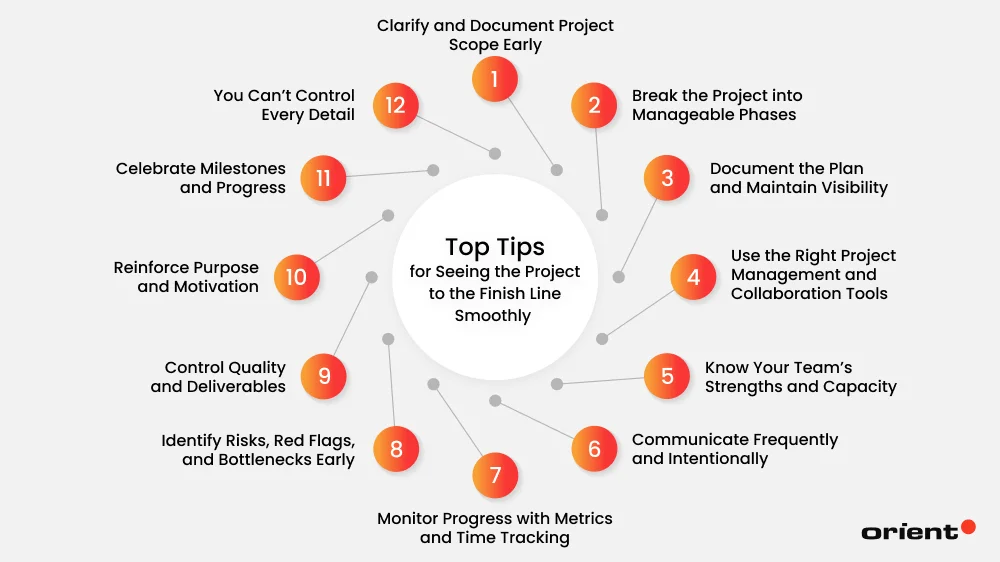
Top Tips for Seeing the Project to the Finish Line Smoothly
Clarify and Document Project Scope Early
Defining a crystal-clear scope doesn’t just start the project. It builds a resilient foundation that keeps development on track and under budget. Successful projects often clearly identify their scope of work even before launching, though this can be a bit tricky as project managers are often caught in the middle of management teams (who wish to increase the scope) and development teams (those who execute the plan). It’s best to do research prior to, regarding goals, timeline, deliverables, risks, technical and non-technical requirements, and so on, to provide teams with the most well-rounded brief.
Break the Project into Manageable Phases
Dealing with long-term projects is like walking up gigantic mountains – one can easily get overwhelmed. Instead of being terrified by the entire mountain in front of you, focus on each next step that takes you up the mountain, or in other words, break down the journey into smaller steps.
Work backwards to set subgoals. From yearly goals, break them down into 6-month goals, then 3-month goals, monthly goals, and eventually, weekly and daily goals. This practice also keeps the timeline realistic, as having a goal set up months ahead can make achieving it feel unrealistic and stressful.
Document the Plan and Maintain Visibility
Documentation gives the team material to refer to at every stage of the project. Strong documentation not only provides essential project details to the reader but also promotes collaboration, updates on changes, and enhances accountability and transparency.
Most importantly, a document gives the team clear instructions on next steps when something goes wrong, allowing team members to recover from setbacks instead of panicking.
Use the Right Project Management and Collaboration Tools
Teams utilizing structured project management tools are 28% more likely to meet deadlines. Gone are the days of relying on emails and Excel charts. Project management tools like Jira, Notion, Asana, Gantt, or Trello take care of communication and more: project planning, resource management, priorities pivoting, risk management, team collaboration, and more.
The best thing is that you have a centralized platform for every crucial document and piece of information. The team won’t need to send constant emails back and forth to locate that one piece of the update from 2 weeks ago.
Know Your Team’s Strengths and Capacity
Familiarize yourself with the team’s strengths and weaknesses. Having this knowledge allows you to form a well-rounded team, where you can leverage everyone’s specialized skills. Not only are the staff happy that they can shine in their field, but it also allows you to allocate resources effectively.
Communicate Frequently and Intentionally
Communication is the connective tissue of any and every project. While quick, daily check-ins, dashboards, and reports can give you a pretty good idea of how everyone is progressing, make sure you encourage team members to reach out when in doubt. It’s a good idea to foster a culture where your staff aren’t afraid to ask questions. Clear and effective communication is how you ensure everyone speaks the same language.
It also helps uncover issues early, align expectations, and reduce costly, unnecessary rework. When feedback flows openly across teams and stakeholders, decisions become faster, risks are easier to manage, and small misunderstandings are less likely to turn into costly problems later on.

Monitor Progress with Metrics and Time Tracking
There is a saying that goes “You can’t improve what you can’t measure.” This data-driven approach gives the team a clear picture of the project’s health and the team’s efficiency. While data doesn’t tell a full story, balancing between hard numbers and strategic vision is how you increase a project’s success rate exponentially. Clear data points can also help your team navigate the day-to-day chaos with mathematical certainty.
Identify Risks, Red Flags, and Bottlenecks Early
While it is true that no one can possibly plan for every single risk, change, or potential bottleneck, knowing what they are can help your team keep a lookout for them. Sit down with your team and discuss all the possible ways the project could go wrong, and what preventive measures you can take. In other words, encourage your team to be proactive, not reactive.
Control Quality and Deliverables
When a project becomes hectic and there are deadlines to meet, quality often takes a backseat. While there are certain standards that the product needs to meet, quality control might not always have clear-cut metrics. This is why we recommend involving the client in the approval process to make sure the product meets their expectations. Another smart approach is to build quality assurance into the project from the start, rather than leaving quality control until the final stage.
Reinforce Purpose and Motivation
In long-term projects, it’s easy to get caught up in new challenges that come up every month. The team might forget the bigger picture or why this project took place in the first place. Reminding the “why” keeps everyone motivated and even excited to see how far they’ve come. Have check-ins with team members every once in a while, to both motivate everyone and recapture their attention on the project’s important “why”.
Celebrate Milestones and Progress
Being focused on the bigger goal is important, but don’t be so focused that you forget the small wins along the way. Establish milestones during the planning phase and reward the team once you reach them. This keeps the team excited and motivated, keeping everyone on track. Reward the team with bonuses if the project phase is completed early or without any major problems. Another great thing about this reward system is that it makes the team feel appreciated, which often boosts productivity and their motivation even more.
You Can’t Control Every Detail
A project rarely goes as planned. Yes, it is important to evaluate the project every 6 months and have regular check-ins, but do know that you cannot micromanage everything. Trust your teammates that they’ll do their job well. Follow the best practices, utilize project management tools, and trust that your teammates will be able to move the project forward. Excessive micromanagement often acts as a bottleneck, stifling developer autonomy and ultimately compromising project velocity.
Closing Thoughts

Ultimately, successful software delivery is a marathon of alignment. Keeping these project management principles at the forefront of your long-term strategy is how you navigate toward the finish line without exhausting your budget or stretching your team’s resources to the breaking point. In an industry defined by rapid change, the ability to maintain a steady, data-driven pace is what separates market leaders from those struggling with technical debt.
It requires a team or partner who values the “long game” of scalability and maintenance over the quick win of a first-day launch. Orient Software is built to navigate that long game alongside you, transforming challenges into measurable success. Contact us today!

Quynh Pham
Writer
Quynh Pham
Writer