Faster time to market: A practical playbook to ship products quicker
In today’s product economy, delay is more expensive than imperfection. Faster time to market expands your opportunity window while competitors are still planning.

Content Map
More chaptersIt is often widely agreed that a product delivered early, though flawed, is often better than a perfect product arriving late. The logic is simple - the sooner you enter the market, the wider your window of opportunity is.
A great example of this logic is ChatGPT - it has become synonymous with generative AI in recent years. When OpenAI released ChatGPT, they didn’t just launch a tool; they seized a category. ChatGPT hit 100 million monthly active users in just two months, becoming the fastest-growing consumer app at the time. Competitors such as Anthropic (Claude), Google (Gemini), and Meta Platforms (Llama) have caught up, but OpenAI’s first-mover advantage has locked in “brand eponym” status. “ChatGPT” now functions like Kleenex or Google in everyday language.
Companies should move fast, yes, this is true and an important survival mechanism in today’s tech landscape - but not recklessly. Today’s article presents the most practical strategies for speeding up time-to-market without compromising quality. Let’s dive right in.
Key Takeaways:
- Time-to-market refers to the total time it takes before a product hits the market.
- Cutting time-to-market is crucial as it brings both short-term and long-term benefits: A larger potential market share, early idea validation, competitive advantage, and securing an image as an innovative market leader.
- There are multiple levers to accelerate time to market: a clear product roadmap, streamlined workflows, and disciplined adoption of Agile and DevSecOps, among others. The principle is simple: incremental improvements at every stage of the development lifecycle compound into faster delivery and a stronger product outcome.
Why improving time-to-market matters
Cambridge dictionary defines time-to-market as “the amount of time it takes to design and manufacture a product before it is available to buy”. In the specific context of the tech world, time-to-market (TTM) captures the full product journey, from concept to release, across core stages like ideation, design, testing, and market entry.
TTM has always been a crucial factor in a software development project, and understanding the importance of improving TTM vastly benefits every aspect of the project.
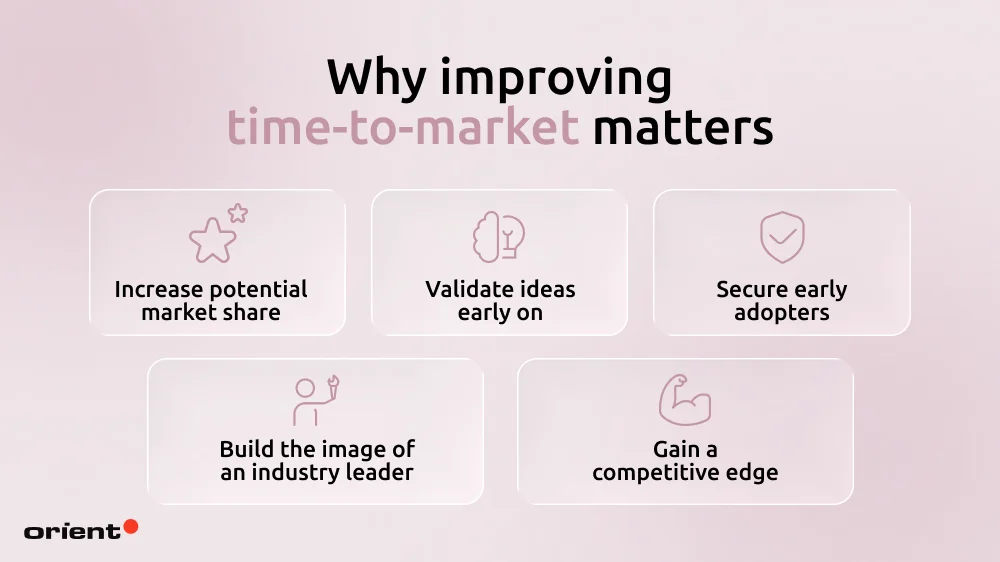
Increase potential market share
Increased potential market share is about more than the possibility of growing profit margin and seeing an early return on your investment. Cutting TTM increases potential market share that can bring in long-term advantages.
- Brand Dominance: Early and high market share creates stronger recognition, reputation, and customer loyalty. As a result, your brand can enjoy the “first-mover advantage.”
- Higher Profits and Resistance: Research conducted by Harvard Business Review concluded that market leaders not only tend to be more profitable, but they are often also more equipped to withstand economic downturns.
All in all, shortening TTM and capturing significant market share early on is how businesses gain a multitude of advantages in the long run.
Validate ideas early on
Pixar director Andrew Stanton is known for his encouragement to “fail early and fail fast”. Failure is an integral part of success, and by “being wrong as fast as you can” (also another quote from Andrew Stanton), you can quickly get back up, learn, and fix whatever isn’t going according to plan. This definitely sounds much better than staring at a fancy plan on a screen and making wild guesses about its level of success.
The same idea can be applied to software development projects. The sooner you can introduce the product to the market, the faster you can gather customer feedback about what’s working, which features need improvement, and what is missing. It also lets you know if the initial idea works or needs reworking entirely.
Secure early adopters
There is always a group of tech enthusiasts who love to test out new tech. Cutting TTM means you get to secure a certain user base early. This is how you secure market share and collect insights to make iterations as quick as possible, cutting R&D costs.
Build the image of an industry leader
If you build and release a product early and with no similar products in the market, you will quickly become an industry leader. Think of the iPhone - Apple has revolutionized the smartphone industry by being first. Even though there have been many competitors that followed suit, like Samsung, Sony, and Google, people think of the iPhone as the leader of the smartphone industry.
Gain A competitive edge
Launching a product early, with little competition, means you don’t have to fight for the user’s attention. You can solidify your brand’s image as the go-to solution for that very specific problem, solidify your brand’s reputation as an innovator, and even enjoy bragging rights when other brands try to catch up with you by releasing similar products.
Can you measure time-to-market?
The short answer is yes, you can. Even then, there is no blanket formula to calculate time-to-market.
A quick note: Before any calculations, it’s important that you keep a proper and detailed record of the project dates.

TTM is often measured based on a start date and an end date. The biggest difference, however, is based on how your team defines the start and end date of a project.
- A start date might be the day an idea is first mentioned, or the day it is approved, the day the whole team decides to move forward with the project, or the day the team completes assigning resources to different departments.
- An end date can be considered to be the day the product hits the market, goes into manufacturing, or when the first sales are made.
Make sure the team clearly defines the start and end points of a project for the most accurate calculations. There is no “right” or “wrong” method, but it does matter that you stay consistent from project to project to track the company’s time-to-market statistics accurately.
Another thing is to make room for adjustments based on product complexity, industry, and project scope.
Strategies for achieving faster time to market
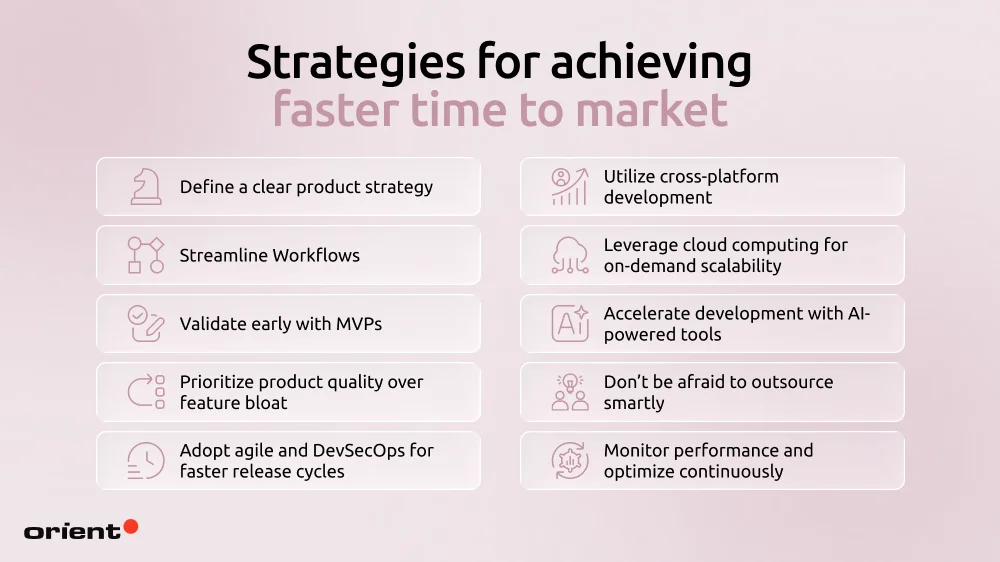
Define a clear product strategy
A well-thought-out product strategy serves as a compass to guide multiple teams to the final goal. The strategy doesn’t only lay out a step-by-step process from initial product ideation development to product distribution, but it also fills in the missing links: Who the product serves, the goals it aims to achieve, and what the company expects in return.

A clear view of the next steps is how you keep every team member on the same page during the development process. As a result, every relevant decision-making process is hinged on a pre-defined document, cutting down on back-and-forth and pushing the app to market much faster.
Streamline workflows
Success is the sum of small wins.
The success of a complex development project comes down to numerous factors, and workflow is indubitably one of them. Every step of the development process, every workflow that is attached to it, will ultimately determine the speed of the overall project.

Have regular reviews with your team and ask difficult questions:
- Where does a task sit “idle” the longest?
- Does it take too many people and too much time to approve minor changes?
- Are all the features for our MVPs “must-haves” or just” nice-to-haves”?
- What is one tool we can implement to automate tasks and save at least an hour of work?
It takes time and effort to effectively streamline workflows, but the effort is often worth it.
Validate early with MVPs

A minimum viable product, or MVP, is an efficient way for companies to quickly validate an idea. Simply put, an MVP is the simplest version of a product that solves a core problem for users. It provides a low-risk testing ground so the team can validate ideas and gather user feedback quickly. This allows the team to go back and refine the features without investing thousands into a final product. Remember that Amazon, the e-commerce giant, started out as a humble online bookshop. People would place orders on the website, and the company would source books from distributors. No warehouses, no complicated systems, just a simple website.
Prioritize product quality over feature bloat
Always keep the core problem you are trying to solve for your users at the top of your mind. Don’t let the shiny features take your attention from the essential ones.

Keep the same mindset with MVPs: Which features deliver the most value and help customers with their pain points? Which features can be removed without compromising the overall quality of the application? As tempting as adding new, fancy features is, do keep in mind that each new function introduces potential budget overruns, delays, and errors, which can all ultimately slow down market launch. Always consult experts if you are unsure of the features list.
Adopt Agile and DevSecOps for faster release cycles
Agile is a popular methodology as it acknowledges that change is inevitable. Instead of following a rigid plan for 12 months, it breaks the project down into smaller, more manageable parts called “sprints”. These sprints usually last 2 weeks, and at the end of each sprint, you’ll have a piece of working software. With this, you can release the product early, generate revenue faster, while the team is working on the rest of the features. Faster TTM is only one aspect of the methodology; teams can also pivot to the newest tech trends in the next sprints since the roadmap isn’t set in stone.

The development cycle can speed up even further if you adopt Agile methodology along with DevSecOps (Development, Security, and Operations). It embeds automated security checks into the CI/CD pipeline. Vulnerabilities are flagged the moment code is written, eliminating audit bottlenecks and reducing expensive redesigns.
Utilize cross-platform development
Cross-platform development allows you to write a codebase once and run the app on a variety of operating systems. There is no need for separate teams for different platforms, and you can enjoy faster development cycles. The costs are thus cut, and maintenance for the app doesn’t take as much effort.

It is crucial, however, that companies carefully assess their project requirements and expectations before choosing cross-platform development. This method of development is the most suitable when:
- You want MVP validation: Cross-platform minimizes cost and risk before committing to fully native builds.
- Your app is data-driven: It is suitable for API-based, content-heavy, or e-commerce apps, but not ideal for graphics-intensive games or hardware-dependent applications.
- Efficient with limited talent pools: Enables web teams (JavaScript/TypeScript) to transition into mobile development, reducing hiring friction.
Leverage cloud computing for on-demand scalability
Cloud scaling directly accelerates time to market by removing infrastructure bottlenecks. Instead of waiting weeks for hardware, teams can provision environments instantly on platforms like AWS, Azure, or Google Cloud Platform (GCP). Automatic scaling prevents launch-day crashes while managed services reduce undifferentiated infrastructure work. This enables faster iteration cycles.

For example, Spotify uses Google Cloud Platform to run automated CI/CD pipelines, releasing updates multiple times a day and responding to user feedback in near real time.
Accelerate development with AI-powered tools
Artificial Intelligence is present in every aspect of life, including software development. It can be an incredibly powerful tool to boost productivity and speed up TTM. Let’s take a look at some notable examples.
- AI can be integrated into large and complex codebases to help developers navigate them. A 2022 study from GitHub found that developers using GitHub Copilot finished tasks 55% faster compared to non-users.
- In some cases, traditional QA can become unwanted bottlenecks. AI can fix this by detecting bugs and even predicting where a bug might occur.
- In terms of project management, AI can analyze past and present data to predict delays or set realistic launch dates.
Don’t be afraid to outsource smartly
Remember: Your in-house team doesn’t have to be experts in everything. Being aware of your own strengths and limitations is how you grow a strong team and accelerate overall time-to-market.

There are several reasons that you might want to consider outsourcing:
- You need an expert to solve a specific technical problem,
- There is a niche skill set that you need, but haven’t been able to hire yet, or
- You temporarily need more hands on board.
Utilizing help from an external partner is smart and cost-efficient to do so - you will have access to the resources that solve all the mentioned problems and more. Do take your time to select a reliable partner with the right expertise in the field, as this can make or break your project.
Monitor performance and optimize continuously
Having key performance indicators (KPIs) in place to measure the development process is how you keep a project in check and quickly introduce it to the market. There are several benefits to having a well-established tracking system in place: clear data creates confident decision-making processes, prevents bottlenecks by facilitating resource allocation, and you can implement experiments and track their success.
Careful monitoring of the overall process also fosters a culture of accountability and encourages everyone on the team to improve their work. You know what they say - micro-optimizations, macro impact.
Accelerating time-to-market with Orient Software

In today’s tech landscape, it’s important to remember that the market doesn’t reward perfect products. It rewards companies that deliver first and improve faster. No two projects are the same, this is true, but the general rules to speed up time-to-market stay the same. There are multiple technologies and tech, too, that support the faster shipment of products to the market.
Speed becomes a real advantage only when it’s sustainable. At Orient Software, we pair agile delivery with scalability to help teams reach the market while the opportunity window is still open. From fast-moving startups to enterprises navigating change, our cross-functional teams focus on execution that removes delay without introducing risk. If your roadmap needs momentum, let’s start talking about cutting months off your time to market. Drop us a line today!

Quynh Pham
Writer
Quynh Pham
Writer