Custom Software Development Agreement: Types of Contracts You Must Know
Whether you are a first-time outsourcer or a seasoned business owner, understanding different types of software development contracts is a crucial step toward an informed decision. We'll provide you with a detailed description of each type and offer on-spot tips to help you navigate contract strategy efficiently.

Content Map
More chaptersA software development agreement is a cornerstone for any successful project. Signing a contract is often the last step in the vendor selection process; however, you should not wait until then to learn about what you are going to sign up for. Here, we’ll break down three contract types in a clear, pragmatic way. After this article, you can learn how each contractual model works and where it excels or falls short. We can guarantee that knowing about these contractual models will be a crucial step in setting your software development outsourcing initiative up for success. So, take note if you must, and let’s get started.
Key Takeaways:
Choosing the right software development contract is more than a formality. It’s a strategic decision that shapes the success of your outsourcing partnership. There are three primary types of contracts. Each offers distinct advantages and limitations, and the best choice depends on your project’s clarity, complexity, timeline, and long-term goals.
- Time-and-Material: Provide the flexibility needed for evolving requirements.
- Fixed Price: Ensure cost predictability for well-defined scopes.
- Dedicated Team: Offer long-term capacity and continuity for ongoing development needs
Understanding how these models work, where they thrive, and what risks they carry empowers you to approach your outsourcing initiative with confidence. With the right agreement in place, you create a collaboration framework that aligns expectations, minimizes uncertainty, and supports smoother, more successful software delivery.
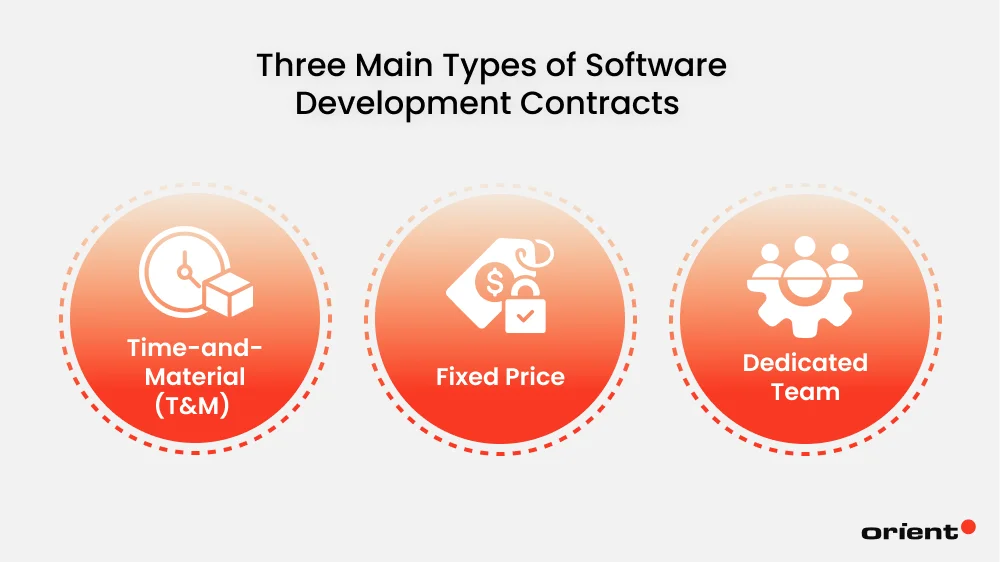
Three Main Types of Software Development Contracts
On the journey toward building a strong, long-lasting partnership with a software company, a well-structured contract is the solid foundation you can set. Beyond a legally binding document, an agreement or contract represents a mutual commitment between parties - usually the software developer (service provider or contractor) and the client (service user).
Contract terms serve as the structural foundation of a written agreement. They delineate ownership rights, responsibilities, expectations, and other obligations that guide the entire collaboration. When crafted thoughtfully, a software development agreement becomes the compass that keeps all parties involved and aligned. It ensures that the project moves forward in a transparent and predictable manner while minimizing risks.
In reality, software development is inherently dynamic as requirements evolve, features shift, and priorities change on a regular basis. And no collaboration exactly resembles the other. Some projects are tightly defined and short-term, while others evolve continuously and fast or require long-term development capacity. Therefore, different types of software development agreements exist precisely because all development projects differ by project budget, scope, timeline, goals, technical specifications, resources, and service models. And the nature of a contract must adapt to those variables.
The three software development contract types below are commonly used in the industry today. Selecting the structure that best supports your needs can maximize the value of your outsourcing partnership, and vice versa.
Time-and-Material (T&M)
If we have to pick the most widely used contract model, T&M must be the one. Under this contractual agreement, the outsourcing vendor bills the client based on the actual hours developers spent on the software development process, along with the other relevant expenses associated with any materials and resources (E.g., tools and software licenses) used.

Pros
The defining strength of T&M is its flexible format that gives business owners the freedom to modify the project scope, add new features, reallocate third-party materials and resources, or adjust deadlines in response to new insights or changing market demands. The best thing is that changes can be made without triggering any additional expense, as you pay only for what you use.

When building complex, evolving products like enterprise systems, AI-powered applications, or integrations with uncertain technical dependencies, this adaptability becomes invaluable. Whether you are building a product from scratch, experimenting with emerging technologies, or refining requirements through discovery phases, T&M provides the room needed for exploration and continuous improvement.
Cons
Valuable adaptability does come with trade-offs. When poorly governed, you may face risks of project scope creep, unclear requirements, or inefficient resource usage. Additionally, budget uncertainty is another concern. Since the final payment is directly linked to the amount of actual work, it will become unpredictable when your project changes its trajectory in any way. Even with estimates, a shift in direction or changing priorities can create tension, causing the total cost to expand beyond initial expectations.

One more drawback of the T&M model is efficiency loss or misalignment. The model itself can leave clients feeling unsure about whether the time and resources are being used optimally or not. The clients may perceive the work as open-ended or inefficient, especially when lacking trust, transparency, and oversight between parties. Needless to say, this may silently ruin a collaboration, not to mention its outcomes.
Last but not least, T&M contracts also place greater management and communication demands on the client. Business owners like you must stay actively involved when it comes to reviewing priorities, approving changes, and giving feedback. For organizations with limited technical leadership or insufficient internal bandwidth, this can be overwhelming. Therefore, poor communication from the client’s side not only slows development but also intensifies frustration on the other party.
Tips
T&M works best when paired with effective project management, clear communication channels, and consistent progress reviews. To be more certain, you should prepare what’s possible, such as the estimated budget, hourly rates for each role, the expected work breakdown, reporting frequency, and billing cycle.
Recommended Use Cases
The T&M approach naturally aligns with agile methodologies, where priorities shift based on user feedback, market trends, or internal discovery. Additionally, its pay-as-you-go structure is advantageous for projects where requirements are still evolving or the full scope cannot be determined upfront.
Fixed Price
This is a straightforward model. Under a fixed-price agreement, the total cost, the scope of work, and the delivery timeline are all predetermined and agreed upon before the project begins. Regardless of the actual time and resources, the outsourcing vendor is responsible for ensuring the project is completed within the agreed budget and schedule.

Pros
The most appealing benefit of a Fixed Price contract is predictability. Clients know what will be built, how long it will take, and exactly how much it will cost. This makes budgeting and internal approvals far easier. It also allows clients to be less hands-on during development because the vendor is expected to manage the work and deliver the results as promised.

For the vendor, the model encourages organized planning and efficient execution since overruns come out of their pocket. When everything is well understood from the beginning, this contract type can run smoothly and avoid the uncertainty of more flexible models.
Cons
Strength can become a weakness if not handled correctly. The structure that makes fixed price contracts predictable also makes them rigid. Once the requirements are locked in, any change tends to trigger additional fees or timeline adjustments. Even small improvements or useful ideas that emerge during development can become difficult to introduce.

Vendors sometimes include a buffer in their price to protect themselves from unexpected complexity, which means the client may pay more than the actual effort requires. Another challenge arises when the early requirements are incomplete or unclear. Misunderstandings in the beginning can easily grow into disputes or delays later, since the entire agreement depends on accurate assumptions from the start.
Tips
If you choose a fixed price model, the most important step is to invest time in planning before signing. Clear requirements, defined user journeys, and visual references make it much easier for both sides to understand the work and agree on a fair price. Breaking the project into milestones can keep communication open and give the client visibility into progress. It also helps to accept that changes will cost extra and to prepare a small reserve budget for adjustments. Above all, work with a vendor who is experienced in this type of engagement, because accurate estimation and disciplined project management are essential.
Recommended Use Cases
A Fixed Price contract works best when the project is stable and well understood. It is a good fit for small to mid-sized applications, clearly defined MVPs, design refreshes, and systems where compliance or regulations already dictate the requirements. Organizations with strict budgets or formal procurement processes also benefit from the cost certainty this model provides. On the other hand, it is not ideal for projects that involve exploration, frequent changes, or evolving ideas, since flexibility is limited once the contract is in place.
Dedicated Team
In outsourcing, this contract model is very common. A dedicated team contract is an arrangement where a client hires a remote team of specialists who work exclusively on their projects for a set monthly fee. Instead of paying for a fixed scope or counting individual hours, the client pays for consistent access to a group of professionals who function much like an extension of their in-house staff. The team can include developers, testers, designers, project managers, or any roles the client needs, and the level of involvement can shift as priorities change. This model focuses on long-term collaboration and ongoing capacity rather than pre-defined deliverables or fixed project cost.

Pros
The dedicated team model offers a level of flexibility that is difficult to achieve in most other contract structures. Because the team is fully committed to the client, the workflow can adapt quickly to new ideas, shifting priorities, or sudden business needs. Clients benefit from continuity, deeper domain knowledge, and a stable working rhythm that strengthens productivity over time.

Communication also tends to flow more naturally because the team becomes familiar with the client’s processes, culture, and expectations. For many companies, this model feels more like having an in-house department without the overhead of recruitment, HR, and long-term employment obligations.
Cons
The biggest challenge with this type of custom software development contract is the ongoing commitment. Since the client is paying for full-time capacity, they must be prepared to keep the team consistently engaged. If priorities stall or planning is unclear, the client may feel that resources are underused.

The model also requires stronger internal leadership, because the client plays a key role in guiding the team’s direction and maintaining alignment. For organizations without a technical lead or product owner, this can become demanding. Also, another consideration is that the total monthly cost may be higher than a short, well-contained project, so this structure is not always ideal for small or one-off tasks.
Tips
To make the most of a dedicated team, it is helpful to treat the team as part of your company rather than an external vendor. Clear communication, defined priorities, and steady planning go a long way. Assigning a product owner or project manager on the client side ensures that the team always has direction and can maintain momentum. Regular check-ins and open discussions about goals and deliverables help keep the relationship collaborative and transparent. Since the model offers flexibility, be ready to take advantage of it by adjusting the team size or roles as your roadmap evolves.
Recommended Use Cases
This type of contract is ideal for long-term initiatives, ongoing software development, or products that are constantly evolving. It works particularly well for companies that need reliable technical capacity but prefer not to hire an in-house team or struggle to find the right talent locally. This model also suits startups and scale-ups that expect rapid growth, as the team can expand or adjust quickly. It is less suitable for small, short-term projects with a fixed scope, where a more contained contract type would be more cost-effective.
BONUS: Verify These Components to Ensure a Software Development Contract Is Enforceable
Before any development work begins, both the client and the vendor must sign a formal software development agreement that outlines all contract terms and conditions governing the partnership. Regardless of the contract model you choose, an enforceable agreement should contain essential components that safeguard the interests of both parties and ensure validity. A well-structured contract tends to erase ambiguity (if any), clarify responsibilities, and significantly reduce the likelihood of disputes. The following sections explain the critical elements every custom software development agreement should include.

Services & Resources Provided
A strong contract begins by clearly defining the services that will be delivered and the resources allocated to the project. The section should state the scope of work in detail. It ranges from the tasks to be performed to the development methodology to be used and the technologies or tools required. Also, the contract should specify the development team’s composition, including each member’s responsibilities and availability. Terms of time and location for service delivery should also be clarified and documented in the description. For example, on-site, remotely, or in a hybrid environment.
When information is laid out with precision, both parties involved secure a shared understanding of exactly what to expect. It ensures everyone is on the same page and proceeds toward the same goal without misunderstanding.
Quality Acceptance Criteria for Deliverables
Quality acceptance is a central pillar of software development, so the contract must define how quality will be measured and validated. Acceptance criteria should clearly outline the functional and non-functional requirements that the final product must satisfy, along with the testing procedures that will be used to evaluate each deliverable. This often includes user acceptance testing, performance testing, security validation, and compliance with industry standards or regulations.
By setting objective criteria for evaluating deliverables from the outset, the contract ensures that both parties agree in advance on what constitutes a satisfactory outcome. This section ultimately serves as the benchmark for determining whether the project has been completed successfully and in accordance with the client’s expectations.
Delivery Dates & Deadlines
Having a well-established timeline for the entire development lifecycle and project delivery is essential. It outlines activities and stages that should be completed within a notice period and establishes a clear schedule with key milestones and due dates. This overview ensures accountability and enables both the contractor and the client to keep track of how the work will unfold and plan resources accordingly.
Moreover, the contract also details how disruptions like unforeseen delays will be managed, including procedures for reporting issues, renegotiating deadlines, enforcing penalties, or invoking force majeure clauses. With a well-defined project timeline, both parties gain visibility into the project’s progress and understand their obligations.
Confidentiality & Non-Disclosure
As the cornerstone of a responsible software development partnership, the confidentiality or non-disclosure agreement (NDA) prevents either party from sharing or misusing sensitive information, whether intentionally or unintentionally. This consists of trade secrets, proprietary algorithms, source code, business strategies, customer data, and any other confidential information or material disclosed during the collaboration.
A strong NDA not only emphasizes data protection protocols but also outlines the consequences of unauthorized disclosure. When needed, confidentiality clauses should also reference compliance with relevant regulatory frameworks such as GDPR, HIPAA, or PCI DSS. By including this section, both parties reinforce trust and ensure that sensitive information remains secure.
Contract Variation & Change Management
Given the dynamic nature, no contract is complete without a well-defined change management procedure. In reality, software specifications are rarely static. They often evolve as new information emerges, user feedback is gathered, or business priorities shift. Although you may not be able to predict the exact alterations, it is still a good idea to outline potential modifications in advance.
The contract should therefore specify how change requests will be submitted, reviewed, approved, and documented. It must also explain how modifications will affect cost, schedule, and resource allocation. A transparent change management process ensures that neither party makes unilateral decisions and that all adjustments are handled systematically. By establishing these guidelines early, the contract protects both sides from scope creep, budget overruns, or disagreements about unauthorized modifications. The contractor and the client can rest assured that updates are handled professionally and without unnecessary conflicts.
Intellectual Property Rights
Intellectual property (IP) ownership is one of the most critical aspects that must be explicitly documented in the software development contract. The agreement must clearly state who will be the exclusive owner of the final product in terms of source code, design assets, documentation, and other deliverables produced during engagement. The software product ownership will be transferred to the client as soon as it is completed and the final payment is made.
On the client’s side, you need to know what rights and privileges you are entitled to once the project is finished. In case of any intellectual property infringement, penalties or legal action must be taken. Without clearly defined IP rights, disputes can arise over usage rights, modification rights, or the vendor’s ability to repurpose components in future projects. Clarifying these terms upfront eliminates ambiguity and protects the client’s long-term control over the custom software product.
Payment Terms & Warranty
The payment section of the contract should specify the financial terms in detail. All the provisions concerning payment, such as the pricing model, invoicing schedule, payment schedules, and acceptable payment methods, must be negotiated and documented.
Depending on the arrangement, payments may be tied to milestones, hourly work, or a fixed cost. It is important for the agreement to address any conditions that may influence pricing, such as currency fluctuations, additional expenses, or tax obligations. The warranty provisions are equally important, as they define how long the vendor remains responsible for bug fixes and updates after delivery and clarify which types of issues fall within the warranty scope. A clear warranty period ensures the software stays stable and reliable after launch, giving the client confidence during rollout and making potential dispute resolution more straightforward for both parties.
Maintenance & Support Services
In addition to a warranty, digital products require ongoing support and software maintenance even after launch. The contract should therefore explain what post-launch technical support and maintenance will be provided. This includes specifying the types of support available, the expected response and resolution times, and any associated fees for ongoing maintenance or feature enhancements. By documenting these details, the agreement ensures that the clients understand the support level they can expect after the product goes live, while the contractors know their obligations. This eliminates the risk of relying on informal promises and helps maintain long-term software stability.
Dispute Resolution & Exit Strategy
Finally, every enforceable software development contract must establish a process for resolving disputes and an exit strategy. Despite best intentions, disagreements can arise, and the contract should outline how such disputes will be addressed, whether through negotiation, mediation, arbitration, or legal action.
An exit strategy is also important, as it clarifies how either party may terminate the agreement and what obligations follow termination. This includes how source code and documentation will be transferred, how data will be handled, and what compensation is due for work completed up to that point. A clear exit strategy protects both parties from uncertainty during the entire contract and ensures a fair and orderly conclusion to the partnership if the need arises.
A Partner for a Comprehensive Coverage of Software Development Services & Contract Models
To make an informed decision, you should consult with a legal professional, or you can collaborate with us. A partnership with Orient Software goes beyond choosing a development model or signing a contract. What clients consistently appreciate is the peace of mind that comes from working with a professional team that is not only proactive and dependable but also invested in their success. At Orient, we take the time to understand each client’s goals and environment, then tailor both the technical approach and the collaboration style to match. This ensures that every engagement feels aligned, responsive, and purposeful from day one.

We provide a full suite of custom software development services (web/mobile app development), QA testing, staff augmentation, and more. More than just a software development company, we bring long-term consistency to our partnerships. Over 100 global clients begin with a single project but stay with us for multiple years because they value the stability, transparency, and trust we provide. Our teams build deep knowledge of each client’s systems, workflows, and vision, which helps us deliver faster and more effectively over time. Whether you are scaling an existing software product, modernizing legacy systems, or exploring new digital opportunities, you have a team that already understands your business and can adapt to you.
Orient Software also makes the outsourcing experience straightforward and well supported. We provide clear communication channels, accessible reporting, and dedicated points of contact, so clients always feel informed and in control. Combined with strong engineering practices, disciplined project management, and a culture of continuous improvement, we create an environment where projects progress smoothly and decisions are made with confidence.
Ultimately, the value of partnering with Orient Software is not only in the quality of the software we deliver but in the quality of the relationship we build. Our goal is to offer the expertise, flexibility, and reliability you need to innovate without unnecessary risk or complexity. Regardless of the contract model you choose, you gain a committed technology partner focused on helping your business grow stronger, move faster, and achieve lasting results. Let’s get started by telling us about your project today.

Trung Tran
Technical/Content Writer
Trung Tran
Technical/Content Writer