
What It Really Takes to Build an Agile Dedicated Team for Your Product
Do you think you are practicing Agile because you run daily standups and use Jira? In reality, Agile does not live in Kanban cards or tools. It lives in how your team coexists and grows with the product. When nearly half of today’s Agile projects still reach a dead end, the real question becomes what is missing. This article decodes the power of an Agile Dedicated Team and shows how to move from merely doing Agile to truly becoming adaptive and unlocking your product’s next level of growth.

Content Map
More chaptersAgile tends to be boiled down to a list of ceremonies in the fast-paced software development world. Nevertheless, Agile is a fundamental attitude that is designed to accommodate change rather than adhere to a strict roadmap. It is an iterative development philosophy, and products are developed in small, manageable steps to facilitate quick feedback and the ability to pivot at any given moment.
The Agile dedicated team establishes a good connection between Agile methodologies in theory and the practical implementation. This dedicated development team, which serves as a long-term extension of the client’s organization, develops a strong understanding of the domain knowledge, shares the responsibilities, and develops strong collaboration patterns over time. This steadiness leads to accelerated decision-making, increased technical quality, shorter feedback loops, more predictable delivery, and actual psychological safety. This makes Agile a real-life adaptive method of approach rather than a collection of remote practices. Let’s discover how to build an Agile dedicated team in this article.
Understanding the Agile Dedicated Team Model
An Agile dedicated team is a cross-functional group who dedicate their full-time to a single product or business objective and are integrated as an extension of your organization. It does not simply focus on the accomplishment of tasks, but on the creation and ongoing provision of product value.
This model is characterized by a high level of cooperation and structure. An average committed agile team gathers fundamental functions such as Developers, a Product Owner/Product Manager, Quality Assurance Specialists/Testers, Designers, and, where needed, a Tech Lead/Scrum Master. The product development, construction, and testing are all under one team, which has the necessary capabilities. No handoffs between siloed jobs and shared responsibilities are concentrated on overall results and not on individual deliverables.
When applied properly, Agile comes with a number of evident advantages to dedicated teams:
- Faster speed with reduced handoffs, quicker decision-making inside the organization, and working in short sprints with well-defined scope.
- More flexibility due to the possibility of reprioritization, adjusting scope, and direction change based on actual feedback rather than being stuck to an original plan.
- Improved transparency through backlog visibility, sprint planning, reviewing, and progress metrics. This keeps the stakeholders and team constantly aware of the status of the products and risks in progress.
- The standard becomes continuous delivery, and the team develops the capability and autonomy to make small improvements available to the market on a regular basis rather than relying on large, risky releases.
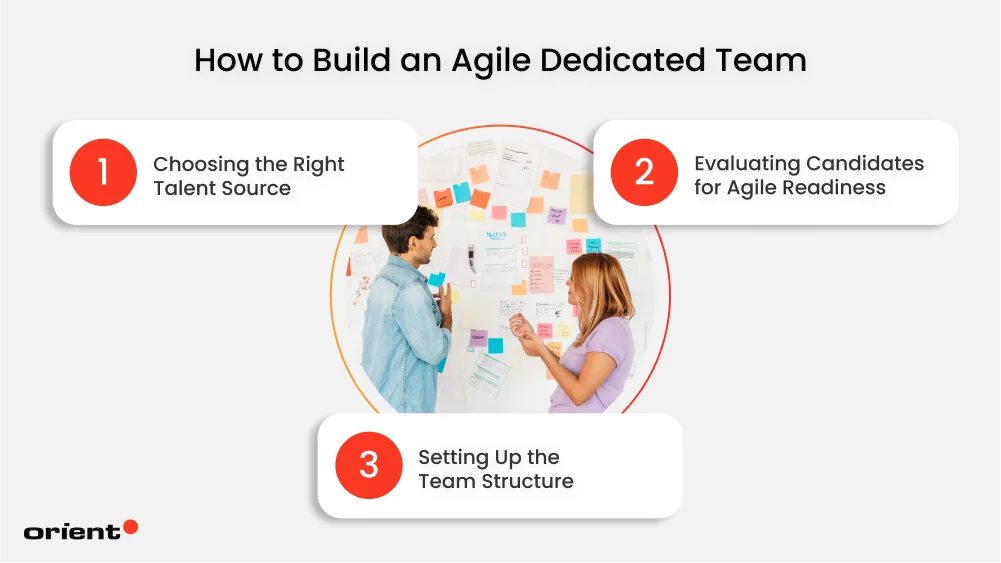
How to Build an Agile Dedicated Team
Choosing the Right Talent Source
When forming an Agile dedicated team, the question is not simply where the talent comes from, but how that talent will contribute and grow with the product over time.
- In-house teams have good control and inherent cultural orientation. The communication is instant, the context is common, and the decision-making is usually accelerated. But the use of in-house talent alone may restrict the access to specialized knowledge and scale slowly and/or expensively, particularly when product demands change or increase at an unscheduled pace.
- Outsourced teams provide access to global talent and elastic capacity. They make it possible to create teams faster and to tap into skills that might be unavailable or prohibitively costly in the local market. It is not a matter of distance as such, but integration. Unless outsourced teams are actively managed to become a product partner and not merely an execution unit, they will be less likely to add insight and innovativeness to their products.
- Hybrid teams address this gap by blending strategic ownership with execution power. Basic knowledge of products and decision-making is kept close to the business, whereas the longer capabilities are brought by a dedicated external talent. A hybrid model, when done properly, generates one group of thought and not two groups that are running in parallel.
Structured onboarding is the critical success factor. Beyond technical configuration, the dedicated and hybrid teams require a common context, understanding of what is being achieved, and alignment on modes of operations. To reduce time to real contribution, limit friction, and avoid latent inefficiencies, it might seem expensive to invest in onboarding, but it saves a lot of time. In the long run, this strategy reduces the overhead of the operations and turns distributed talent into a product team performing at high levels instead of a pool of resources.
Evaluating Candidates for Agile Readiness
Evaluating the flexibility of a candidate to Agile means determining how they will perform in a fluid, ever-changing team setting, rather than just verifying if they fit into a predefined job description.
Technical skills are the fundamental basis, but the real distinction is how the candidate fits into the current product direction and how they can expand in tandem with the product. This match is usually reflected in the list of projects and experiences put in their CV, particularly in the clarity with which they present the circumstances, business objectives, problems, and quantifiable outcomes of their work. A solid basic competence and quick ability to learn, rather than deep, specific expertise with a fixed technology, tend to dominate an Agile environment.
Cooperation and communication are also essential. Agile dedicated teams are based on constant alignment, mutual understanding, and open communication between the technical and business divisions. These candidates are able to express ideas in a clear and understandable way, listen to many different points of view, and adapt their communication style to fit in smoothly, and can bring product value into the organization sooner.
Agile also demands an active mind for problem-solving. Strong candidates do not sit back and wait until instructions are given out in detail when the requirements of the project or product are not clearly specified during the initial stages. To the contrary, they go out of their way to explain the grey areas, pose specific questions, and work together with the team to determine the best way ahead. They instinctively organize conversation in terms of business goals, intended results, and general influence as opposed to merely doing separate tasks.
Cultural fit and wide adaptability are what are behind all these factors. Applicants who are open, assume true ownership, and process feedback constructively have a high likelihood of success in the dedicated agile team model. Such features can keep the team dynamics alive, promote psychological safety, maintain and assure performance consistency, and guide continuous improvement to enable high-performing agile teams as well as the product to develop alongside the organization in the long term.
Setting Up the Team Structure
An organized Agile dedicated team is established as a cross-functional team that is capable of producing a product through to its end without involving any external handoffs. In reality, this can be based on the Scrum methodology, in which a small and stable team of 5 to 9 individuals collaborates closely. There is no sequential working between the Product Owner, Engineering, Design, and Quality Assurance, but rather, all these are done on a daily basis, sharing context and responsibilities.
This structure is made effective by clear ownership. The Product Owner sets priorities, maintains the backlog, and acts as the voice of both the business needs and user needs, and ensures that the team is doing the right thing. The Scrum Master is concerned with the team’s work by facilitating the Agile practices, eliminating barriers, and assisting the team to become better and self-managed. This division of roles brings focus, and team autonomy is maintained.
With the increasing number of products, multiple teams based on Agile can perform concurrently. Coherence is achieved by practical integration points in terms of sharing of planning, reviews, and shared technical standards, but not extensive coordination levels. Team composition can be inclined either to generalists or specialists, or both, depending on the needs of the product, but delivery and quality are always shared.
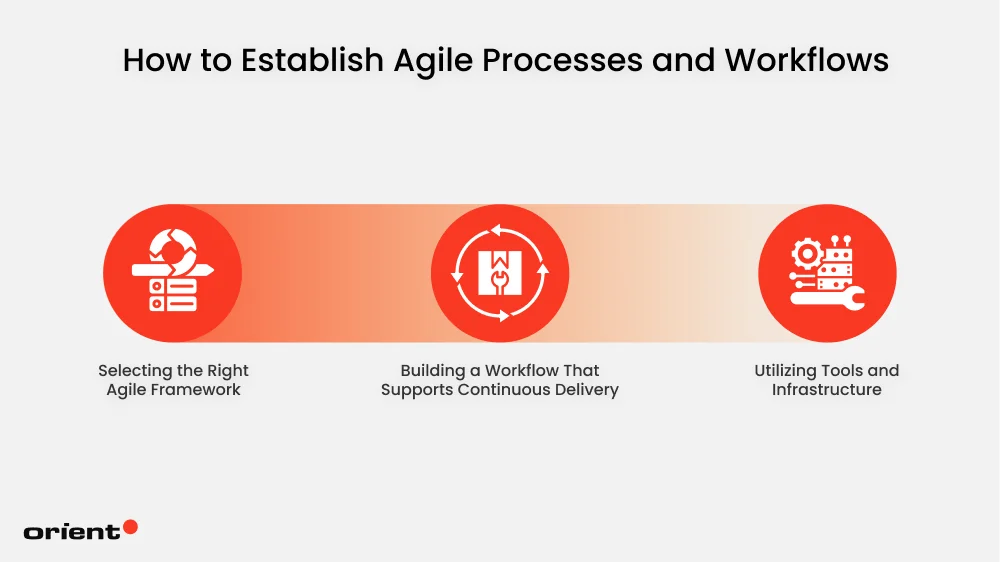
Establishing Agile Processes and Workflows
Selecting the Right Agile Framework
Agile is not just Scrum or Kanban. There are numerous other frameworks and methods involved in the Agile ecosystem, like XP, SAFe, LeSS, and Crystal. Nevertheless, when it comes to the Agile dedicated team, the value is not in knowing or utilizing as many frameworks as possible. Rather, it is in the choice of an operating strategy that is well-suited and can be maintained in the long term.
Practically, the majority of committed groups begin and grow towards Scrum, Kanban, or a loose blend of either. This is not because other frameworks are not effective. This is due to the fact that Scrum and Kanban specifically deal with the two most essential issues of a committed team.
The framework selected must be based on the type of product and the team’s maturity level, rather than the name of the model. Scrum is most effective in cases when the product is highly uncertain, and the team needs to learn rapidly and keep changing the course. Conversely, Kanban is better deployed when the team is already stable, the backlog is transparent, and the attention is directed to the optimization of the workflow and real throughput.
The other frameworks tend to be evidently valuable only when the organization attains a greater size or when it is constrained by very specific aspects.
Building a Workflow That Supports Continuous Delivery
Flow is used to create a continuous delivery workflow, not ceremonies. The work is transferred to production after an idea goes through a well-prioritized list of work (also known as a backlog in Scrum), constantly refined as the business requirements and technical expertise change. By keeping priorities up to date, the team will concentrate on producing value rather than working on out-of-date plans.
Planning then acts as a checkpoint for alignment rather than a rigid event (similar to sprint planning in Scrum, or replenishment in Kanban). The team agrees on what results to go on to next and establishes clear criteria of completion (acceptance criteria), converting abstract requirements into concrete, testable results. Delivery metrics like deployment frequency give an objective perspective on the smooth flow of work and delivery to users on a regular basis.
Throughout execution, short feedback loops keep the system responsive. Regular communication (daily syncs or standups), review of outcomes (reviews or demos), and reflection on how work is done (retrospectives) assist the teams in early detection of friction and quick adaptation. This consistent pattern of alignment, delivery, and learning enables an agile, committed team to maintain continuous delivery over the years without depending on one framework.
Utilizing Tools and Infrastructure
Teams that have a structured planning cycle and a high degree of dependency tend to gravitate towards tools such as Jira, where greater configuration, robust workflow, and advanced reporting are worth the learning curve. Conversely, speed and simplicity are the values of teams that embrace flows and prefer the requirements of lighter tools like Trello or Monday.com, where minimal setup, multiple visual views, and built-in automation can make work move forward with less overhead.
Although the tools differ in complexity, they all have the same goal: to make the priorities and work in progress visible and easy to reason about so as to support Agile processes and delivery predictability.
The team distribution and communication intensity are the key factors that form collaboration tools. Lightweight chat and informal discussion can be effective in co-located teams, but tools such as Slack or Microsoft Teams are useful in distributed environments, remote teams, or external teams and promote effective collaboration through the use of persistent conversations, integrations, and built-in search functionality.
When speed is less important than alignment, shared context, or trust-building, especially in the time of planning and review that reinforces the Agile ceremonies and team dynamics, video tools like Zoom become crucial.
On the delivery side, version control and CI/CD pipelines are required when the teams want to do frequent releases with low risks and high deployment frequency. They ease the complexity of integration points, and deployments are no longer heroic.
The cost of quality assurance increases with the size of the system, and test automation is used to balance the increasing cost of quality assurance; and code reviews are used to balance knowledge transfer with quality control, as a team ensures architectural consistency without owning any part in common. These practices offer iterative development, rapid feedback, and high-quality outcomes in Agile development regardless of whether the team is internal, dedicated, or part of multiple Agile teams.
Managing and Scaling Your Agile Dedicated Team

Creating a High‑Trust, High‑Transparency Environment
Trust in an Agile Dedicated Team does not stem from friendliness. It is based on whether a team is brave in speaking the truth, when the truth is not very pleasant to hear. After working together long enough, people in teams soon realize that there is hardly ever a problem with a lack of skill. They are typically products of softening or filtering information before it reaches the one who should know it.
Transparency starts with communication on a daily basis. It is not the amount of talking but the right words that must be said at the appropriate moment. Risks that are technical, unsound assumptions, or too optimistic estimates are to be raised early when the cost of correcting the issue is minimal. Trust is ruined in the shortest possible time when bad news is kept from present records in the most favorable way.
If teams are spread over several time zones, transparency is not achieved by ensuring that they have more meetings. It is based on coming up with work processes that do not require everyone to be online at the same time. Important decisions should be well documented in a written form so that any person can read them, question them, and be involved in decision-making, no matter what time of the day it is. When important issues arise only on live calls, geographical distance is soon transformed into a type of power disparity.
Performance Management in Agile Teams
Agile performance management is not about measuring everything. It is of quantifying the right things that allow the team to self-correct their behavior. Velocity and cycle time are only useful in determining where the team is experiencing friction and not to make absolute comparisons between teams or mechanical sprint-to-sprint analyses.
Quality measures like rate of defect, percentage of rework, or duration of bug fix should be accorded the same weightage as speed measures. Otherwise, the conversation on the subject of performance will soon go astray.
The most difficult task facing managers in teams that are committed is the temptation to micromanage when expectations are not immediately met. Micromanagement is not often based on a mistrust of the team. It is more commonly due to the manager having limited signals to feel comfortable. With the goals being explicit, progress being observable, and quality being evident with the help of data, the necessity of detailed intervention is automatically reduced.
Scaling the Team as the Product Grows
Scaling an Agile Dedicated Team rarely fails due to a lack of people. It usually breaks because people are added at the wrong time. When critical decisions keep funneling to just a few individuals, or when the backlog only moves forward thanks to one domain expert, the team is already overloaded. The problem simply has not yet shown up on the progress charts.
Scaling should not start with the question “Who do we need to hire?” It should begin with “Where are we actually stuck?” A chaotic backlog and unclear priorities are signs that Product Ownership lacks sufficient depth. An architecture that becomes increasingly difficult to change is a signal that technical leadership is overloaded. Adding people without first removing the real bottleneck usually results in more meetings and conversations, not faster delivery.
The most difficult aspect of scaling is the ability to maintain the Agile spirit when the organization becomes larger. Successfully scaled teams consider maintaining small, independent teams that have a clear decision-making authority and strive to maintain boundaries, as opposed to incorporating additives of coordination and control. Each new approval tier eliminates a bit of speed and part of ownership.
Ensuring Long‑Term Success in Agile Teams
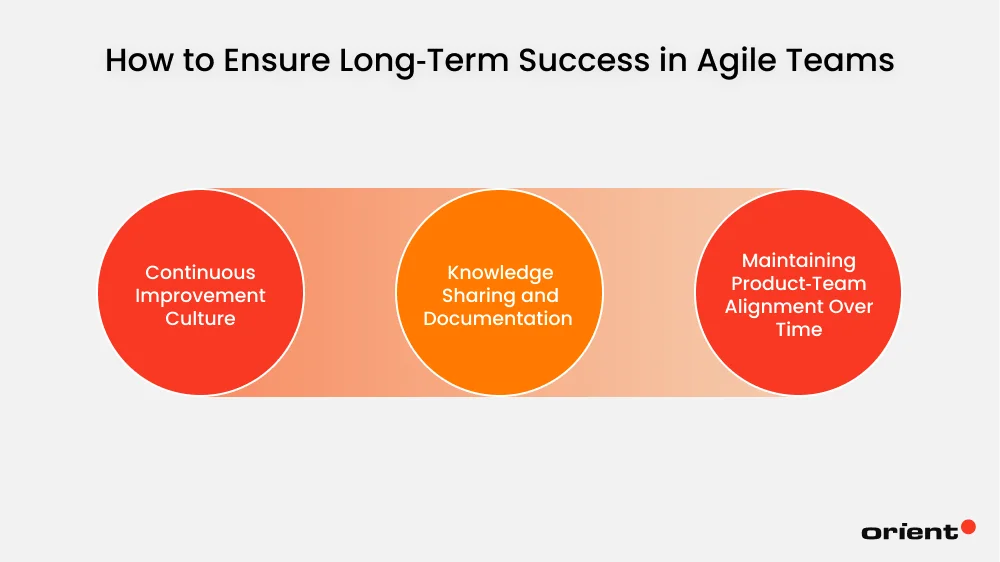
Continuous Improvement Culture
A lot of Agile teams deliberate on the concept of continuous improvement, yet they tend to repeat the same retrospective with a few variations put in their words. The problem is not often a shortage of improvement ideas. The actual issue is that there is no mechanism to impose those improvements on day-to-day behavior.
The usefulness of a retrospective is not gauged by the number of issues it reveals. It adds value by generating a single small tangible change that actually occurs during the following sprint. Action items that are excessive or too wide and vague, or those with no identifiable owner, soon turn the retrospective into a catharsis session.
A culture of experimentation does not emerge simply by allowing the team to “be wrong.” It is constructed by reducing the actual cost of being wrong. Only when the scope is narrow, the timebox is narrow, and the success criteria are pre-agreed upon do experiments occur consistently. When all the experiments are unclear and drag on endlessly, the team subconsciously falls back to the previous and more secure method of operation, despite their awareness that it is not the best.
Knowledge Sharing and Documentation
Knowledge silos do not occur as a result of selfish members of a team. They are created by the fact that knowledge is not regarded as a part of the product itself. When the people who write the code are the only ones having the knowledge of how the system works, the team has made one point of risk, which will later require a heavy toll to be paid.
Knowledge sharing cannot be done effectively by writing more documentation. It is a result of integrating knowledge into the real working flow. The critical technical choices, the trade-offs, which were properly calculated, and the expensive mistakes, which were paid with a heavy price, must be captured just after they were made. When critical knowledge is held only in the minds of a small group of people, one vacation or sick day can make the whole team come to a crawl.
Maintaining Product‑Team Alignment Over Time
A roadmap should not be viewed as a rigid commitment. It ought to be a living code of hypotheses that are constantly put to the test. Effective long-lasting teams review the roadmap not to determine what percentage of it has been done, but in order to discuss whether the initial assumptions are valid. Once a roadmap is no longer accurate as a representation of reality, refusing to abandon it only pretends to keep the progress moving.
User feedback and market variation can only provide real value where they initiate certain, physical, priority changes. Whenever feedback is simply recorded and registered but never shifts items along the backlog, the team will slowly lose the concept of what the work is all about. The team being loyal to the set course of action does not bring long-term consistency. It is the result of the product and engineering continually amending the plan in unity with the new realities.
Common Mistakes to Avoid When Building an Agile Dedicated Team
The most common mistake when building an Agile Dedicated Team is hiring people based solely on technical skills. Strong coding ability can help the team move fast in the first few sprints, but if that person does not know how to ask good questions, is afraid to raise risks, or refuses to take responsibility beyond their assigned tasks, the team will pay a very high price later. A dedicated team needs individuals who are willing to share the burden of problems, not just complete the work handed to them.
On the other hand, most groups discuss cultural fit but understand it in an ambiguous manner. Cultural fit is not a situation in which all people are the same, or they get along on a personal level. It has the same perception concerning responsibility, quality, and conflict management. When a person fails to communicate that core set of values, all Agile processes begin to curve around them rather than vice versa.
The other common error is the fear of missing control, which in turn creates the need to get the calendar overloaded with meetings. Better alignment cannot be achieved just by holding more meetings. They tend to take too long before making decisions and consuming energy. If a decision is only able to survive when everyone is present in the same room at the same time, then the real issue is the way of working, and not the schedule of the meetings.
Lack of ownership is an unspoken, dangerous illness. Where there is a shared responsibility for everything, no one is truly responsible. An Agile dedicated Team works well only under the conditions when each significant piece of work has an individual who stands up and owns it end-to-end, even when the result is below expectations.
Last, but not least, the most risky error is to consider Agile as rituals. Daily standups, sprints, and retrospectives are made regularly, but still decisions are centralized, feedback is not taken into consideration, and change is considered a risk. When Agile is simplified to a schedule of gatherings and a set of buzzwords, the group might superficially appear very Agile, but underneath, it is scarcely any better than a waterfall company cut into smaller sections.
Conclusion

Creating an Agile dedicated team is not a cost optimization issue that can be solved in the short run, but a type of relationship choice. Value is actually created only when both parties view each other as equals in the process of contributing to the results, and not as a customer and a provider of services.
Once the trust, transparency, and ownership are established in a proper manner, Agile is not just a working method anymore; it is an enduring competitive advantage.
Companies that managed to excel using such a model do not have to inquire “how many story points this team produces?” They would rather pose the question of “how well this team knows the product and whether they are really assisting us to solve the right problems?” This is because the long-term partnership mentality enables the team to grow with the product, as opposed to it being substituted each time the setting is altered.
When seeking a partner who does not just provide team members but would also be happy to co-create, run, and grow an Agile dedicated team in a sustainable manner, Orient Software is an option to be evaluated. Having used long-term Agile models with many products, Orient Software aims at building a truly business-aligned team instead of merely finishing projects.
Agile is not the shortest way, and the right partner with the right attitude is the one who helps the product travel far and be strong in the long term.