
Best Augmented Reality Companies: Who’s Leading the Future of Immersive Tech?
Augmented Reality (AR) is a cutting-edge technology that transfers digital content, such as data, pictures, and virtual objects like 3D models, onto the actual world in real time. With AR fast developing, only a few pioneering companies are competing to carve out the future of this immersive technology. Here, we delve into the innovators driving the process forward, who are defining the future experiences, and how their advances are redefining industries.

Content Map
More chaptersOver the past few years, augmented reality companies have introduced a few revolutionary products in the AR and VR markets, with all of them displaying a unique attitude to extended reality and immersive experiences. The Vision Pro by Apple is a significant move that has the potential to transform the world by integrating superior display screens with eye and gesture tracking to create a smooth spatial computing experience. Project Moohan by Samsung represents a bold strategy of creating an AR technology framework of the next generation, which is an architecture that is based on compact hardware and powerful processing. In the meantime, the Ray-Ban Meta AI smart glasses are based on the premise of everyday functionality and fashionability, with a traditional eyewear design, built-in cameras and microphones, and an artificial intelligence helper to support everyday tasks.
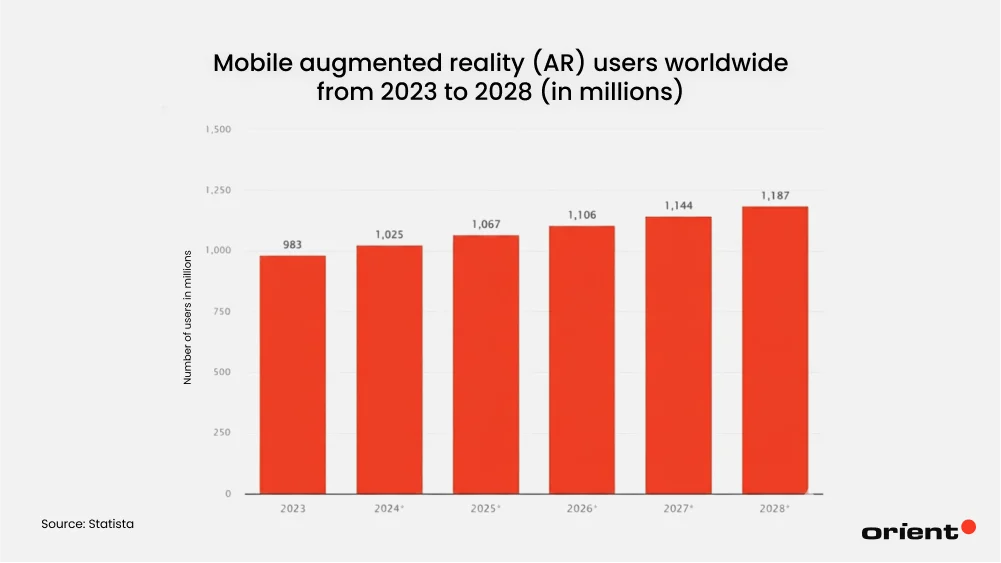
AR development has turned out to be one of the key tendencies in today’s technology. Statista also predicts that mobile AR users around the world will reach 1.19 billion in 2028. At this wild pace of speed, there is no longer a question of whether AR will be a necessary technology. The question is which companies are at the forefront of innovation that will shape the next phase of immersive experiences. The organizations that will influence this future and bring AR closer to mainstream reality will be discussed in the following sections.
The Rise of Augmented Reality
The three main pillars of the AR development at the moment include artificial intelligence, spatial computing, and hardware development.
- Artificial Intelligence is the brain of AR devices, as it allows them to comprehend the real world around them. It is able to identify virtual items, trace the movement of hands or the body by using computer vision, and provide the user with the appropriate information in real time in the user’s field of view.
- Spatial Computing goes further and provides devices with a clear picture of the location of the user and the spatial interrelationships of objects in the real world. Environmental information is continuously captured by depth cameras, motion sensors, and ambient light sensors, enabling the system to create a true 3D model of the space. Hence, virtual objects are no longer seen as being superimposed. They attach themselves to actual surfaces, stay in the right place as the user moves, and behave in a natural manner as part of the physical world.
- Hardware-wise, the transition to MicroLED and MicroOLED displays has broken a number of the restrictions of the classic LCD and OLED displays. MicroLED and MicroOLED are much brighter, have more precise colors, and have extremely high pixel density, which guarantees a clear, bright image even under bright light. In addition, the technologies use less power, which opens the way to flatter, more lightweight AR glasses that can be worn throughout the day without any strain.
These developments are an indication that augmented reality is no longer a fanciful technology but is developing to become mainstream consumer-friendly AR glasses and devices, and is set to improve all areas of life, including personal entertainment and professional processes, with AR applications and enterprise applications.
Industry Applications Driving AR Adoption
Healthcare: AR is showing the greatest influence on the sector by radically changing the perception of a patient’s anatomy by the surgeons. An article written in the World Journal of Surgical Oncology described a brachial plexus tumor resection in which the doctors utilized 3D models that were created using the MRI scans, shown on a head-mounted device to provide specific guidance to the surgeon. AR decreased positional error from 5.0 mm to 2.0 mm on 3D-printed models in the task that required precision, the guiding of a scalpel during liver surgery, and decreased cutting time by nearly half, from 55 seconds to 32 seconds.
Retail: The consumer is now able to see a product in their physical environment before making a purchase, such as IKEA Place, which allows customers to virtually take furniture, such as sofas, tables, or lamps, and place them in their living rooms to determine the fit and compatibility with their style. Within the beauty industry, Sephora has a Virtual Artist, and L’Oreal has a ModiFace-based app that turns smartphone cameras into virtual fitting rooms, enabling a customer to instantly try on lipstick, eyeshadow, or hair color with just a single tap.
Education: A high school study in Turkey reported the implementation of AR by a teacher during 10 weeks of biology classes. Students were able to have more intuitive content through the interactive 3D models, which greatly contributed to better understanding. Also, a recent international review of 40 experimental studies of AR in the teaching of biology at different levels determined that the utilization of AR through smartphones or mobile devices demonstrated significant improvement in conceptual understanding, interest, learning motivation, and visualization of complex systems, including anatomy, cells, circulation, genetics, and microbiology.
Gaming & entertainment: Ingress, a game that changed real-world spots into energy portals that must be accessed via physical movement and interaction in everyday settings by Niantic, has demonstrated its capacity to turn routine walks into exciting journeys with the help of AR.-,Augmented%20Reality%20(AR),-Augmented%20reality%20(AR). In the meantime, the rise of digital fashion and virtual avatars has made AR an important bridge between gaming, social media, and e-commerce.
The “Big Tech” Titans: Shaping Consumer AR
The AR market seems to be in a state of confusion; perhaps it’s because the largest stakeholders in the tech sector haven’t found a consensus as to what mass-market augmented reality should technically be. There is no mutual convergence of their visions; they are head-on collisions. However, this collision of ideas is driving the whole industry ahead.
Apple
Apple didn’t come into the AR race to play the game; it has come to change the rules of the game. Vision Pro is not attempting to usurp either the smartphone or the personal computer. Rather, it is an attempt to redefine the basic manner in which an individual engages with the surrounding physical world. To Apple, augmented reality is the next operating system of everyday life, and the building blocks to such an ambition have been set over the years through ARKit and LiDAR.
- ARKit is much more than a mere developer toolkit. It is the common language that Apple has forced throughout all its ecosystem that normalizes the planes, the lighting, the motion, the depth, and the behavior of real things. It turns the camera into an instrument of perception and makes every iPhone a device capable of AR in real-time without any special equipment.
- LiDAR is the next step on that foundation. Instead of merely estimating the surfaces by sight, LiDAR scans and real-time rebuild the environment, providing the depth measurements with a high level of accuracy. It is what enables Vision Pro to pin the digital content directly to the location in the real world, and it is why the hundreds of millions of currently existing iPhones and iPads become the largest AR platform on the planet without uttering a word.
No other company can roll out a foundation as wide, as deep, and on that scale, and that is the strategic moat that will not be replicated by competitors.
Meta (Facebook)
Meta takes an entirely different direction and views augmented reality from a social perspective.
With the Quest 3, the company doesn’t conceal the fact that virtual reality and AR are converging, but actually welcomes the mixed reality nature and transforms it into a new platform for connecting people. Quest 3 has a high-resolution color passthrough, which brings the real world into the headset, in which users can view their physical environment together with the virtual objects being overlaid on it. It does not pursue the perfect, lightweight AR glasses but provides something immediately comprehensible: an augmented form of the same room you are currently in.
The other masterstroke of Meta is Spark AR. Through this AR platform, millions of creators have been enabled to develop AR filters and AR experiences that are native to Instagram and Facebook. Spark AR made augmented reality no longer a secretive technology available to an elite audience but a daily routine, just like cat-face filters and virtual cosmetics became a natural part of online communication. By positioning people as the audience of AR as a tool to express themselves as opposed to a technical attribute, Meta has gained a competitive edge that its competitors cannot simply imitate: the social grammar of AR.
Meta understands that the most powerful tool is not having the newest hardware but rather what millions of people opt to do on a daily basis. Once a whole community begins communicating and playing with the use of augmented reality, Meta will become the mother of the mainstream language of augmented reality, persuading the rest of the AR industry to copy it.
Google, as usual, is a long-term player with long roots. Its AR does not come in the form of a glitzy standalone object. It’s embedded directly into a system within a billion-long ecosystem already in billions of daily lives:
- Through Google Lens, the camera is not merely looking but knowing what is on the screen and placing the correct information only on the real-life thing. Tap a product to see its name, price, or place of purchase, and you are already in AR: a layer of contextual information stuck directly onto reality at the point of need.
- ARCore is the unseen force that enables this to work consistently on hundreds of millions of Android devices. It allows phones to know instantly what a table is, what a wall is, and the actual distances, such that virtual items never drift or become lost. With the use of ARCore, any Android application is able to add AR experiences without making users learn something new.
- The strength is undeniable in Google Maps Live View: you can see the arrows of the route and the names of the streets stuck on the real street right before your eyes with the help of your camera. This is a textbook AR, with digital information tied in place and in 3D rather than floating on a two-dimensional map. It may not be referred to as AR by the users, but they use it whenever they require directions.
Microsoft
Going in a completely different direction, Microsoft is the only player that does not necessarily have to sell people on the future of augmented reality. They entered the field early. In 2016, HoloLens 1 became the first fully standalone mixed reality headset in the history of the industry that can place stable virtual objects into the physical space of the world and allows users to interact with them using hand gestures.
Whereas the rest of the AR industry was running full throttle into the consumer hardware battle, Microsoft was quietly turning towards pragmatism. They knew that AR was not the technology that could be offered to the masses yet, but it was already incredibly useful in the setting where absolute accuracy is required.
HoloLens 2 was made to suit the purposes of such events: eye tracking is improved, the field of view is extended significantly, and the ability to interact with hands is so precise that engineers can extend their hands and turn a virtual object in the air. The machine can currently be found in factory maintenance, operating rooms, technical education, and any environment where a couple of millimeters of error can cost millions or lives. It is not the demonstration toy that will likely impress television viewers in the living room, but a business tool that helps to address complex, high-stakes issues today using well-known solutions of enterprise AR.
Top AR Hardware Manufacturers
Although the tech giants are defining the future of augmented reality in their own unique way, there is another group that is silently but effectively developing, and this group is the AR companies that consider AR hardware as their ultimate center of concern.
Magic Leap – High Fidelity AR for Enterprise
Magic Leap is an innovative firm that was established in 2010 with the ambitious aim of developing a groundbreaking, consumer-friendly AR glasses device. Its initial product, the Magic Leap 1, which was released in 2018, was disappointing due to a small field of view, low brightness, high cost, and no useful use of augmented reality to consolidate the mass market. Because of this, the company shifted to the enterprise market in 2020.
Magic Leap 2 was developed with a strict and professional redesign. It has a much broader viewpoint, sharper optics, and a dynamic dimming capability that can reduce real-world light transmission from 22% down to just 0.3%, allowing users to have their eyes fully focused on 3D content even in well-lit operating rooms or factory floor environments.
Vuzix – Smart Glasses Built for Work
Vuzex, which was established in 1997, is among the oldest AR hardware competitors. While much of the AR industry is pursuing the utopian idea of a single XR future of seamlessly integrated AR, VR, and MR into an all-encompassing reality, Vuzex has been pursuing a much more practical route: the development of lightweight, rugged AR glasses that directly address the actual work of the enterprise.
The Vuzex Blade and the M-series are just some examples of product lines that show this philosophy. The Blade resembles regular eyeglasses and operates on a compact waveguide display to superimpose information, as well as providing photo and video capture and voice recognition, and is lighter and can be used in a variety of tasks like inventory inspections, order verification, or remote support.
The M-series, particularly the popular M400, has grown to be a de facto standard in the industry due to its tough construction, high-resolution camera, extended battery duration, and attachment to hard hats or safety glasses. This enables the technicians to operate freely in extreme conditions. Such glasses are not just used to display step-by-step instructions: they could also provide a live video stream to the distant specialists.
XREAL (formerly Nreal) – Consumer AR, Lightweight and Stylish
XREAL was established in 2017, and it has specialized in consumer-driven AR glasses. The mission was straightforward: to invent lightweight glasses that would appear like ordinary eyeglasses, be convenient to wear, and be able to integrate with the devices people already possess, like phones, laptops, and gaming consoles.
Such exceptional models as XREAL Air (formerly Nreal Air), XREAL Air 2, and XREAL Air 2 Pro represent this vision. They are extremely small, have a weight of just 72-75 grams, and look like trendy sunglasses or prescription eyewear, thus being comfortable to wear all day. Worn, they are a huge virtual screen, sold as being the same size as a 130- to 201-inch screen at a distance of a few meters, and ideal, from a point of view, to watch movies, play games, stream videos, or open a virtual monitor to do work.
Enterprises Utilized AR Solutions
TeamViewer (Frontline)
TeamViewer is the world’s most popular tool for remote desktop. When it landed in the AR space, though, it applied the same concept and took it to a different level, namely the human-to-human remote control, literally speaking.
Using its Frontline platform, the remote expert does not sit at a desk and explain to a person the steps they need to follow or point out on the still screenshots. Instead, they can view precisely what the field worker is viewing using smart glasses and can provide instructions directly into the actual perspective of the worker.
The technician just follows the virtual signs that appear in front of his eyes. There is no need to turn over manuals or seek repetitive explanations. This method has been particularly effective in warehousing, maintenance, and assembly settings where a single-millimeter error can shut down a complete production line.
Scope AR
Provided that TeamViewer transforms remote experts into literal, remote hands-on guides, Scope AR addresses an alternative reality: experts are not always around when you need them. This is precisely the reason why they designed WorkLink as an enterprise “procedural memory” system that transforms all the multifaceted processes into clear, visual steps superimposed directly onto the actual equipment using augmented reality solutions.
WorkLink means that manuals are no longer 50-page-long PDFs or videos that employees need to pause and rewind. Rather, whole processes are written as interactive AR experiences, which can be seen, moved about, and controlled in 3D space. Technicians only need to wear the AR glasses and follow the virtual objects, annotations, and arrows, which can be seen at the precise point where they are in the working environment.
Enterprises with Expertise in Developing AR Solutions

Orient Software
The approach to AR that Orient Software takes differs significantly from platforms such as Augment or Blippar: Orient does not provide an off-the-shelf AR platform but rather fully customized AR solutions, integrating the new application with existing data systems, business processes, and technical infrastructure unique to the company.
The history of success of Orient Software in terms of automation and logistics platforms, as well as interactive systems and spatial-data applications, shows that we already have the technical basis and experience to grow into AR/VR/XR. We learn how to use real-time data pipelines, accurate tracking, device-state synchronization, multi-user synchronization, and secure support with internal systems, all the key ingredients to trusted, production-scale AR applications.
In the case of businesses that require more than just a partner that will make things “look cool”, one that can integrate AR into existing infrastructure and assure performance, security, and scalability in the future, Orient Software is the wiser alternative over pure-play AR platforms.
Augment
Augment is the firm that developed a dedicated AR platform designed for commerce that would allow businesses to introduce their 3D products into the real world in only a few simple steps.
The first step involves uploading an existing 3D model to the platform by a company (or creating and optimizing the model can be done by Augment in case no existing models are present). The system then manages, compresses, and standardizes the assets such that they will run on any mobile device in a smooth way.
Instead of requiring companies to create an intricate AR technology, Augment offers a lightweight SDK or a straightforward iframe embed. After integration, the customers can pull their phone at a space, and the product will instantly come up in the real-life dimension with proper materials and finishing. This simple, yet extremely scalable implementation system has seen Augment being the preferred application by worldwide organizations like Coca-Cola, Nestlé, Siemens, and Boeing.
Blippar
Blippbuilder is at the center of Blippar, a no-code platform that allows marketers, educators, or any creative team to create AR experiences by using simple drag-and-drop, and no programming is required. The users choose a template, add pictures or 3D models, add interactions (pop-ups, animations, mini-games, etc.), and publish it on the web. It can be experienced by using the phone camera in the pocket of the end users—no app download is required.
The difference with Blippar is that it not only produces AR content, but it also provides a full self-service platform. Via websites or via QR codes, companies receive authoring tools, content hosting, in-depth user-behavior analytics, and smooth embedding. This makes AR a versatile, 24/7 component of marketing campaigns rather than a project in itself, which needs an independent technical team to operate.
How to Choose the Right AR Partner or Platform
When it comes to selecting an AR partner, the first question should be: What device is this actually going to be running in the real world?
An app that is great on a smartphone will be virtually useless at a factory where technicians require both hands to do their work. Begin by figuring out what hardware your users will actually operate: are they having customers hold phones so they can see the visualization of a product, or are workers wearing devices that are head-mounted, such as HoloLens or Magic Leap? Request the partner to do an on-the-fly demo on that specific device immediately.
The scalability is the next challenge to overcome after the question of the device has been resolved. It may seem that any AR pilot will appear pristine to ten users, but once you roll it to a hundred or a thousand users, all seems to go wrong. The system should be able to support high-end 3D models without choking, apply correct user permissions and roles, and be easily integrated with your existing CRM, ERP, or MES.
It is only at this point that you get to the most important differentiator: Do you use AR in marketing or utility? The two worlds are entirely different.
- When the task is to allow customers to check out a sofa in their living room or to play with a product visualizer, you require a platform that would be optimized to be aesthetically polished, have smooth phone functionality, rapid web integration, and viral distribution.
- If you are intending to monitor an intensive process on industrial equipment, there should be rock-solid tracking precision, step-by-step processes, hands-free functionality, and extensive system integration.
The quickest way to separate serious partners from the rest is to ask three things:
- “Give me an example of a project that you have already implemented that is like mine.”
- “Demo it on the very device that my team is going to use.”
- “Simulate the real scenario I care about right now.”
Conclusion

The market of smart glasses and augmented reality has never been so lively and colorful. Starting with giants like Apple, Meta, Google, and Microsoft, to emerging innovators like Scope AR, Augment, Blippar, and TeamViewer, each of the players is creating its own niche with its own distinct approach.
The market is no longer controlled by one or two major companies. It is now a congested racetrack with dozens of competitors who are heading in all different directions. Ultimately, the victor will not be the company that sells the most devices today. It is the company that will determine how billions of human beings engage with the digital world within the next five to ten years. For now, that racetrack is still under construction, brick by brick, by the companies mentioned above.
Your business does not have to wait till the track is finished. You can enter the race at this point and gain an early advantage with viable AR solutions that are already positively implemented worldwide. Orient Software has collaborated with Vietnamese and international corporations to create immersive, scalable, and affordable AR solutions that revolutionize industries- retail and manufacturing, healthcare, and education.
Through our technology updates, you will receive exclusive information on the recent AR innovations, case studies, and how to ensure your organization is ahead of the pack. And when you are also willing to go a step higher, our professional AR development team is available to guide you on how to design and create solutions that suit your business objectives. Do not merely see the future, be in it. Get in touch with Orient Software to find out how AR can hasten your digital transformation process.