
Most enterprises don’t have a shortage of data. They have a problem making that data useful.
A single project decision might start in a Slack conversation, be documented in a Google Drive file, and later be changed in an engineering ticket. Finding the right answer means connecting all three. Multiply that across CRM platforms, ERP systems, shared drives, emails, and internal documentation, and it’s easy to see why employees spend more time searching for information than using it. Teams ask colleagues for context again and again, recreate reports that already exist, and lose knowledge when experienced people leave.
Adding an AI assistant doesn’t fix this on its own. Without reliable retrieval, an assistant can give outdated answers, miss key context, or mix up information that should stay separate. Those mistakes reach customer service, operations, compliance, and business decisions.
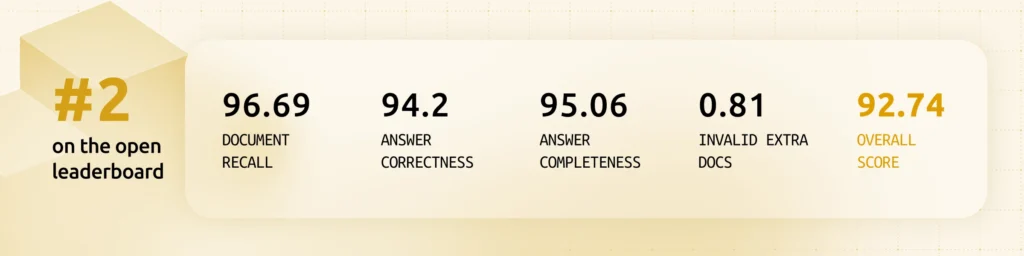
Neurond AI, a division of Orient Technology Group, set out to test its approach to this problem in public. On EnterpriseRAG-Bench, a public benchmark for retrieval-augmented generation (RAG) over enterprise internal knowledge, Neurond secured #2 out of 39 systems with an overall score of 92.74 (as of Nov 4, 2026). Its Document recall of 96.69 is the highest of any system on the leaderboard.
What the numbers mean for your business
The leaderboard also lists widely used managed retrieval services and baseline pipelines, which gives the scores useful context:
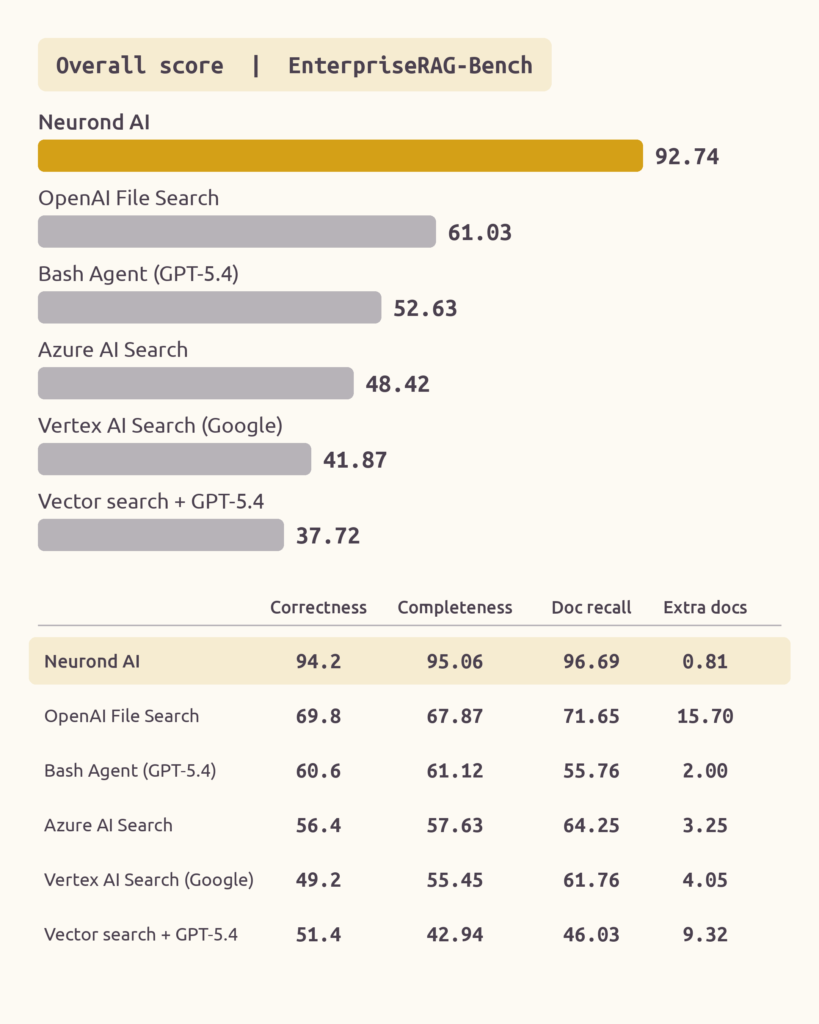
Two other baselines are worth noting: a bash agent built on GPT-5.4 reaches 52.63 overall, and a vector search + GPT-5.4 baseline reaches 37.72. Neurond’s 92.74 is 31.7 points above the closest of these systems (OpenAI File Search), and it leads all of them on correctness, completeness, document recall and invalid extra documents.
In practical terms:
- Answer correctness (94.2): roughly 94 out of every 100 questions were answered correctly. This matters most, because an incorrect answer scores zero no matter how complete it looks.
- Answer completeness (95.06): the answers covered nearly all of the information each question required. When a decision depends on the full picture, a partial answer can be as risky as a wrong one.
- Document recall (96.69): the system found almost all of the relevant source documents, even with about 512,000 documents spread across nine systems. If a relevant document is missing, the answer is incomplete before the AI starts writing. A high recall gives the answer-generation step a stronger evidence base.
- Invalid extra documents (0.81): on average, fewer than one irrelevant document was returned per question (lower is better). More retrieved documents don’t mean better results. Irrelevant content adds noise and makes it harder to find the evidence that matters.
Taken together, these results give a more complete picture than the overall ranking alone. They show how Neurond’s system handled the interconnected demands of enterprise retrieval: finding relevant evidence, limiting irrelevant results, and turning retrieved information into accurate and sufficiently complete answers.
How EnterpriseRAG-Bench was design
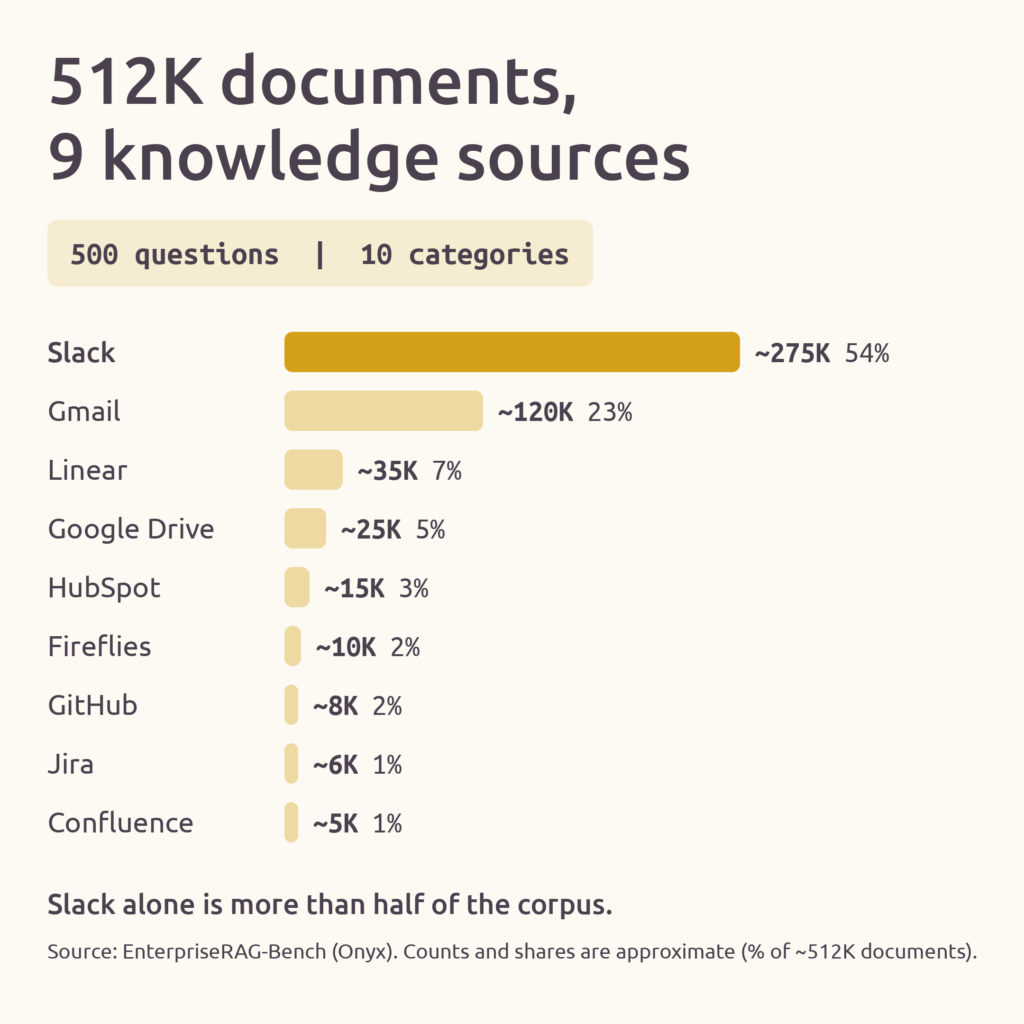
EnterpriseRAG-Bench, developed by Onyx, is an open benchmark that tests how well AI systems find and use company-internal knowledge. It simulates a fictional company, Redwood Inference, with roughly 512,000 documents across nine systems, and asks 500 questions in ten categories, from direct lookups to contradicting documents and questions the corpus cannot answer. Each system is scored on whether it retrieves the right documents and writes a correct, complete answer.
Why enterprise RAG is harder to build in-house
The leaderboard highlights an important distinction: having access to a capable language model and a document repository does not automatically translate into effective enterprise retrieval. Popular managed services score between 41.87 and 61.03, while even a GPT-5.4-powered agent with direct file access achieves only 52.63. These results underscore the complexity of enterprise-scale retrieval, where success depends on addressing several interconnected challenges
- Fragmented data environments: connecting legacy systems, cloud platforms, databases, and business applications without disrupting existing workflows.
- Data quality and consistency: handling duplicated records, outdated documents, conflicting information, and inconsistent terminology.
- Access control and security: making sure users only retrieve what they are authorized to see, in line with organizational policies and data privacy requirements.
- Changing business information: keeping knowledge current as projects evolve, customer records change and policies are updated.
- Accuracy and trust: making answers traceable to sources, reducing unsupported responses, and recognizing when the available information is not enough.
- Scalability and performance: maintaining quality as data grows, and more people and applications depend on the system.
Every stage of the pipeline affects the final answer. Poor data quality can affect retrieval accuracy. A missed document leaves an answer incomplete. Unrelated documents add noise. And even with the right evidence, the system still has to interpret it correctly.
Evaluation doesn’t end at launch. Building an AI solution is not the end of the process. Teams need systematic evaluation to see where relevant information is being missed, where irrelevant results are creeping in, and where answer quality needs work. Benchmarking offers one consistent way to measure this, but a real deployment also has to be tested against the organization’s own data, workflows, and business objectives. This cycle of testing, measuring and refining is how Neurond reached its result, and it is the part most in-house projects underestimate.
From benchmark performance to enterprise projects: How Neurond brings value
Partners already working with Orient Software on software and AI projects can draw on Neurond’s specialist Data & AI expertise where knowledge retrieval matters most. Reliable retrieval opens the way to applications that go beyond basic search, and Neurond brings the applied expertise to turn complex enterprise data into practical AI capabilities.
By combining research, engineering, and systematic evaluation, Neurond can help organizations get:
- Fewer missed answers. On EnterpriseRAG-Bench, Neurond recorded a Document recall of 96.69, the highest on the leaderboard, showing its ability to retrieve a high proportion of relevant source documents. For a business, that means a stronger starting point for building AI applications that need to find critical information across large, fragmented knowledge bases.
- A tested way of working. The team reached an overall score of 92.74, ranking #2 among 39 systems, through a process of testing approaches, measuring retrieval and answer quality, and refining the system. Partners can benefit from this engineering approach, applied to their own data and requirements, with performance evaluated before deployment.
- One team from data to delivery. Neurond brings expertise in designing and evaluating the retrieval layer, while Orient Software can support its integration into existing software systems and business workflows. Together, this creates a path from expert knowledge retrieval to AI solutions that work within real business environments.
For organizations working with Orient Software, this means a stronger technical foundation for enterprise AI projects, quality measured before launching rather than after, and one team combining specialist retrieval expertise with software and AI delivery.
What the team learned on EnterpriseRAG-Bench feeds directly into that work, including:
- Knowledge assistants: helping employees find project history, policies and past decisions across disconnected systems.
- Customer support: giving agents and customers answers grounded in the right internal sources.
- Internal operations: cutting the time spent searching, asking colleagues for context, or recreating existing work.
- Compliance: retrieval that respects access rules and can point back to its sources.
Making enterprise knowledge work for your business
Enterprise AI creates value when organizations can put their existing knowledge to work. But achieving this requires more than deploying a powerful language model. It requires reliable access to the right information, an architecture that fits the business environment, and engineering that accounts for accuracy, security, and scalability.
Neurond’s EnterpriseRAG-Bench performance marks an important milestone in its work on enterprise knowledge retrieval. The team will continue refining its RAG architectures, exploring how to retrieve relevant information from large and complex knowledge bases, and improving the reliability of AI-generated answers.
Ultimately, benchmark performance is one measure of technical capability. The real test is how effectively that capability addresses the challenges within an organization’s own data and workflows.
Is your organization looking to make fragmented enterprise knowledge more accessible and useful through AI? Talk to us about designing and building a Data & AI solution around your business needs.