
AI in software development is having a significant impact on how applications and systems are being created, deployed, and updated. When incorporated into the software development life cycle (SDLC) correctly, AI has the potential to help improve productivity, foster innovation, safeguard against security threats, and increase user satisfaction.

How software development teams achieve these outcomes depends on several factors: Their level of experience with gen AI tools and their willingness to adopt a more open-minded perspective. These qualities work together to reign in the next generation of software development, where AI does not replace but augments a developer’s ability to deliver innovative solutions.
In this article, we’ll discuss AI’s impact on software development. Namely, we’ll cover how AI in the software development life cycle (AI-DLC) is upending traditional frameworks. You’ll see what a typical AI-SDC looks like, and learn about its benefits. You’ll also learn how Orient Software’s approach to AI-SDC can deliver impressive results for your project.
Key Takeaways:
- AI-DLC represents the next evolution in software development, where the strategic use of AI is incorporated into each stage of the cycle.
- Accelerated time to market, more room for innovation, and higher user satisfaction are just some of the many advantages of adopting the AI-DLC approach.
- At Orient Software, we are keeping up with the latest software development trends, effectively using AI to streamline development, reduce human error, and deliver more meaningful outcomes.
What is AI in the software development cycle?
AI-DLC is an enhanced version of the existing SDLC framework. In a standard Agile SDLC, software development teams break down each step of development into stages. From planning and designing to coding and testing, each stage is carried out in a predictable and structured manner, ensuring the software meets business goals and user requirements.
AI-DLC takes the traditional SDLC framework to the next level by incorporating AI into each step of the development cycle. Software development teams, with the aid of AI experts, use AI to help plan, design, test, and deploy software applications. And they do so in a faster, more efficient, and more secure manner than traditional workflows. By using AI to assist with each stage of development, software development teams have more time and resources to focus on more complicated tasks, thus paving the way for more innovative solutions.

AI-DLC also differs from the SDLC framework by replacing ‘sprints’ with ‘bolts’. Whereas sprints typically take several weeks or months to complete, bolts (aided by gen AI tools) can take mere hours or days to complete. This shift in terminology demonstrates how AI-DLC is expanding upon the traditional SDLC framework, not replacing it entirely. It represents the next step forward in delivering great software applications and systems.
How popular is AI in the software development lifecycle? 84% of developers are using or planning to use AI tools in their development workflows. Generating boilerplate code, unit testing, and documenting are some of the most common tasks aided by the use of gen AI tools. Statistics like this demonstrate that AI is not going anywhere, and software development teams that adapt first will likely gain a major edge.
What are the benefits of AI in software development?
There are many advantages to incorporating AI into the software development cycle. One of the biggest advantages is the potential to accelerate your time to market. Other advantages include the potential to drive greater innovation, deliver higher-quality products, and foster a more collaborative environment. Let’s explore these advantages in greater detail.
Accelerated time to market
Incorporating AI into the software development cycle has the potential to accelerate your time to market. From code generation to documentation to testing, AI can accelerate the rate at which it takes to complete all kinds of tasks. The result? Your software application gets into your users’ hands faster than the competition. This gives you the upper hand when it comes to deploying updates, resolving bugs, and responding to user feedback.

Whether you plan on using AI to streamline existing tasks or generate entire applications from scratch, the potential productivity gains could be significant. Research shows that AI productivity gains are most evident in tasks like active coding (with time allocation down by 13% compared to coding without AI), planning and design (-3%), and documentation (-2%).
Greater focus on innovative thinking
By using gen AI tools to automate a wide range of development tasks, software development teams have more time and resources to focus on more innovative solutions.

For example, a software development team may choose to invest more resources in improving the user experience. They may be able to conduct more user testing, uncovering insights that were previously inaccessible to them due to time and budget constraints. This is just one of the many possibilities of reducing the need for software developers to perform repetitive tasks, instead delegating such tasks to properly trained agentic AI tools.
Higher-quality products
When incorporated into the development cycle properly, the right gen AI tools can help raise the quality of software applications and systems. This is achieved by using AI to help align software development tasks with client goals and user requirements. AI can help create plans, case profiles, and user data, giving software developers deep insight — insight into what problems they’re trying to solve, and how best to solve those problems. This way, software development teams can deliver software applications and systems that more closely align with a client’s goals.

Teams can also use AI to enforce strict software development standards, such as coding practices and industry-specific guidelines. For example, developers can train gen AI agents on the company’s best coding practices, ensuring they follow the right informal rules and guidelines. Doing so can help improve consistency and increase code quality, enhance scalability, and reduce technical debt.
At Orient Software, our 400+ dedicated team is highly skilled in using AI to build high-quality software applications and systems that meet user expectations. Our use of the latest tools helps augment our developers’ existing skillset — not replace those essential skills. We conduct human oversight on every gen AI tool that contributes to your project. This way, you reap the AI productivity gains and get the assurance that your software application is vetted by a human expert.
Enhanced collaboration and communication
Software development teams can deploy AI to foster greater collaboration and communication. Since AI can handle routine tasks like code generation, teams can more effectively work together. They have the freedom to brainstorm, experiment, facilitate feedback, challenge preconceived notions, and form unified goals. This shifts the development process from a lonely, isolated experience to a more dynamic, collaborative space; a space where acceleration and innovation are championed equally.

Gen AI-powered tools can also help streamline other project management tasks. Such examples include task allocating and monitoring, deadline estimating, and allocating resources for specific cases. With the potential for more accurate timelines, clients can be better prepared for the deployment phase.
Phases of an AI-driven development life cycle
The switch from a traditional SDLC framework to an AI-DLC structure represents a number of unique changes. With AI being at the drivers’ seat for each stage of development, AI-DLC fundamentally changes how software developers plan, build, and deploy their projects.
At the same time, though, AI-DLC does still adhere to the Agile methodology in important ways. For example, continuous feedback is still incorporated into each stage, where human observers verify AI outputs for suitability.
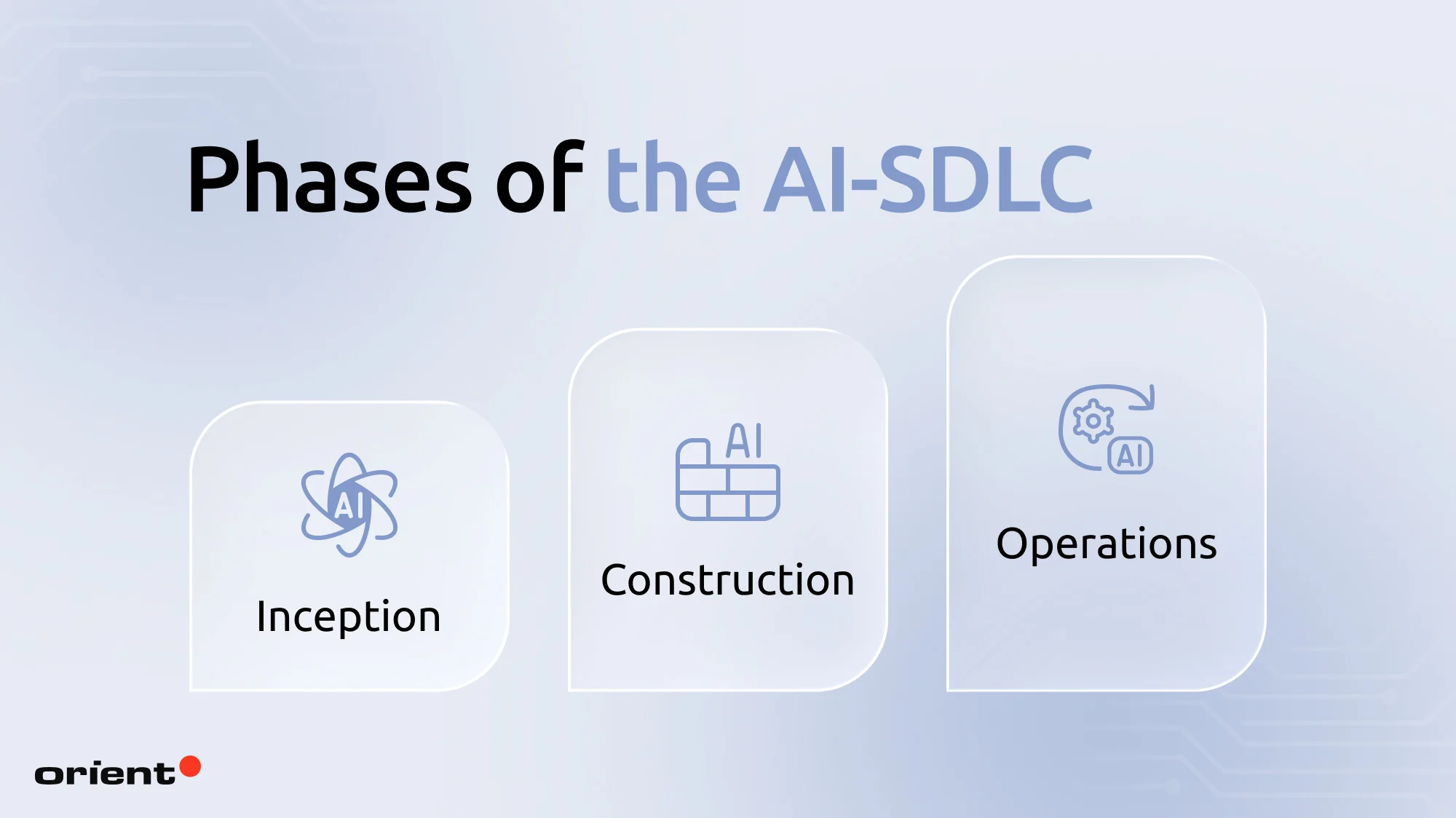
Here is a brief rundown of what a typical AI-DLC pipeline looks like in a software development project.
- Inception phase – AI helps define client and technical requirements, create unique case studies and user profiles, generate project plans, and clarify questions. Human observers then verify the AI’s outputs before any code is written.
- Construction phase – Based on predefined guidelines, AI helps with tasks like coding, testing, and building CI/CD configurations. Construction is completed in “bolts” as opposed to “sprints”, which are condensed down into hours or days rather than weeks.
- Operations – AI follows the instructions provided in the Inception and Construction phases to deploy and monitor the software. It observes runtime behavior, detects anomalies, and recommends remediation strategies. Humans carry out tasks like maintaining governance and security while responding to incident escalation events.
Inception
The inception phase is where planning and design happens. Software developers use AI to define client and technical requirements, generate project plans, create custom case studies and user profiles, and clarify questions asked by the team. Essentially, the inception phase is where AI helps turn intent into a unified plan, ensuring teams are on the same page.
Humans thoroughly validate the outputs generated by the AI, addressing ambiguities and mistakes before any coding begins. The successful completion of this phase ensures that the AI has the right guardrails in place to follow through on its plan during the Construction phase.
Construction
With a plan in place, the AI starts building the software application. It takes care of coding, building and executing test cases, and building CI/CD configurations. Humans then thoroughly review, modify, and approve all outputs at predefined checkpoints.
All context decided upon in the inception phase is carried through to the construction phase, especially security and technical considerations. Architectural decisions, security considerations, and business limitations are retained to ensure consistency between all stages.
Operations
The operations phase is where the AI deploys and monitors the final project. It handles tasks like deployment orchestration, the observation of runtime behavior, and anomaly detection. Developers not only observe the outputs but also help maintain governance and security compliance. Human intervention is also a core aspect of responding to incident escalations.
AI-DLC best practices to follow
What you just read was a detailed breakdown of a typical AI-DLC. But what are the best practices to follow when incorporating AI into the software cycle? There are many factors to consider, such as your available resources and budget. There are, however, a few universal best practices that apply across the board.

At Orient Software, we closely follow these best practices — and many more — to ensure the success of your project. Whether your project is big or small, our approach consistently meets the highest standards while being personalized to suit your exact needs.
Here are just some of the many AI-DLC best practices to consider. When you’re approaching a software development team, take the time to learn if they follow these best practices.
Promote continuous human oversight
It’s important to remember that AI is not a ‘set it and forget it’ solution. Human review is an important component of the AI-DLC framework. Without the right people overseeing an AI’s output, unpredictable results can occur.
Choose a software development team that takes human oversight seriously. They should be involved in each stage of the cycle, from designing and coding to testing and deploying. Your team should have a contextual understanding of what each AI solution is doing, why, and how it’s doing it better than the manual way.
How important is human oversight? Very important. According to the Stack Overflow Survey 2025, the number one frustration among respondents was AI output quality: solutions that were almost right, but not quite there. Having people to fine-tune those slight errors is vital to improving product quality and the user experience.
Enforce rigorous AI code testing
It’s no secret: AI-generated code is not perfect. It has the potential to be unpredictable, to suggest less-than-ideal code snippets. That’s why it’s important for software development teams embracing AI to enforce rigorous AI code testing standards.
That means taking the time to review the quality of code generated by these outputs. Has it produced the best possible suggestion? Or is there a lighter, more optimal alternative out there? Your software development team should be able to justify the code they use in your products. This way, they can more easily maintain your software, as they know exactly what’s going on under the hood.
Partnering with a team that “vibe codes” their way through a project is a recipe for disaster. When something goes wrong, they won’t know what caused the issue — at least not straight away. It could take hours, possibly days, to diagnose a problem and deploy a fix.
Employ version control for seamless rollbacks
Version control is an effective way to keep track of progress. It enables a team to safely rollback the software to an older version, one that is stable and accessible. In the event of a major error, being able to “turn back the clock” is a valuable resource. It enables them to compare the two versions, to determine where the source of the problem may lie.
Gen AI can help streamline version control. It can run routine checks, explain complex changes, and provide context reviews. This helps speed up the process of comparing versions and identifying problems.
Break down complex tasks into manageable steps
When it comes to shipping AI-generated code, it’s important to break down the review process into batches. This gives the team ample time and resources to carefully review each line, ensuring no stone is left unturned.
Gen AI can help out in other ways, too. Gen AI can help break down complex tasks based on skills, capacity, and available resources. Prompts like, “How long would it take for an engineer to create an API integration plan?” can help project managers allocate resources and deadlines accurately.
Choose Orient Software for AI in software development services
AI in software development represents a huge leap forward. When combined with human oversight, the use of gen AI can help increase productivity, foster a more collaborative environment, and encourage more innovative thinking. Of course, you need a software development company that understands the benefits and limitations of the technology.

When you partner with Orient Software, you benefit from over 20 years of excellence. Having completed over 200 successful projects, our ability to deliver on our promise is second-to-none. And by keeping up to date with the latest advancements, we can advise you on how AI can help your business grow.
Ready to take your business growth to the next level? Contact Orient Software today.