
In an era defined by artificial intelligence (AI), change is happening at an unprecedented pace that a majority of businesses were never designed to absorb. New capabilities appear almost overnight, and workflows evolve within months rather than years.
In this reality, founders and business leaders are sitting with the same uncomfortable tension to move faster with AI or be cast aside. Therefore, constant learning and continuous innovation have shifted from competitive advantages to non-negotiable expectations in today’s technology industry. Developers upskill not because they want to stay relevant but because the work itself demands it. Leaders experiment not because they have the luxury of curiosity but because experimentation is now the only responsible way to lead.

For software development service providers in particular, this pressure is double-sided as they are no longer competing solely on the quality of their services. The competition pivots on how quickly their people and systems can evolve toward AI proficiency. The pressure to evolve is real, and it is no longer seasonal. And yet, speed without sustainability is not growth. It is burnout wearing the mask of progress.
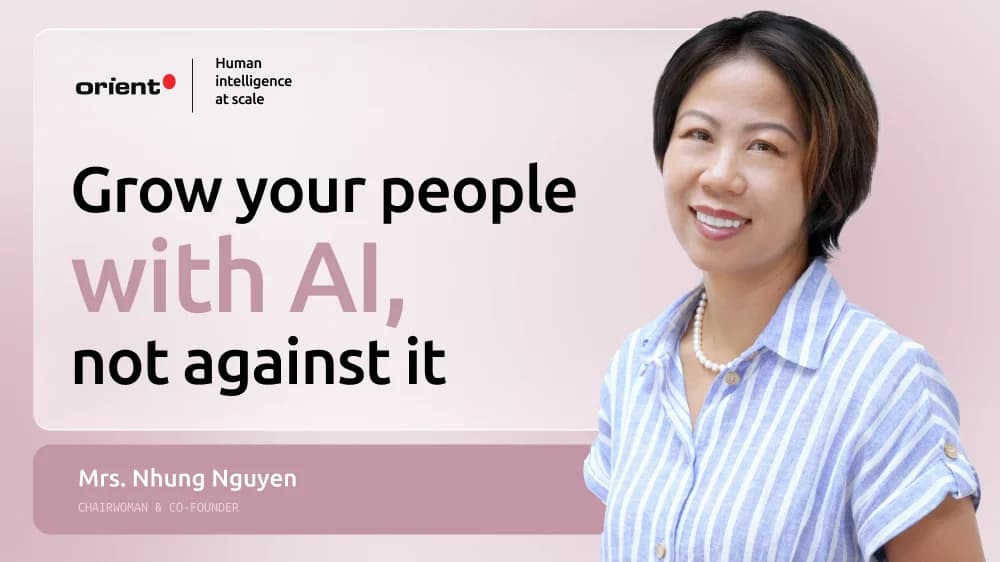
It is this exact tension that Ms. Nhung Nguyen – the Chairwoman and Co-founder of Orient Software – has navigated for over two decades. She has steered an organization with 400+ members through 20 years of organic growth and every major shift the industry has seen. In this writing, we explore the blueprint this powerful woman in tech used to build a thriving company by putting people at the center of every AI-forward decision.
AI is expanding what organizations can do, while raising the pressure on their people
Indeed, AI has unlocked a new horizon of what’s possible. Its widespread adoption is accelerating businesses across industries, transforming how they operate from the inside out. This is not the first time technology has reshaped work. The internet, cloud computing, and mobile-first development all demanded significant adaptation. But what truly sets the AI era apart is the speed, accessibility, and immediacy of change at a pace most could not imagine.
In the boardroom, the allure of artificial intelligence is often framed through the lens of expansion. Faster code generation, more efficient quality assurance, and near-instant data synthesis all aim to return one of the most precious resources: time. Tasks that once consumed hours now take minutes. Outputs that previously required deep research and specialization or large teams can be completed in a remarkably shorter time.

Not only the founders and leaders but also the executives can acutely see and feel the real-world applications of AI in their operations. Its advanced capabilities are changing how they work in measurably more productive ways. But they are also raising the ceiling of expectations, setting a higher bar on how people perform using AI.
What looks like progress on the surface often feels like stress underneath. According to data by Upwork, 96% of C-suite leaders expect autonomous AI agents to improve employee productivity. However, 77% of staff report that using AI has intensified their workload, while 47% of employees acknowledge that they cannot achieve the high employer demands on productivity and performance gains.
That gap between what leadership hopes for and what people experience is not a minor disconnect. It is structural. And it is a trap that stops talent from competing against their previous performance. Instead, they start to compare and implicitly race against what AI is capable of. Under this top-down pressure, every moment of not knowing something turns into a liability. Every mistake becomes evidence of irrelevance. And every hour spent pursuing a new skill feels like falling behind rather than moving forward.
With the baseline rising continuously, people feel that they are being measured against AI outputs even more, so they no longer approach learning deeply. They begin to reach for shortcuts to complete tasks and optimize for looking more productive rather than doing meaningful knowledge work and delivering real value. In such a context, not only the learning mindset is corrupted, but also collaboration suffers since everyone is heads-down in their own competition.
If mandating the use of AI tools costs a business its people’s willingness to learn, grow, and collaborate, then it was never the expansion to begin with. It was over-expectation wearing the mask of innovation. On the surface, it creates a fake momentum that the organization is moving fast. Unfortunately, it is hollowing out underneath.
“People have always been the foundation. AI just raised the stakes.” – Ms. Nhung Nguyen
Those organizations that avoid the trap of productivity and velocity are not the ones resisting or slowing down AI adoption. Conversely, they are the ones who never lost sight of who was truly carrying the business forward. It is a distinction that sounds simple. But in practice, it demands a leadership conviction that most business owners only discover after they have already paid the cost of ignoring it.
Not every leader who talks about people-first has spent twenty years proving it, but Ms. Nhung has.
“The further AI advances, the more irreplaceable human investment becomes. That is not a contradiction. That is the point.“
Since co-founding Orient Software in 2005 with only a few elite engineers, she has carried a vision that was never just building a software development agency, but to create a world-class environment where tech talent in Vietnam could genuinely grow. That founding belief became the operating principle that has guided every major decision since, including how Orient has chosen to navigate the arrival of AI.
During the infancy of AI, Ms. Nhung and her co-founder already sensed its enormous potential, not as a threat or disruption to manage, but as a capability worth understanding deeply and approaching with care. That early recognition gave Orient Software the time of opportunity. It’s the time to observe, to think, and to ask the question: “What does AI-driven transformation actually demand for the people being asked to absorb it?” Most leaders only ask after the pressure to act now or never has already arrived at their doors.

Ms. Nhung shared: “The hardest truth about AI implementation is that it was never really about the technology itself. Every failed rollout I have seen came down to the same thing. It’s the people who were not brought along, not invested in, and not trusted with the bigger picture.
If you manage tools without preparing users, you do not get transformation. You’ll get resistance, disengagement, and eventually the quiet exit of the key people you could least afford to lose. Technology can be adopted or upgraded overnight, but a team you can rely on can take years to build, yet just seconds to lose.
So, the key has never changed. Invest in your people first, invest in them continuously, and the technology will follow. The other way around has never worked.”
When AI evolved, and the urgency to act fast was at its loudest, she chose to approach it differently. No FOMO. No rushing. And no illusions about the unlimited power of AI. While others were accelerating, Ms. Nhung decided to pour resources into her talent, deepening the human expertise, judgment, and the kind of creativity that no LLM-based agents can replicate.
Indeed, this is how a chairwoman has been quietly building the steady foundation for her business and people to thrive in the age of AI. And beneath the foundation runs a single thread that holds everything together: A growth mindset. Not as a personal development concept, but as an organizational philosophy embedded into how Orient’s people think, learn, and evolve every single day. And it is what the next chapter of Orient’s story is built on.
Her mindset, her method: Growing talent who never stops learning
She views AI through the lens of human confidence & potential
Most companies are hyper-focused on what AI is capable of. Their leaders naturally lead with technology when they announce new AI solutions. Unfortunately, the management rarely provides employees with the preparation, context, and honest conversation about what AI really means for their roles, values, relevance, and future. What employees receive is a vision that promises transformation, efficiency gains, and competitive advantage.
Without transparent communication and hands-on training, you are mandating AI implementation. It will soon open a gap between vision and reality, where doubt and job insecurity begin to take root. In that gap, unanswered questions move in silence. Am I still needed here? Will my skills hold value? Am I being measured against something I was never designed to compete with? These are not irrational fears but the predictable consequence of being handed a powerful, rapidly evolving technology with promises but without support.

Nothing kills curiosity faster than that and replaces it with something far more damaging: compliance. Employees use agentic AI tools simply because they are told to do so without genuine engagement or belief in what they are doing. They stop asking how they can grow with AI and start asking how they can avoid being exposed by it. No more experimenting or learning.
Ms. Nhung views this as a leadership failure when vision and reality collide. Her response to it is not to begin with technology and capability. She chooses to look beyond technology and see what her people are capable of becoming.
Her perspective on this is not cautious or defensive. It is genuinely empowering.
“Don’t fear AI. Don’t fight AI. Grow yourself into someone AI cannot replace and learn to work alongside it as the most powerful tool of your generation.”
It is no reassurance of humans’ potential in the age of AI but a reframe, confirming a shift from competition to human-agent collaboration and growth. Because in Ms. Nhung’s view, the ceiling on what AI can do is already defined. The ceiling on what people can grow into, when genuinely supported, trusted, and given room to grow, is not.
She models the growth mindset from the top
Encouraging people to embrace AI and grow with it is easy. Showing them what it looks like is a completely different story. The burden of AI adoption is never meant to sit on employees alone. It sits on the leadership layer first. Leaders and managers should not simply advocate for a growth mindset. They need to practice it in ways the entire organization can see and follow.

Through the pragmatic lens of a business owner, Ms. Nhung emphasizes that a strong growth mindset will never spread through messaging or enthusiasm alone. It is imparted through behavior, cascading through different layers and becoming the DNA of an organization.
The most powerful thing a leader can do is visibly, authentically learning,” said Ms. Nhung Nguyen.
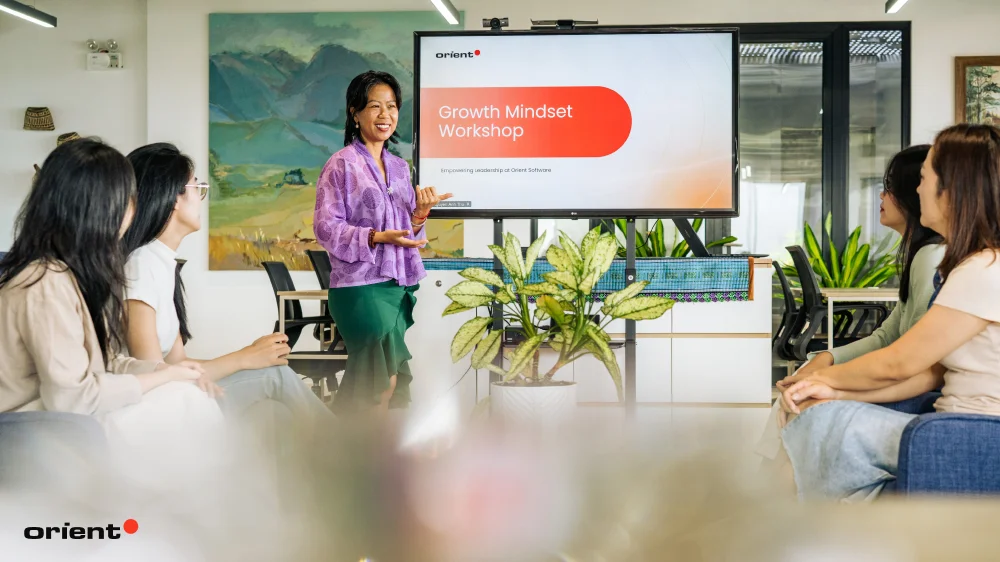
At Orient Software, a learning-first philosophy is not a value on the wall. It is a daily practice for all. Through structured Learning and Development programs, open knowledge sharing, and a genuine encouragement to use AI meaningfully across every role, Ms. Nhung ensures that growth is never something the organization asks of its people while leadership watches from a distance. The management roles must always be the first to participate in.
When leaders model curiosity and continuous learning rather than immediate expertise, they start passing down confidence and making growth the entire organization’s way of operating. Ms. Nhung aims to make continuous learning a discipline wired for human capital development, so that each individual inside the company not only understands but also genuinely lives it every day. And she has been consistently modeling it for over 20 years of Orient Software.
She builds psychological safety into the culture of change
Conviction shapes how a business leader thinks, while behavior defines how a culture wired for growth moves. However, neither can reach people they are meant to develop if people only feel afraid to fail, reluctant to admit uncertainty, or anxious about their relevance. The gap between what leadership is excited about and what employees are quietly carrying is where the human spirit either holds or breaks.

As a high-level leader, Ms. Nhung pays attention to the gap.
“We are not robots, and we should not try to compete with one another either. We are humans who learn by doing, failing, reflecting, and trying again. It is the imperfection that makes human potential limitless as long as we never stop growing,” Ms. Nhung emphasizes.
Under the pressure of AI tooling, a growth mindset flourishes or dies based on the environment you build around it. It is internal, self-driven, and cultivated, not received from above. Therefore, employees don’t need more hype about AI. They demand an environment where they feel known, listened to, and understood. They need to feel safe enough to be imperfect while improving themselves.
At Orient, Ms. Nhung fosters a receptive environment empowered by openness, collaboration, and a learning mindset. People across levels and roles are encouraged to speak up and ask questions without the fear of judgment, to experiment without fear of failure, and to raise concerns without fear of consequence. Mistakes are treated as the natural cost of genuine exploration. That’s how an organization actually grows, rather than just performing learning.
She watches for the moment AI use becomes AI dependence
There is a line between leveraging AI and leaning on it entirely. It is not always obvious when it gets crossed. Ms. Nhung reminds leaders of a cautious take. If left unguarded, the same tool introduced to augment human capability and help people grow can insidiously turn into the reason they stop developing. People appear to be performing at a higher level with AI assistance. However, when stripping away the tools, what has been growing the whole time? The underlying human capability or the AI itself? A leader must be able to name it directly.
The difference between healthy AI use and dependence is not about frequency. It is about direction. Are your people utilizing tools to go further than they could alone, such as to think bigger, move faster, and deliver more meaningfully? Or are they simply using it to avoid the discomfort of figuring things out themselves? One builds human capability over time. The other quietly erodes it.
This is what Ms. Nhung advises business leaders to watch out for. Not the line between using AI and avoiding it but the one between using AI to grow and using AI instead of growing. AI tooling should be introduced as an enabler; people always remain larger than. The tooling should never outgrow the person holding it. When AI makes it too convenient to skip the struggle, it skips producing genuine growth as well. And people-first leadership has to step in and recalibrate.
Every leader needs to keep this in mind: “The day your people stop growing is the day your AI starts running the organization. That is not AI forward. That is people backward.
Final thoughts: The true competitive edge lies in human growth, not AI stack
Ms. Nhung does not sugar-coat AI transformation. She names it for what it is while pointing out the business challenge hiding beneath.
“The real risk of AI adoption is not that it will fail. It is that it will succeed just enough to make you forget about your people. And by the time you realize it, the cost has already outweighed any efficiency gains. You are not winning but borrowing against the future.” Ms. Nhung shared.
There is a version of AI success that looks impressive on a dashboard, but the people behind those numbers burn out, disengage, and stop learning. They eventually leave and take with them the institutional knowledge, the contextual judgment, and the human depth that no AI tool can reconstruct. Then, Ms. Nhung calls that a hollow victory.
In addition, AI adoption is never the finish line. It is a part of the transformation in the AI era. Every organization today has access to the same frontier AI models with the same automation capabilities. The technology itself is no longer a differentiator.
What cannot be copied, purchased overnight, or deployed in a sprint is a workforce that knows how to work alongside AI at the highest level. People who can direct intelligent agents with genuine judgment. Who questions outputs with the kind of contextual expertise that only lived experience provides. Who pushes AI further than it could go without real human intelligence behind it.
What separates organizations that simply make use of AI from those that genuinely grow with it is not the AI stack. It is the people-first approach, including the conviction, the culture, and the quality of collaboration between humans and agents. The mindset leaders follow can determine whether AI becomes a true growth engine or just an expensive tool running in the background.
“Technology, no matter how advanced, will eventually get outdated or replaced by something more powerful. But people who never stop questioning, learning, and growing will not become obsolete,” Ms. Nhung added.
Ultimately, Ms. Nhung expects business leaders to recognize their own situations. When they do, she wants them to understand that having a growth mindset is not a soft advantage. It is the only sustainable one that helps you navigate through every wave of change and thrive beyond the age of artificial intelligence.