


Software development outsourcing is a significant investment. It is acknowledged as a business strategy for both tech and non-tech companies to handle their engineering needs without the overhead of scaling in-house resources or delivering the products they could not build alone. And like any important decision, outsourcing rewards business owners who come prepared and costs those who don’t.

In reality, businesses that struggle with outsourcing do not lack the budget or the intent. They lack the full picture. Lots of founders and leaders approach outsourcing as a shortcut in which they can hand the software engineering work over and wait for the deliverables. These tend to skip the critical step of understanding outsourcing, and they treat it as something to figure out later or assume that they already know enough. As a result, they rush into vendor selection, setting off a chain of uncertain decisions.
Successful outsourcing is not a matter of luck. It is about knowing exactly what you are doing before you start. By the end of this guide, you will.
What is software development outsourcing?
In the broadest sense, outsourcing refers to the practice of contracting the software development work to an external party rather than handling it internally. The scope ranges from hiring a dedicated team or individuals to build, maintain, or scale a software product to entrusting a partner with a single feature, a technical function, a short-term build, or the entire development process. The external partner could be a solo freelancer, a team of skilled developers, or a full-service provider.

The scope of what you can delegate to an outsourcing partner extends beyond handing off execution to an outsourcing provider. The trusted outsourcing partner can offer strategic consultation, professional guidance, and technical expertise across domains:
- Custom software development: Developing software (a product, platform, and application) from the ground up, designed for specific business objectives and requirements rather than being built for the broadest possible audience and adapted to fit yours.
- UI/UX design: Researching and creating how users experience a digital product in terms of look, feel, and interaction.
- Quality assurance (QA) and testing: Verify the software functionality and performance across conditions, ensuring it works as intended.
- Legacy system modernization: Optimizing, rebuilding, or migrating outdated systems into modern, scalable architectures without disrupting ongoing operations.
- Artificial intelligence (AI), machine learning, and robotic process automation (RPA): Assisting businesses to adopt and integrate intelligent capabilities without the need to build that specialized expertise in-house.
- Cloud and DevOps: Supporting infrastructure management, deployment pipelines, and system reliability, so your systems run fast, scale when the business demands it, and stay available when it matters most.
- Data analytics and business intelligence (BI): Converting raw data into clear, actionable insights that inform decisions.
- More.
Software development outsourcing in reality: The most current statistics
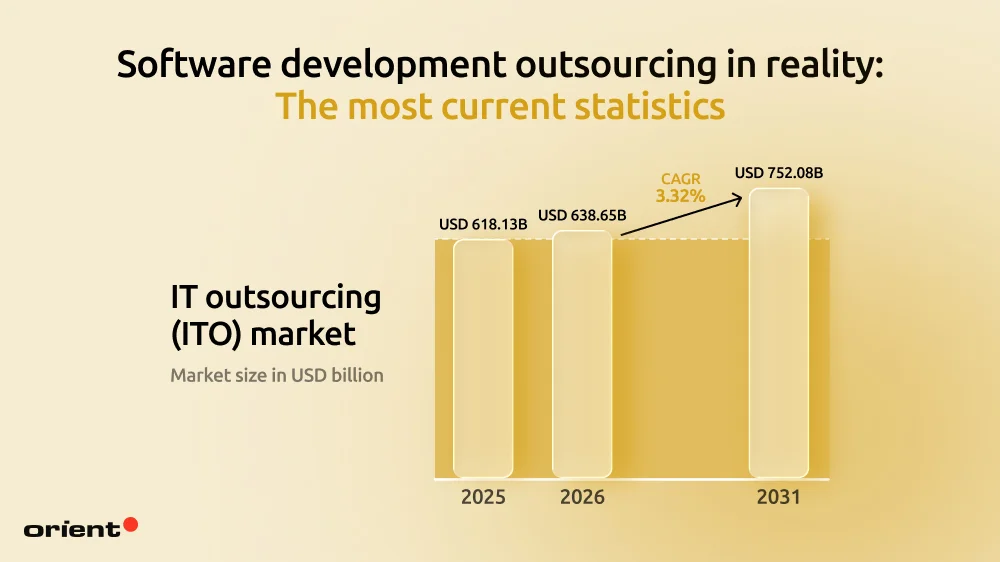
- The global IT market size was valued at $638.65 billion in 2026, and it is projected to grow to $752.08 billion by 2031, at a CAGR of 3.32% during the forecast period. (Source: Mordor Intelligence)
- 72% of organizations outsource software engineering to gain access to specialized skills and talent (32%), meet customers’ demands more efficiently (35%), reduce costs (34%), and improve performance and quality (33%). (Source: Deloitte)
Read more: The 22 Most Interesting Outsourcing Facts & Statistics
Available software development outsourcing models
As a decision maker, you can choose how you want to engage with an outsourcing provider. That choice matters as it determines your cost structure, your level of control, your collaboration dynamic, and ultimately whether the engagement is set up to deliver or set up to disappoint.
There are multiple engagement models, and they span three different dimensions: Where your partner is located, how your external teams are structured and delivered, and how the financial engagement is contracted.
By location
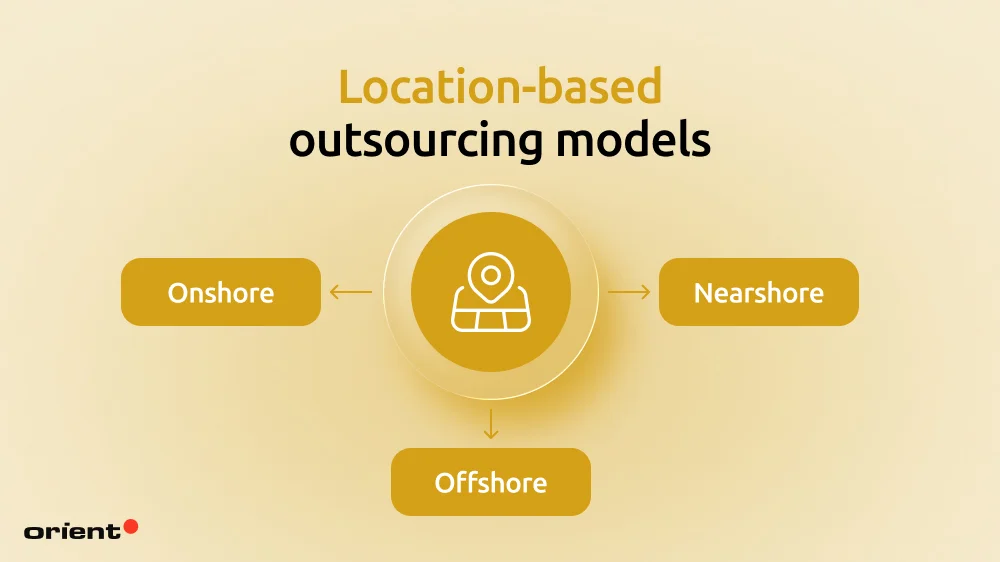
- Onshore outsourcing: This model involves working with a partner or outsourced team based in the same country or city as your business. Onshore outsourcing carries the highest developer rates in exchange for the convenience of physical closeness with no time zone gaps, no language barriers, and no legal complexity to navigate.
- Nearshore outsourcing: You partner with a service provider located in the nearby region with overlapping or compatible time zones. That proximity is enough for real-time collaboration and achievable cultural alignment. This engagement model enables you to strike a balance between collaboration quality and cost efficiency that neither onshore nor offshore can match alone. Nearshore outsourcing is more affordable compared to onshore and closer in geographical distance than offshore. This model works best for those who need the responsiveness of an onshore partner without the onshore price tags. It is no coincidence that nearshore has become the fastest-growing model among startups and growth-stage companies.
- Offshore outsourcing: You engage with a team or vendor in a more distant region. Offshore software development outsourcing offers the most competitive rates and access to global tech talent pools as benefits. However, the trade-off is the significant time zone difference that demands clearer communication protocols, stronger project requirements, and clearer documentation. The offshore model rewards businesses that come prepared with well-defined requirements or prioritize cost savings. Offshore outsourcing is the most effective path to quality engineering talent available.
By team structure
The way you choose to outstaff determines how much control you retain over the outsourced staff as well as the work, and how deeply the engagement embeds into your operations over time. There are two popular models to consider, and the right one depends on what your project goals are and what your in-house development team can support.
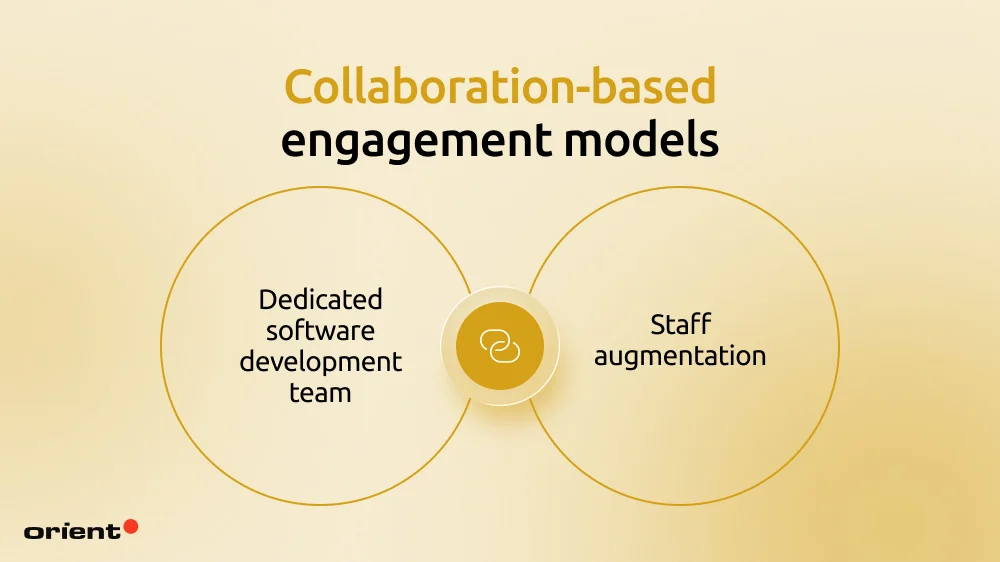
- Dedicated team: Think of this model as an external unit exclusively assembled around your requirements and assigned solely to your project. The size and composition of a dedicated software development team are yours to define. The team strictly follows your workflows and practices, aligns with your vision, and responds to your priorities. All members are vendor-managed, which means the service provider is responsible for the operational layer, from recruitment to HR (contracts and payroll) and team administration. What you own is the direction. The dedicated model is designed for long-term partnerships and complex projects rather than short engagements.
- Staff augmentation: This model involves augmenting your internal team with external expertise. Individual professionals (developers, testers, or UI/UX designers) are placed directly into your existing team structure to fill specific skill gaps and add capacity where you need it. They work inside your processes and collaborate with the client’s in-house team members as direct hires.
By financial contract
These models are how the engagement is priced. They determine where the risks sit, whose incentives are aligned with the deliverables, and how much predictability you have over your spending as the engagement progresses.
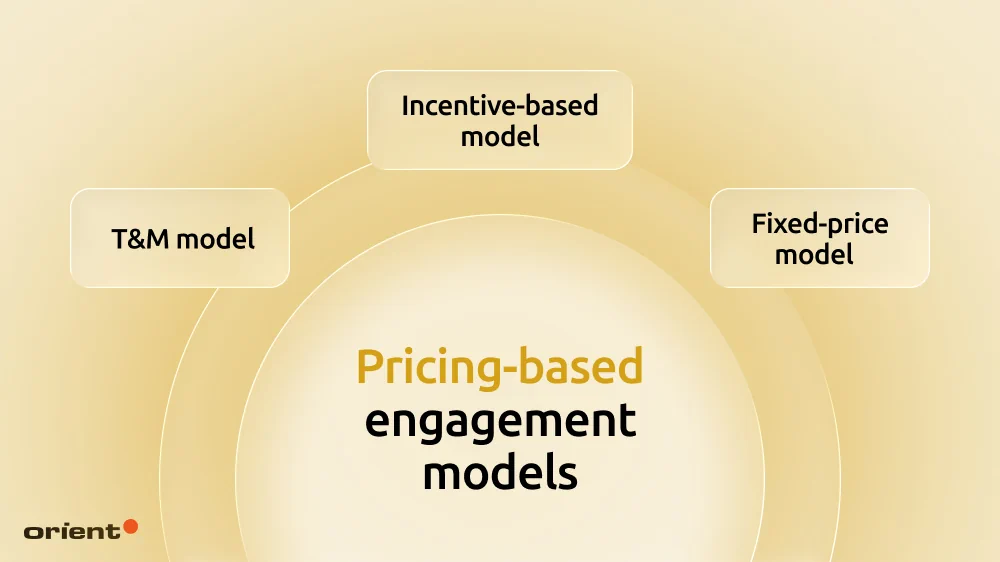
- Time-and-material (T&M) model: You pay for the actual hours worked by the software developers and resources utilized throughout the engagement. This model enables high flexibility to change scope, priorities, and even requirements as the project or product evolves without worrying about penalties. Simply put, T&M allows you to adjust the scope and only pay for the work done. Note that there is also no ceiling on cost without active oversight, so discipline is important to keep your budget under control. Therefore, the T&M model is more suitable for long-term, large-scale projects, the ones with evolving requirements.
- Fixed-price model: Before a single line of code is written or a member is interviewed, the scope, timeline, and total cost are already finalized. The outsourcing partner delivers what was defined for the price that was contracted initially. What you gain is cost predictability, but at the price of flexibility. Once the engagement is underway, changes come at additional fees. If a project is still in the middle of shaping requirements, fixed-price engagements can lead to higher costs.
- Incentive-based (Performance-based) model: As a client, you spend money on the outcome (specifically performance and value) rather than hours worked. The compensation structure is split into two parts: A base payment that covers the work and a bonus/incentive that is earned when predefined targets are hit. For example, if the service provider just finishes the work as required, they receive the base payment. But if they can build a better product or deliver it faster than expected, they earn more profit. You should consider the incentive-based model only when the engagement is long-term and the success criteria are well-defined.
By scope of engagement
The final dimension is about how much responsibility you hand over to the software development outsourcing company and how much you retain.
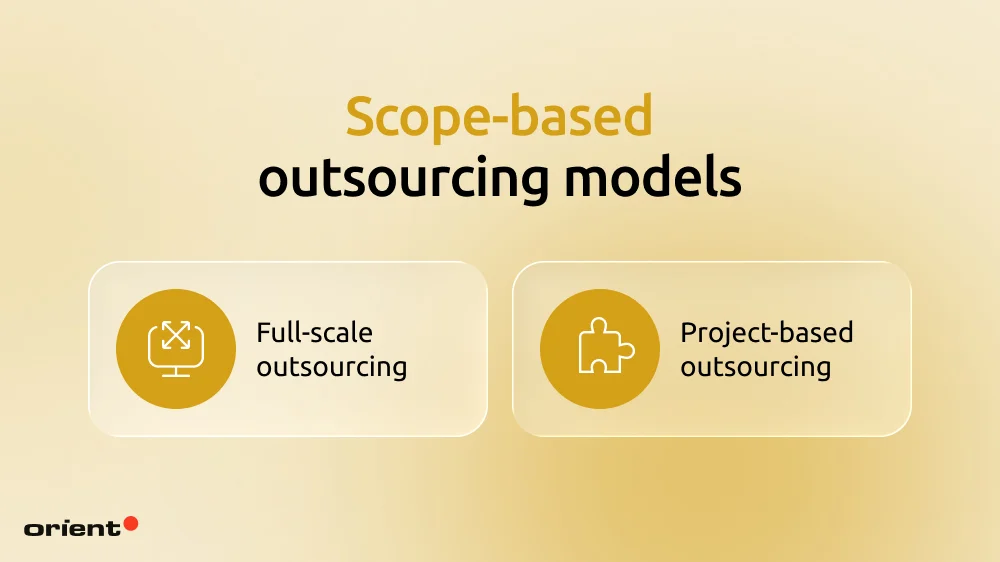
- Full-scale outsourcing: Under this engagement model, the entire project operation is transferred to the service vendor, from architecture and design to development, testing, deployment, and maintenance. Your role is to define the vision and set the priorities, while the outsourcing partner owns the full development lifecycle and delivers the outcome. Companies often choose full-scale outsourcing when they have no technical capabilities or have limited resources to build full-fledged teams on their own.
- Project-based outsourcing: Also known as solution-based outsourcing, this model provides an as-needed commitment in which a defined, time-bound scope of work is delegated to the external party. For example, a specific feature, a standalone product, or a discrete phase of development. The scope is fixed, and the work is clearly defined initially. When it is delivered, the engagement closes. There is no need for long-term commitments or embedded relationships. Project-based outsourcing is suitable for offloading seasonal peaks or quick tasks (E.g., ad-hoc support), enabling an in-house software development team to prioritize core functions and value-added activities.
What influences the actual outsourcing costs?
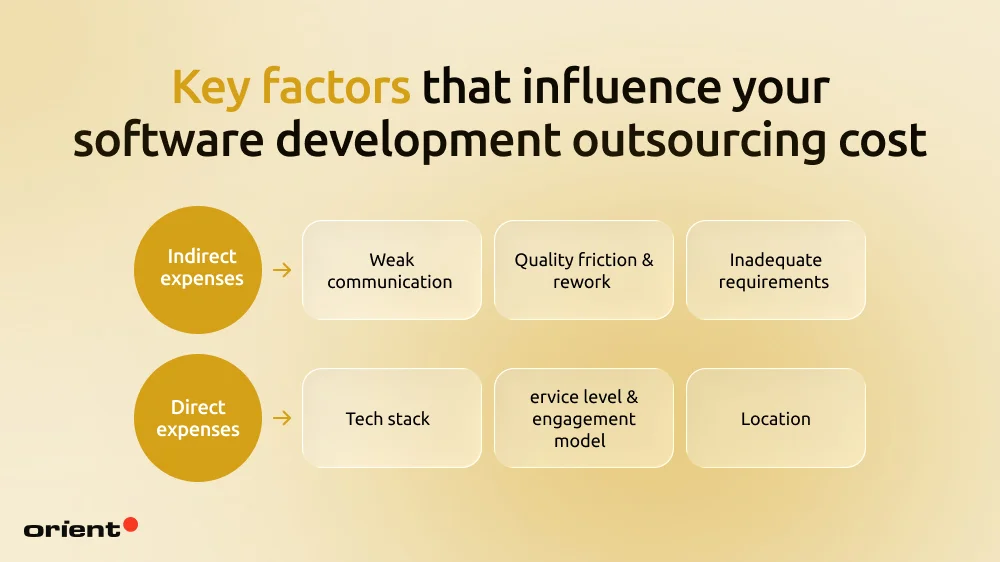
How much does software development outsourcing cost? The total number is determined by two primary factors: Direct and indirect costs.
Tangible costs to note down
Beyond the line items on a proposal or invoice, direct expenses are the primary financial drivers behind the total cost of outsourcing custom software development. They are the result of multiple choices a business leader makes regarding what, where, and how to outsource. They are predictable to estimate and easy to budget for.
Technology stack: WHAT to ask for
The technical requirements dictate the talent pool size, the hourly rate, and the total number of billable hours. The impact of your tech stack choices is based on two factors: How much the experts cost to acquire and how fast they can work and deliver value. You can choose to stretch your budget or tighten it.

- Talent availability and market demands: The most direct influence on your budget is the scale of supply versus demand of the tech labor market. Professionals specializing in mainstream frameworks, development tools, and widely adopted programming languages tend to be easier and more cost-effective to hire. In contrast, talent in niche specialized expertise like AI, machine learning, blockchain, or uncommon languages, such as Rust, commands a scarcity premium translated into higher costs as the service vendor must spend more on salaries and benefits to acquire them.
- Development velocity: The choice of technology and tooling directly dictates the volume of billable hours required to reach a milestone. Modern frameworks that come with extensive libraries and pre-built components enable rapid prototyping and deployment. Development teams can significantly reduce the total hours billed. However, cutting-edge technologies and tools often command a higher hourly rate for senior talent.
- Team seniority: The composition of an outsourced team is one of the critical levers in determining the final invoice of direct costs. You can decide the ratio of junior, mid-level, and senior professionals within a squad based on your project complexity and requirements. Choices matter here as they translate into more than just a base hourly rate. They influence the volume of support roles and oversight required. For example, a junior-heavy team typically necessitates a larger investment in technical guidance and project management tools to ensure performance at par.
Service level & engagement model dynamics: HOW you want to outsource
The framework of partnership also has a direct impact on your total investment. How you choose to engage with a software development company determines whether you are paying for time spent (billable hours and developer rates) or results delivered.

- The service level acts as a premium for certainty. When you require guaranteed response times, high uptime, or specific quality benchmarks, the direct cost increases to account for the dedicated resources and monitoring systems the vendor must maintain. Essentially, you are charged for a transfer of operational risk; the more accountability the vendor assumes for the system’s performance, the higher the service fee.
- Different outsourcing models have different pricing structures. The determinant here is the management shift. The cost depends on whether you allocate your investment toward raw execution or managed development cycles and results. An engagement that asks for leadership, project management, and accountability from the outsourcing partner will naturally have a higher sticker price.
Location: WHERE you outsource to
Another major driver behind the direct total cost of outsourcing is the geographical location of your partner. Through the lens of value per dollar, the location you choose not only dictates the labor rate and service fee ranges but also affects the entire ecosystem that supports your outsourcing endeavor. Most businesses make use of geographic arbitrage, the economic differences between regions, to access high-tier technical talent at a cost that would otherwise be impossible in their local markets.

Moreover, factor in the local conditions, such as workforce, education standards, English proficiency, and business culture. Ensure these essentials align with your goals. For example, Vietnam becomes the magnet for tech investment because of its competitive prices and large force of young talent specializing in the latest technologies.
Learn more: List of Leading Software Development Outsourcing Companies in Vietnam
Unforeseen expenses to watch out for
Unlike visible costs, these often hidden numbers often lie in the friction between your in-house team and the external counterpart. Here are the common triggers you should watch out for:

Communication breakdowns
Beyond simple language barriers, verbal misunderstandings or delayed responses often occur due to geographical distance and time zone gaps, especially when it comes to remote collaboration. When these happen, they trigger a cascade of hidden costs in the form of “dead time” spent waiting for feedback and a heavy documentation burden, not to mention slow or even frozen productivity. Additionally, a poor communication flow also forces a shift toward micromanagement or redundant oversight, which increases the internal operational costs of maintaining alignment.
Quality friction & rework
When software solutions delivered fail to meet the defined quality benchmarks, a significant multiplier for hidden expenses is triggered. This friction often stems from the mismatch between technical output and the business intent, or the outsourcing partner lacking contextual depth of your product logic or industry. Either way, business leaders face the risk of paying twice or more for correcting or reworking, which is expensive in most cases.
Unclear or inadequate requirements
The lack of clarity is not only the silent killer of outsourcing returns on investment (ROIs) but also the root cause behind both communication breakdowns and quality issues. When software projects begin with vague expectations rather than concrete, functional specifications, they are at risk of a massive financial tail in the form of scope creep and logic gaps.
What you must know: The key benefits & challenges of software development outsourcing
Outsourcing has matured into a standard business strategy for companies aiming to scale rapidly without stretching their budgets, but there are more advantages. In order to truly leverage software development outsourcing, business leaders and founders should look beyond the surface-level benefits and prepare for the challenges.
Advantages
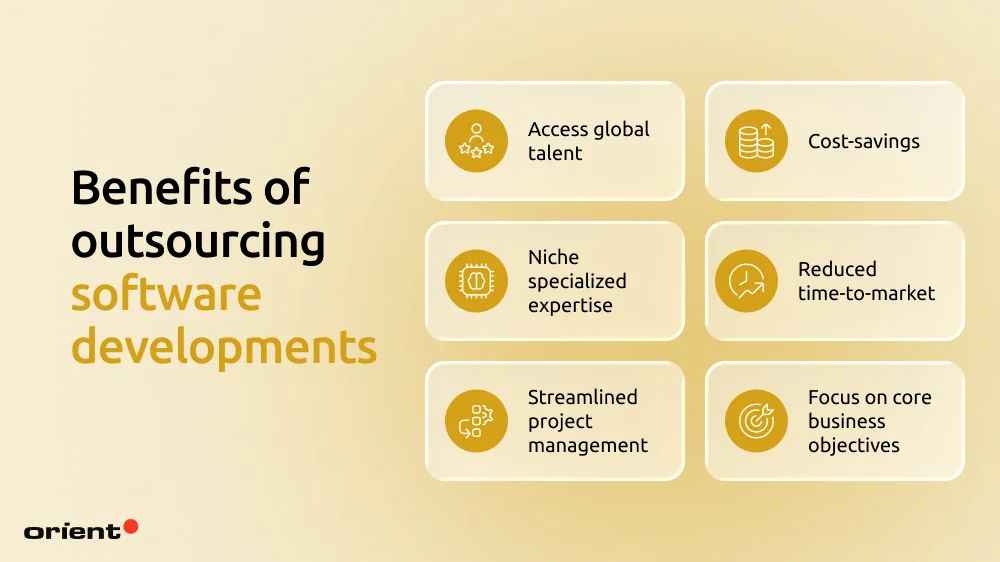
Access top-tier tech talent
Tech companies in over-saturated markets like Silicon Valley, New York, or London, are grappling with a dual crisis: The chronic shortage of qualified developers and a prohibitive labor cost driving compensation packages to unsustainable levels.
By outsourcing, businesses in popular hubs can alleviate the geographical bottleneck and expand their talent search from local markets to a global talent pool.
Tap into niche technical expertise
In the current tech landscape, it is a financial and management impossibility to build and maintain an in-house team that is expert in every emerging field, typically generative AI, large language model (LLM) orchestration, and blockchain architecture.
Strategic outsourcing offers business owners a competitive edge. It allows them to tap into an outsourcing partner’s depth of expertise and rent the learning curve on an as-needed basis rather than building everything from scratch, investing in full-time hires, or reskilling their current in-house teams.
Simplify project management
A common misconception is that working with an external team increases the management burden. The reality is quite the opposite. An established partner absorbs the operational friction and administrative heavy lifting that usually drains your window of time. From recruitment and background check to onboarding and setup, the partner takes over them all, so your internal HR team does not have to.
Additionally, collaborating with a software outsourcing company is not just about buying services or hiring developers. Businesses, especially startups, can also benefit from a mature project management ecosystem stress-tested across multiple client environments. Reliable outsourcing partners come with ready-made structures of sprints, stand-ups, and documentation standards. They simplify communication processes between teams and assign project managers or leaders to serve as the go-to contact points in order to reduce the noise for your internal leads. Through time-tested workflows, internal leadership can shift from micro-managing tasks to directing outcomes.
Save development costs
One of the privileges of outsourcing is financial agility. By delegating parts of a project or the entire software development lifecycle to a specialized partner, a company can first save costs on engineering and tech hiring. Secondly, companies outsourcing software development to nearshore or offshore countries can leverage geographical arbitrage to access senior-level talent at much lower rates.
Not only does it save expenses like recruitment fees, benefits, office infrastructure, and software licensing, but effective outsourcing also enables companies to scale up or down resources in direct response to market conditions and evolving needs without the painful friction of layoffs, hiring freezes, or idle capacity.
Focus on core business processes
When an organization attempts to handle every technical detail internally, the leadership tends to be consumed by the mechanisms of software delivery rather than overseeing the long-term business direction. By entrusting technical execution to a specialized partner, the internal leads can reclaim their strategic bandwidth and allocate their time to what matters more, such as refining the product roadmap, analyzing market shifts, and deepening customer engagement.
Moreover, outsourcing also allows business owners to prioritize core competencies while handing off non-core functions to a capable partner with relevant expertise. This ensures the leadership team stays focused on innovation instead of being sidelined by the logistical noise of the development cycle.
Speed up the time-to-market
In addition to significant cost savings, outsourcing offers a competitive advantage in the tech industry: Speed.
By partnering with a service provider, you gain access to instant infrastructure to get started faster. Outsourcing eliminates the waiting time on the mobilization phase (The preparatory stage in construction and project management regarding resources, personnel, equipment, etc.), like searching for specialized talent and setting up teams. You can step into a ready-to-run engine that has everything prepared customarily for your own project.
This speed is further amplified by parallel development. Instead of working in a linear flow, both internal and external teams can run simultaneously on a project, handling what is aligned with their own strengths. Plus, the follow-the-sun model allows teams in different time zones to work. Plus, you can utilize the “follow-the-sun” model in which teams in different time zones can run continuously. Without waiting or delaying, your partner’s team picks up where your in-house staff left off, and the pattern repeats in the next cycle. This keeps your project in motion 24/7.
Disadvantages
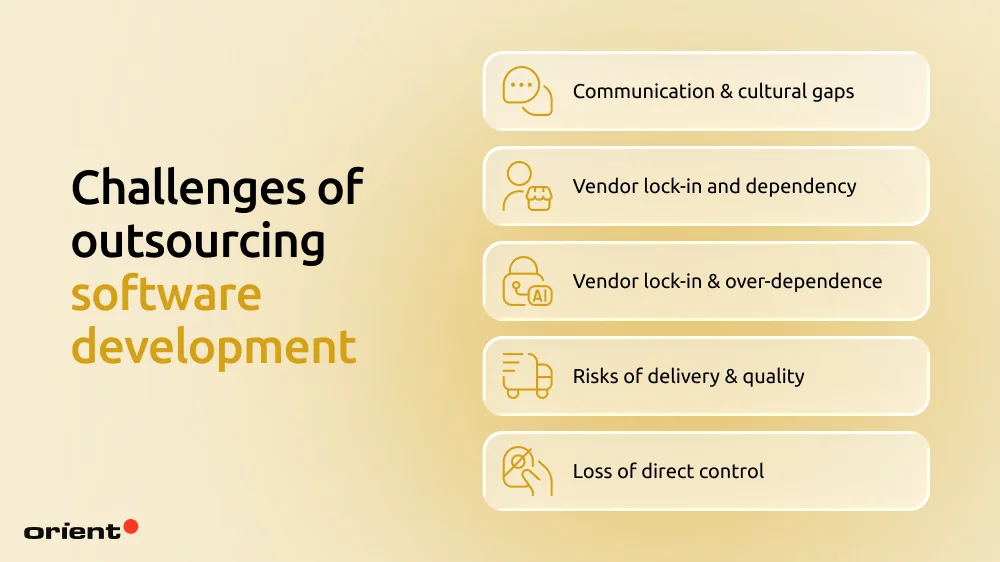
The communication & cultural nuances
Business owners should respect diversity when they choose to outsource and work with external teams, especially across countries. The geographical distance, cultural differences, and language barriers are a few among the common reasons behind your troubles in day-to-day communication.
What feels straightforward and efficient to one team can be perceived as abrupt or incomplete to another. If not managed properly, even subtle differences in how teams interpret urgency, feedback, or accountability can lead to misunderstandings, vague expectations, and poor collaboration. Over time, small gaps can accumulate into misalignment and major project delays.
The time zone “lag”
While remote teams and offshore vendors expand talent access, they also introduce coordination challenges, such as delays in feedback loops, slower issue resolution, lack of shared working hours for synchronous communication, or duplication of work caused by poor role and responsibility clarity. If an organization is not fully equipped to manage work across different time zones, small gaps like these can compound over time and gradually erode project momentum.
The security & intellectual property (IP) risks
Both security and intellectual property consistently rank among the top concerns in software development outsourcing. Engaging external service providers requires you to grant access to sensitive code, business logic, customer data, or proprietary product information. This level of exposure introduces risks that extend beyond technical execution into compliance and ownership. Without defined safeguards and enforceable agreements, these risks often evolve into long-term legal and operational consequences.
The risk of vendor lock-in
Vendor lock-in occurs when a business becomes so reliant on a specific outsourcing provider who retains complete control over critical product knowledge, infrastructure, documentation, or development processes. As a result, even routine changes or strategic pivots may ask for continued involvement from the same provider. Switching to another vendor or transferring work back in-house, at this point, can be too costly or operationally risky.
The delivery & quality risks
Outsourcing does not guarantee consistency, and not all vendors deliver at the same standard. The distance between what’s promised and what’s delivered is where most of the risk lives. While vendors may present strong capabilities on paper or during an interview, actual execution varies heavily depending on team composition, processes, and engineering discipline.
Therefore, a reliable, capable outsourcing vendor is non-negotiable. The true partner goes beyond being a merely technical supporter and operates as a genuine extension of your in-house team. It is grounded in transparency, disciplined delivery, and a laser focus on meaningful outcomes rather than overpromising.
The lack of direct control & oversight
By nature, outsourcing inherently means ceding a degree of control over how work gets done. As service buyers, you see outcomes on reports far more clearly than the process that produces them. What reaches you is often a filtered, summarized view. Without full visibility, you can only react to the problems rather than steer around them.
Note that not all challenges are visible at the planning stage. Some reveal themselves only when the project is underway.
Software outsourcing & common mistakes you can’t afford to make
If you do not wish to run back and forth to tackle the consequences, stay one step ahead and prevent risks from occurring. Whether you are about to outsource only some tasks or the whole software development life cycle, make sure you are mindful of the following common pitfalls. Each is a decision or omission that sits entirely within the service buyer’s control.

Outsource without sufficient knowledge
A majority of businesses that fail to outsource software engineering are first-timers. When starting out, they follow the same pattern: Rushing into the process without adequate understanding of outsourcing mechanics. Walking in blind makes you easy to sell to and hard to negotiate with. Master the basics before the first sales call; it’s what separates a buyer who shapes the engagement from one who signs what’s put in front of them.
Treating cost as the only factor
Outsourcing does reduce costs, but cost-led selection trades against quality, seniority, and the vendor’s willingness to push back on bad requirements. Technical depth, verifiable references, and communication quality predict outcomes far better than hourly rate. The cheapest vendor is rarely the cheapest outcome.
Failing to clarify requirements
A surprising number of projects begin with a vague brief and a hope that the outsourcing partner will fill in the gaps. In reality, they will, just not in the direction you want. Define scope, objectives, deliverables, and timelines before the first RFP; ambiguity at the start gets paid for later in revisions and scope disputes.
Skipping or rushing due diligence
Leaning on the vendor’s own pitch deck and hand-picked references is not due diligence. Proper vetting means independently sourced reviews, technical interviews with the engineers who will actually do the work, and structured conversations about how the service provider handles failure, not just success. An extra week spent on due diligence is always more cost-effective than uncovering problems after the contract is signed.
Rushing into an agreement
Time pressure is the enemy of a good contract. IP ownership, data security, termination rights, and penalty clauses tend to get glossed over. However, these are exactly what you’ll need if anything goes wrong. Read the contract carefully, as if the relationship will fail, because that’s when its terms will matter most.
Misjudging a partner and sticking with the wrong one
Even thorough due diligence has a miss rate, and you may end up with the wrong vendor sometimes. However, the real cost of a bad choice isn’t the initial misjudgment. It’s how long you stay. A failing partnership compounds: Deadlines slip further, quality erodes, trust breaks down on both sides, and the codebase you inherit gets harder to rescue with every sprint.
And once the warning signs are clear and consistent, rather than occasional, you know it’s time to take action. A wrong partnership will not fix itself. Start the transition. Secure your code and documentation, line up a replacement before you end the current engagement, and make a switch. You need to accept that a clean break at the right time, however disruptive, is almost always cheaper than maintaining a partnership that is falling apart.
Neglecting documentation
Documentation feels like overhead until the moment you need it, and by then it’s too late. Without clear records of architectural decisions, API contracts, setup steps, and the reasoning behind key choices, knowledge lives only in the heads of the people who wrote the code. If they transition, whether through retiring, rotating off the account, or leaving the outsourcing vendor, the knowledge disappears with them. The cost shows up when you try to onboard a new engineer, hand the project to an internal team, or switch vendors entirely. What should take days takes weeks, and new teams inherit code without context.
Common software outsourcing contracts
Outsourcing is a significant investment, so it requires careful consideration not only in choosing the right vendor or model but also in selecting the right structure to frame the commercial and legal agreement.
The contract establishes the essential foundation of the outsourcing partnership. It defines how work is handled and delivered, how risks and responsibilities are shared and enforced, and how payments and support are managed.

Each and every project comes with its own level of complexity, flexibility, and uncertainty reflected in its unique requirements and specifications. So, business owners need to determine the most suitable type of contract to protect their investment.
Here are the common types of software development outsourcing contracts:
- Fixed-price contract: According to this contract, project scope, deliverables, timeline, and total cost are negotiated upfront and agreed upon. This type works best for businesses that already have clearly defined project requirements and limited expected changes.
- Time-and-material (T&M) contract: An agreement where the client company pays based on the actual time spent and resources used during development. It offers projects with evolving requirements the flexibility they need to scale without worrying about overhead costs.
- Milestone-based contract: This type ties payments to the completion of predefined project phases and deliverables. In this approach, clients can keep track of measurable progress and delivery outcomes more easily.
- Cost plus contract: The client reimburses the outsourcing vendor for actual development costs along with an agreed fee of profit margin. This contract type is often considered when the project scope is undecided or when it is uncertain and difficult to estimate upfront.
- Retainer contract: This is a long-term agreement in which you pay a recurring fee for ongoing access to development services, technical support, or maintenance. The retainer contract is suitable for projects that require continuous improvement or post-launch support.
- Outcome-based contract: As its name suggests, this contract type links payment to specific business processes or technical outcomes achieved rather than hours worked or resources allocated. It emphasizes results and demands well-defined success metrics.
- Build-Operate-Transfer (BOT) contract: Under the terms of this contract, an outsourcing provider establishes and operates a development team or offshore center on behalf of the client. The ownership and control will be transferred to the client after a specific period of time. The BOT contract is often used for strategic long-term expansion of a company.
A breakdown of the entire process: Fundamental steps toward successful outsourcing
Outsourcing software development doesn’t look as straightforward as it does on paper. It calls for a sequence of decisions, and each of them aligns with a step, mapping the full arc from the moment you consider outsourcing to the point where the engagement starts and delivers.
Here, we break down the entire project into 6 critical steps toward a successful outsourcing partnership and the desired outcome.
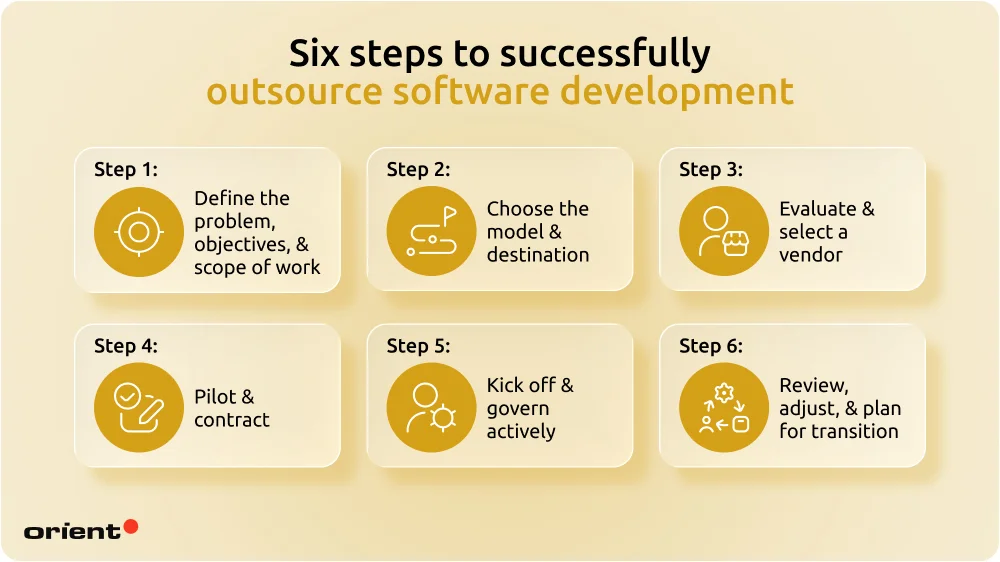
Note that there is no one-size-fits-all process. The steps below provide a general framework that applies to most outsourcing engagements, but the depth, sequence, and emphasis of each will vary depending on your company’s size, industry, project complexity, and internal maturity. Business owners should adapt this process to their contexts rather than following it rigidly.
Step 1: Start with the problem, not the vendor
Most outsourcing engagements fail here, not at execution, because the service buyers tend to skip the reasons for outsourcing and jump straight to finding a provider. Don’t make the same mistake. Whether you are a startup building your first product, a mid-sized company extending an in-house team, or an enterprise offloading a specialized workstream, the foundation should be: Get clear on what you need to solve and what success will look like before you talk to anyone.

- Identify the root problem: Name the real issue driving your decision to outsource. It might be a capacity gap during a growth or peak phase, an internal skill shortage in specialized areas (AI, blockchain, cybersecurity, cloud computing), a time-to-market constraint, an in-house cost structure that no longer makes sense, or a need to establish a long-term presence in a new region. The problem you want to solve determines what kind of engagement to opt for and who can provide the solution.
- Clarify the objectives: Next, translate the problem into clear business outcomes, not technical tasks. For example, launching an MVP to validate a new revenue stream within six months instead of building a mobile application. This tells an outsourcing vendor exactly what to aim for and what really matters when trade-offs appear. No guessing.
- Scope & document the work: Convert objectives into concrete requirements: Deliverables, timelines, technical constraints, integration points, and acceptance criteria. The depth of this document naturally varies.
- Define success in measurable terms: Decide on what on-time, good quality, and working look like in reality. Don’t make it complicated; keep everything simple yet specific instead. Success should be measured through delivery milestones, defect rates, performance benchmarks, and the business metrics that indicate the outsourced work actually delivers value. If you don’t have a definition of success, the outsourcing firms will supply an outcome that reflects their priorities, not yours.
Step 2: Determine the right outsourcing approach & destination
Next, structure how the work will be delegated and where it will take place. Keep in mind that getting this right is far more about the best fit than the best option. And don’t forget that the approach and destination you choose now will quietly influence every decision that follows, from the contract you sign to the outcomes you ultimately get.

- Pick the right outsourcing model: The right engagement depends on how defined the work is, how much ownership you want to retain, and whether the relationship is short-term or strategic. A mismatched model creates friction that no amount of vendor quality can overcome.
- Choose the right outsourcing destination: Decisions at this point entirely depend on the location-based model you picked earlier: Onshore, nearshore, or offshore. From there, you decide which region or country to delegate work to or establish extended teams in. Each offers its own advantages and introduces disadvantages. A place that’s attractive on cost may be weak on IP enforcement; one that’s strong technically may sit in a time zone that erodes the savings. Remember to weigh the pros and cons together rather than prioritizing only what you aim at.
Step 3: Shortlist & vet service providers
Regardless of your size or industry, the aim of this step is to move past what the vendor says they are capable of and verify what they actually do. A strong outsourcing partner can absorb a mediocre brief, while a weak one will struggle even with a perfect specification.

- Build a shortlist based on fit, not reputation: Select vendors whose domain experience, technical stacks, pool size, and preferred engagement style align with your requirements. The ideal candidates should be the ones specializing in solving problems like yours. Focus on suitability and compatibility. For example, a boutique firm of twenty may serve a startup better than a global consultancy with thousands of engineers.
- Vet capability through independent evidence: Don’t just assess pitch decks, polished case studies, and hand-picked references, as these are what the outsourcing provider wants you to see. Real vetting should be on independently sourced references from past clients, reviews of actual code samples, verification of certifications and financial stability, and technical interviews with the engineers who will directly work with you. Ask how they’ve navigated challenges, handled failures, and dealt with difficult clients. Evidence-based answers reveal more than the success stories.
- Assess communication and working style early: Technical expertise is important, but effective communication is more important. Pay attention to how responsive the outsourced team is during the sales process, how clearly and adequately they ask and answer questions, whether they push back on ambiguous requirements or simply say yes to everything you demand, and how well their written and spoken communication holds up under pressure. These are indicators that preview the behavior and style of a team in practice.
Step 4: Run a pilot & sign a contract that holds up
Remember this: Pilot first, contract second. Assess how an outsourcing vendor performs under real conditions and pressure before committing to the full scope of work. And when you are ready to commit, you need to determine how to structure the contract to protect you when things go well as well as when they go wrong.

- Run a pilot: A small, scoped trial (a two- or three-week task) with a clear deliverable reveals more about a vendor’s real discipline than any number of meetings. For example, a scoped feature, a proof-of-concept, or a discovery phase. The purpose is to test how the outsourcing vendor estimates, communicates, writes code, and responds to feedback in a low-stakes setting. It replaces sales-stage behavior with delivery-stage behavior, giving you a reliable signal to either move past a vendor or fully commit. Keep the pilot small enough to be low-risk but still meaningful enough to stress-test the engagement.
- Negotiate the contract as if the relationship will fail: This is not out of pessimism, but out of practicality. The clauses that matter most are the ones you hope never to use. IP ownership, data security and confidentiality, acceptance criteria, change-request procedures, termination rights, penalties for missed deadlines, and guarantees around team stability are what you’ll reach for when the engagement goes sideways. Read every clause with that scenario in mind, and don’t let time pressure push you into signing a document you haven’t fully understood.
Step 5: Kick off & govern actively
Signing the contract is the start of the work, not the end of it. The first few weeks set the tone for the entire engagement, and the governance you establish early is what keeps the relationship on track once the initial energy fades.

- Set up the operating rhythm from day one: Define meeting cadence, status reporting, escalation paths, tooling and repository access, documentation standards, and decision-making authority on both sides before any code is written. The goal is to shorten feedback loops and make problems visible early, while you still have time to act on them.
- Stay involved during execution: Outsourcing doesn’t absolve you of involvement; it changes its shape. Attend demos, review code, challenge decisions, and keep a small internal team with enough technical depth to hold the vendor accountable. The clients who get the most out of outsourcing are the ones who treat the vendor as an extension of their team, not a black box.
Step 6: Review, adjust, & plan for transition

A good engagement doesn’t stand still. Track outcomes against the success metrics you defined earlier and give feedback specifically. Do this on a regular basis rather than saving it for a formal review if you want to ensure your outsourcing engagement is on the right track. And from day one, you should also prepare the engagement so you can exit cleanly in the future. How? Require documentation, architectural decision records, and onboarding materials as continuous deliverables, not end-of-project paperwork.
Note that most outsourcing partnerships are not killed by a single failure. In fact, they erode before collapsing. That’s why step 6 is crucial to prevent you from losing optionality and save you from potential troubles later on.